
In the airless void beyond our solar system, where sound should not exist, a 48-year-old spacecraft is hearing something constant, structured, and deeply strange.
For more than a decade, NASA’s Voyager 1 has been recording a faint but persistent tone in the interstellar medium — a hum rising and falling like a distant cosmic heartbeat.
Scientists did not expect this.
No one was listening for it.
And what the data now reveals is forcing us to reconsider what we thought we knew about the space between the stars.
On September 5, 2013, NASA confirmed Voyager 1 had officially left the heliosphere — the protective bubble of solar wind created by our Sun — and entered interstellar space.

It was the first human-made object to do so.
But the confirmation didn’t come from cameras.
Those had been turned off since 1990 to conserve power.
It came from an almost forgotten instrument: the Plasma Wave Subsystem, two 10-meter antennas designed in the 1970s to detect vibrations in charged particles too faint for any other sensor.
In April and May of 2013, those antennas picked up something unexpected.
Oscillations in the surrounding plasma, triggered by a massive coronal mass ejection from the Sun that had taken over a year to reach the spacecraft.
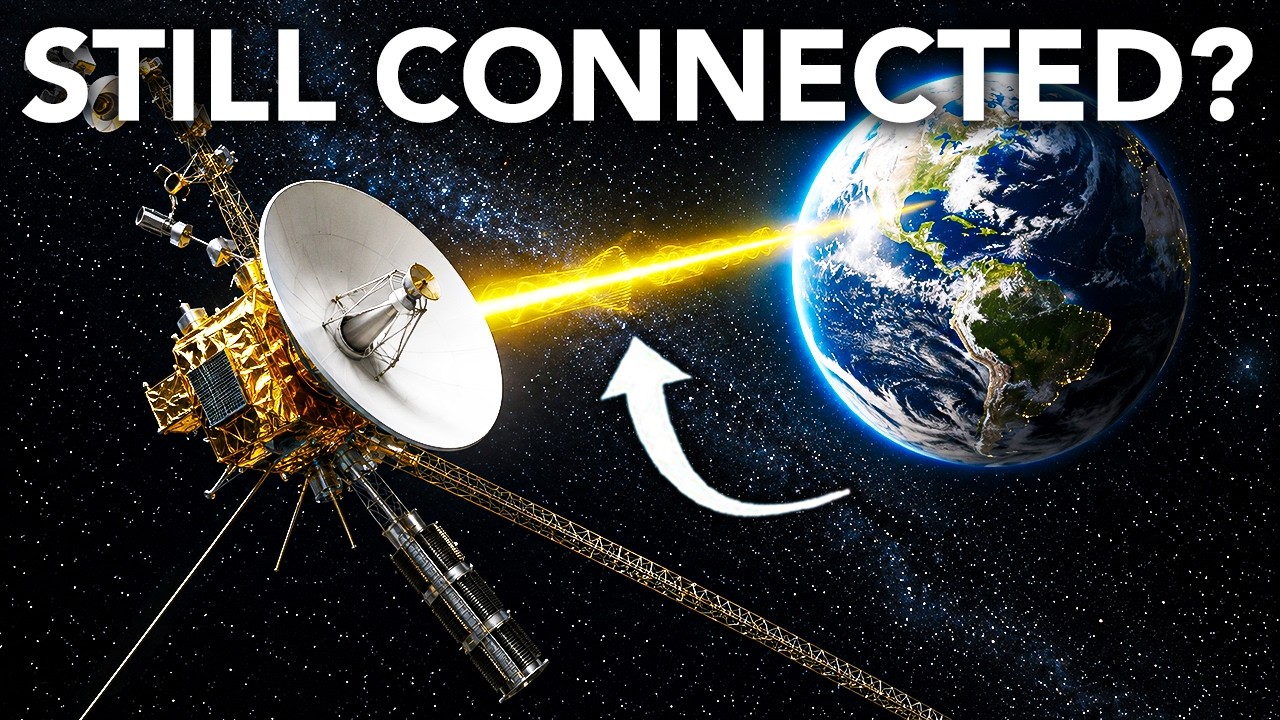
When translated into sound, those oscillations produced a clear, eerie tone.
What began as a one-time event soon proved to be something far more persistent.
In 2014, another wave triggered a second oscillation.
By 2017, researchers noticed the plasma wasn’t just ringing after major solar events.
It was humming continuously — a faint, steady tone present in the background almost all the time.
In 2021, the finding was formally published in Nature Astronomy.
Voyager 1 had detected what researchers called a “persistent narrowband emission” — essentially a continuous hum in the interstellar plasma itself.
By 2024, the tone was still there, eleven years after the first detection, recorded by a spacecraft older than most of the engineers now monitoring its data.
The implications are profound.
Interstellar space is not empty.
It contains roughly one particle per cubic centimeter — a near-vacuum by Earth standards, but still enough material to carry vibrations.
Those vibrations, when converted to audible frequencies, produce the hum Voyager 1 continues to record.
Don Gurnett, the University of Iowa physicist who designed the Plasma Wave Subsystem before Voyager even launched, described the discovery as opening an entirely new way to study the density and structure of the material between stars.
The instrument, built with 1970s technology, had become a working microphone in interstellar space.
The hum is not a signal in the sense of a message.
It carries no encoded information, no deliberate pattern.
It is the natural byproduct of thermal excitation in interstellar plasma — electrons vibrating at frequencies determined by the density of the medium around them.
Plasma physicists had predicted something like this mathematically decades earlier.
What makes the discovery remarkable is that an aging spacecraft, never designed for this purpose, was sensitive enough to actually detect it.
This raises a deeper, more unsettling question.
If a 50-year-old instrument could stumble upon something this fundamental simply by drifting far enough and listening long enough, what else might already be present in that same stream of data — waiting for the right instrument, or the right moment of attention, to notice it?
Voyager 1 continues its lonely journey, now more than 15 billion miles from Earth.
Its plutonium power source loses roughly four watts of output each year.
Engineers carefully manage which instruments remain active, prioritizing the most valuable science as the spacecraft’s energy slowly fades.
The Plasma Wave Subsystem is expected to keep functioning into the early 2030s, providing the longest continuous record of interstellar plasma ever collected by a single instrument.

The hum it records is not dramatic.
It is not a signal from an alien civilization.
It is simply the universe doing what the universe does when left to itself — vibrating quietly in the dark.
Yet hearing it at all feels like catching the galaxy in a private moment, singing to itself in frequencies no human ear was ever meant to perceive.
Voyager 1 was never built to last this long or travel this far.
It was designed for a five-year mission to Jupiter and Saturn.
That it continues to return new science nearly half a century later is a testament to human ingenuity and the surprising resilience of machines built in an earlier technological age.
As the spacecraft drifts ever farther into the interstellar void, its final transmissions will eventually fall silent.
When that day comes, humanity will lose its longest-running eyes and ears beyond the Sun’s protective bubble.
The data it has already returned — including this persistent cosmic hum — will fuel research for generations.
The universe, it turns out, is not as quiet as we once imagined.
Even in the near-emptiness between the stars, there is sound — faint, structured, and constant.
A tone that has likely existed for billions of years, utterly indifferent to whether anything was ever built that could translate its vibrations into something a human could recognize.
Voyager 1 didn’t go looking for this hum.
It found it by accident, sitting in the data for years before anyone noticed the pattern.
That raises an uncomfortable possibility.
How many other phenomena might already be present in the data streams from our farthest-flung machines — waiting for someone, or something, to finally notice them?
For now, the hum continues.
A 48-year-old spacecraft, built before the personal computer, is still listening to something no human has ever heard before.
And in the silence between the stars, the universe keeps singing its quiet, endless song.