In the search for life beyond Earth, astronomers have spent decades chasing a question that once belonged only to science fiction.
Could another world, orbiting a distant star, possess the ingredients necessary for life?
For years, every promising discovery seemed to end with the same conclusion: interesting, but inconclusive.
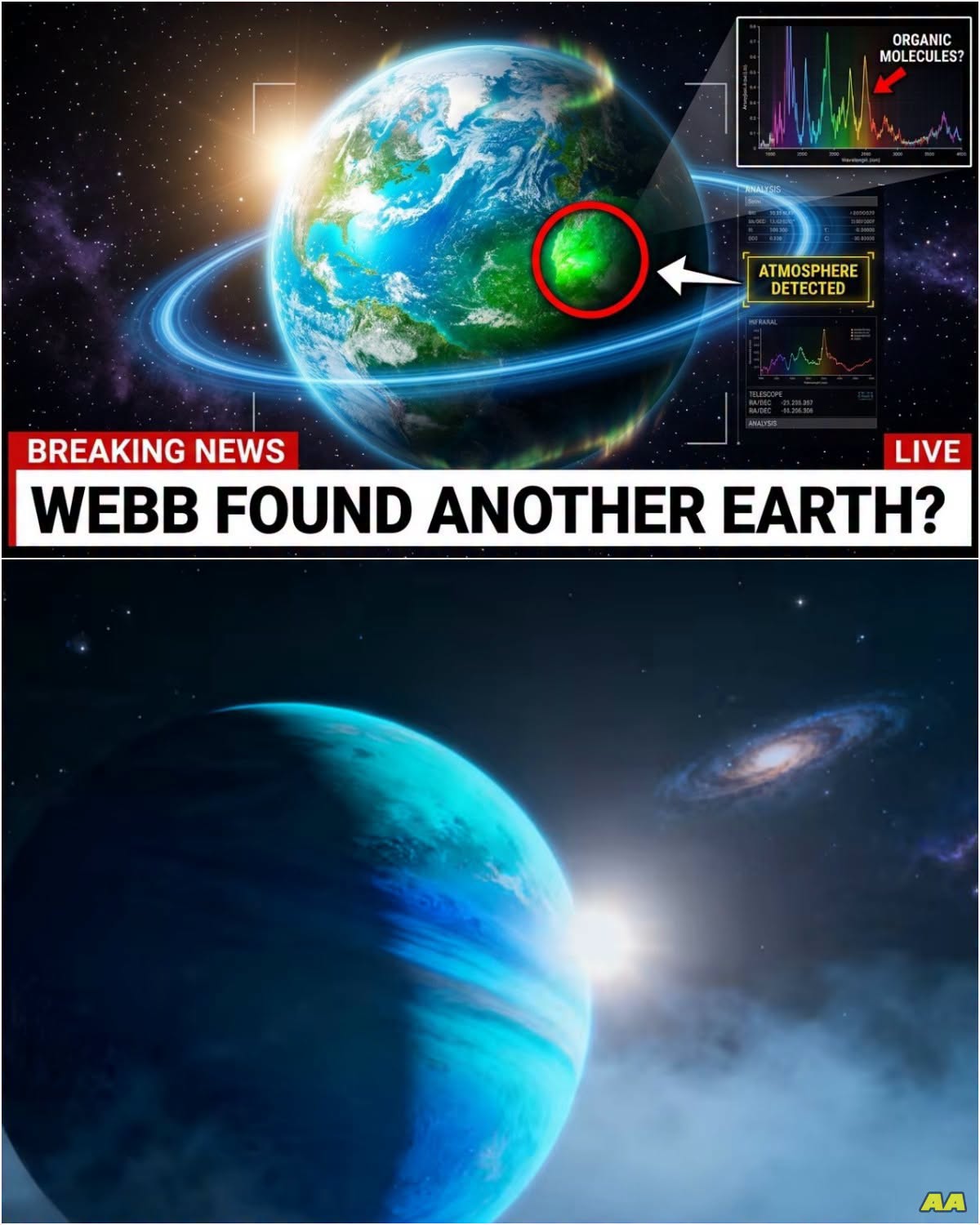
Then the James Webb Space Telescope turned its mirrors toward a planet known as K2-18b, located about 124 light-years away.

What it found sparked one of the most intense scientific debates of the decade.
Some researchers suggested Webb had detected the strongest evidence yet that an alien world might support life.
Others urged caution, arguing that the data could be explained without biology.

The result was not a confirmation of extraterrestrial life, but something almost as fascinating—a real-time demonstration of how science investigates extraordinary claims.
K2-18b was first identified in 2015 by NASA’s K2 mission, the successor to the Kepler Space Telescope.
At first, it attracted relatively little attention.
The planet measures roughly 2.6 times Earth’s diameter and about 8.6 times Earth’s mass, placing it in a category known as “sub-Neptunes.”
Unlike Earth, no planet of this type exists in our own Solar System, making it difficult for astronomers to predict exactly what such worlds might be like.
It orbits a cool red dwarf star in the constellation Leo, completing one orbit every 33 days while remaining inside what astronomers call the habitable zone—the region where temperatures could potentially allow liquid water under the right conditions.
Understanding the atmosphere of a planet more than a hundred light-years away may sound impossible, but astronomers have developed a remarkably elegant technique.
Whenever K2-18b passes directly in front of its star, a tiny portion of the starlight filters through the planet’s atmosphere before reaching the James Webb Space Telescope.
Different gases absorb different wavelengths of light, leaving behind distinctive patterns known as spectral fingerprints.
By studying these missing wavelengths, scientists can determine which gases are present without ever sending a spacecraft anywhere near the planet.
The measurements are extraordinarily delicate.
The atmospheric signal represents only a tiny fraction of an already faint dip in the star’s brightness, requiring Webb’s unmatched infrared sensitivity to separate meaningful information from background noise.
Years before Webb began collecting data, researchers proposed an intriguing possibility.
Perhaps planets like K2-18b were not miniature versions of Neptune at all.
Instead, they might be “Hycean” worlds—a term combining “hydrogen” and “ocean.”
According to this hypothesis, such planets could possess enormous global oceans hidden beneath hydrogen-rich atmospheres.
If correct, Hycean planets might dramatically expand the number of potentially habitable worlds in our galaxy.
Rather than searching only for Earth-like planets, astronomers would suddenly have an entirely new class of worlds capable of supporting life.
The James Webb Space Telescope delivered its first major observations of K2-18b in 2023.
Those observations immediately resolved an earlier disagreement dating back to measurements from the Hubble Space Telescope.
Where Hubble had detected an uncertain atmospheric feature, Webb’s sharper instruments identified methane with high confidence.
The telescope also detected carbon dioxide, marking the first confirmed observation of carbon-based molecules in the atmosphere of a planet located within its star’s habitable zone.
That achievement alone represented a major milestone for exoplanet science.
But hidden within the same dataset was a much weaker and far more controversial signal.
Researchers noticed a possible signature belonging to dimethyl sulfide, or DMS.
On Earth, this molecule is produced almost exclusively by microscopic marine organisms such as phytoplankton.
Because of that association, DMS has long been considered a potential biosignature—a gas that could indicate biological activity if detected in another world’s atmosphere.
The initial signal, however, was extremely weak.
It fell well below the statistical threshold required for a scientific discovery.
Instead of announcing alien life, the research team requested additional observing time with Webb to investigate further.
In April 2025, using Webb’s Mid-Infrared Instrument, the same researchers reported a stronger signal that appeared consistent with dimethyl sulfide or its closely related chemical cousin, dimethyl disulfide.
The result reached approximately three sigma confidence.
While statistically significant, it still fell short of the five sigma standard typically required before scientists consider a discovery confirmed.
Nevertheless, the announcement generated headlines around the world.
For many readers, it appeared that humanity might finally be on the verge of finding evidence for life beyond Earth.
The scientific community reacted differently.
Instead of celebrating, independent research teams immediately began examining the same data.
Multiple groups processed Webb’s observations using different computer models, statistical methods, and atmospheric assumptions.
Their goal was not to prove the original team wrong.
It was to determine whether the claimed biosignature remained visible regardless of how the data were analyzed.
That process lies at the heart of modern science.
Extraordinary claims must survive repeated attempts at verification before they become accepted knowledge.
Several unexpected problems soon emerged.
One analysis found that updated models produced a much hotter estimate for K2-18b’s atmosphere than earlier studies had suggested.
If the planet were significantly hotter, maintaining a stable liquid-water ocean—the key assumption behind the Hycean hypothesis—would become much more difficult.
Other researchers demonstrated that methane, already known to exist in the atmosphere, could generate spectral features resembling those attributed to dimethyl sulfide.
In other words, the supposed biosignature might simply be an artifact of overlapping chemical fingerprints rather than evidence of biology.
The debate intensified throughout 2025 and into 2026.
Additional analyses questioned whether the original detection depended too heavily on specific modeling assumptions.
Eventually, NASA organized a comprehensive independent reanalysis involving multiple research teams, new transit observations, and hundreds of atmospheric models.
Rather than relying on a single interpretation, researchers compared dozens of approaches to determine which conclusions remained consistent across every method.
The outcome was both reassuring and disappointing.
The study confirmed methane, carbon dioxide, and an atmosphere rich in water-related compounds.
However, it found no conclusive evidence supporting the presence of dimethyl sulfide or dimethyl disulfide.
The strongest claim that had generated worldwide excitement could not yet be confirmed.
That does not mean K2-18b ceased to be interesting.
Quite the opposite.
The planet remains one of the most unusual worlds ever studied.
Its atmosphere appears unlike anything found in our Solar System.