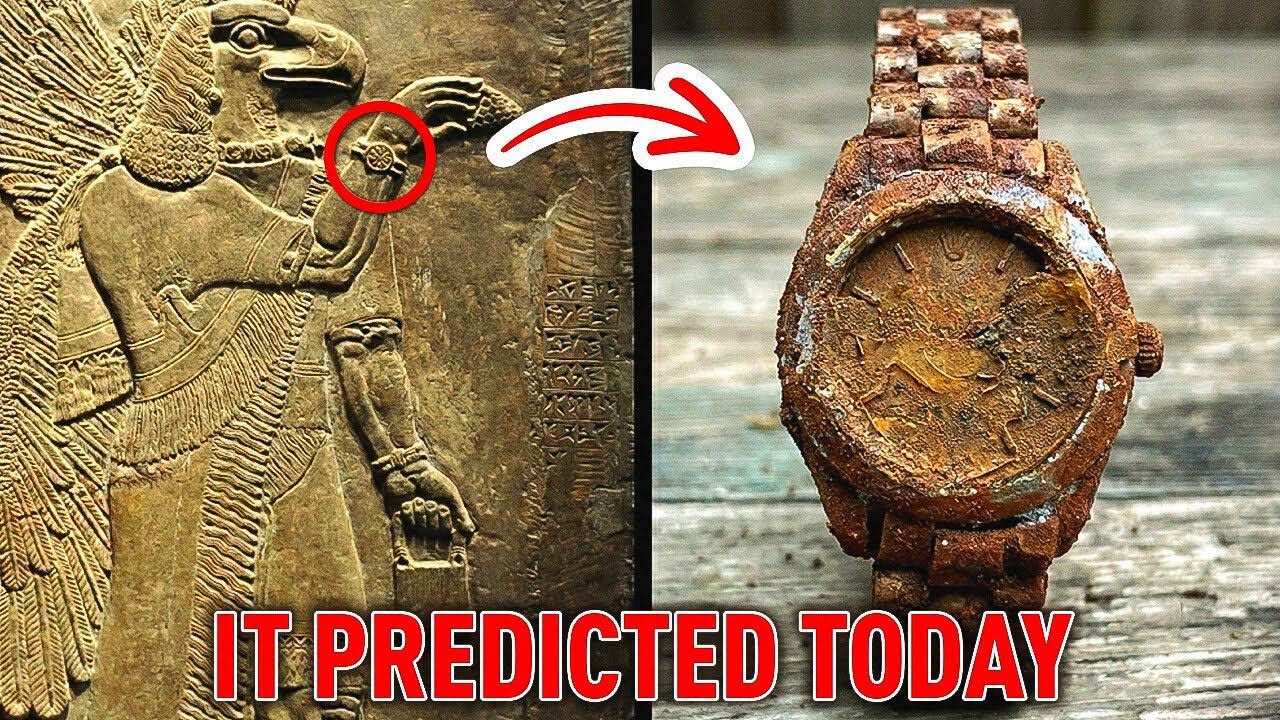


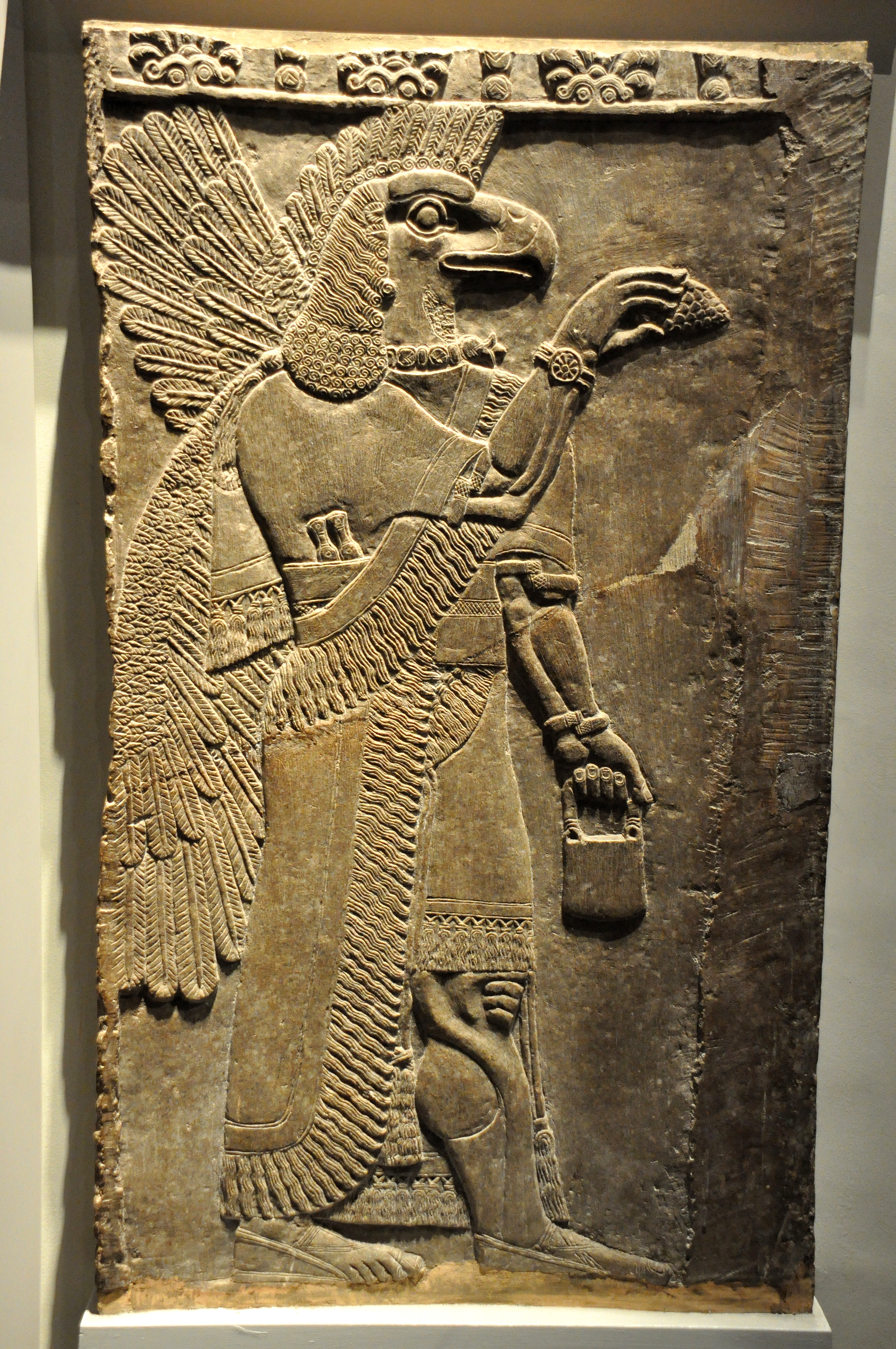
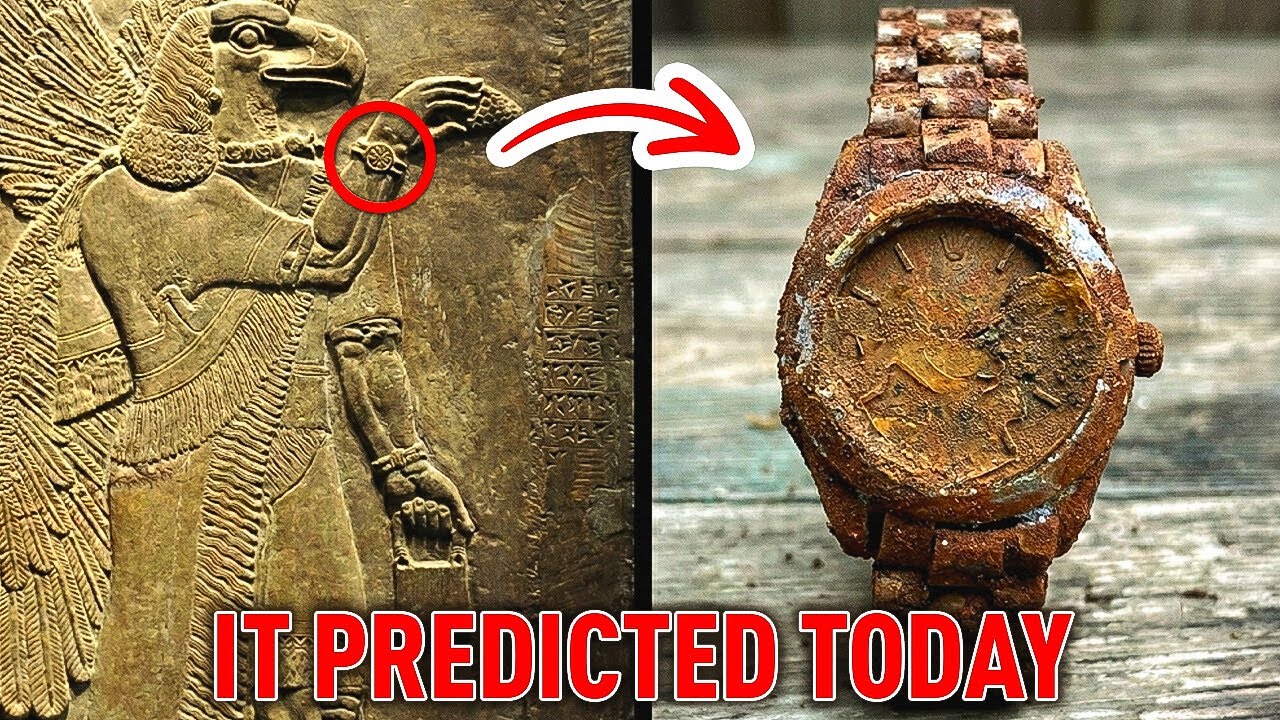
What if a mysterious object carved into ancient stone wasn’t just symbolic, but something we still don’t fully understand today? Across multiple ancient civilizations separated by thousands of kilome and thousands of years. Archaeologists keep finding the same strange object. It looks like a small bag with a handle. And the most surprising part is how consistent the design is no matter where it appears. The most well-known examples come from ancient Mesopotamia, especially from the Sumerian and later Assyrian civilizations dating back over 3,000 years. In detailed stone reliefs, human-like figures and winged beings are shown holding a small bucket-shaped object with a clearly defined handle. These figures are often identified as abcalu, mythological beings associated with wisdom and ritual practices. In many cases, they are shown next to sacred trees performing what appear to be ceremonial actions. The object itself is almost always depicted the same way.
It has a rigid structure, a flat base, and a curved handle that fits perfectly in one hand. This level of consistency is unusual for symbolic art where shapes often vary depending on the artist or time period. Here the proportions remain nearly identical across different carvings, suggesting that the object had a specific and recognizable form. In many scenes, the bag appears together with another object that looks like a pine cone. Researchers believe this combination may represent a ritual practice, possibly involving sprinkling water or oils. Based on ancient texts, the most widely accepted explanation is that these objects were ceremonial containers, sometimes described as ritual buckets used in purification ceremonies. But this explanation starts to break down when similar shapes appear outside Mesopotamia.
At Gobecletepe, one of the oldest known archaeological sites in the world, dating back over 11,000 years, carvings include symbols that closely resemble the same baglike form. This is thousands of years older than Sumerian civilization. Even more surprising, similar shapes have been identified in Mesoamerican cultures, including early carvings. These civilizations developed independently with no confirmed contact between them. Yet the object looks strikingly similar. That raises a difficult question. Why would completely separate cultures depict nearly identical objects? One explanation is symbolic convergence where different civilizations independently create similar symbols to represent the same idea. A container holding something important or sacred is a concept that could emerge in multiple places. But the precision of the design makes this harder to fully accept. The object does not just look symbolic. It looks functional. The handle is proportioned in a way that suggests it was meant to be carried.
The base appears stable as if it could be placed on a surface. The overall design resembles a real object more than an abstract symbol. This has led some researchers to question whether we are missing part of the picture. More speculative theories suggest the object could represent lost technology or tools that no longer exist. Others believe it may symbolize knowledge, power, or some kind of transfer between humans and the divine. However, there is no physical evidence to support these ideas. No actual object matching this exact design has ever been recovered. And that detail is important. If these were common tools, we would expect to find at least one surviving example. The fact that we only see them in carvings suggests they may have been ceremonial, rare, or even symbolic representations of something that was never meant to be preserved physically.
Another key detail is who is holding them. In almost every example, the object is carried by important or mythological figures, not ordinary people. This suggests it had a specific meaning or role, possibly tied to status, ritual authority, or religious practice. Today, the most accepted explanation remains that these were ritual objects used in ceremonies. But that does not fully explain their consistent design or their appearance across different cultures and time periods. The Sumerian bag remains one of those rare cases in archaeology where the object is clearly visible, widely documented, and still not fully understood. It is not hidden or obscure. It appears in some of the most studied sites in the world. And yet there is still no single explanation that accounts for all the evidence. Sometimes the mystery is not in what we cannot see but in what we see too often without fully understanding it.
Now have you ever seen cricut balls that are 3 billion years old? Clerks spheres were found in deposits of the mineral pyrilite in South Africa and rock the science world. They do look like tiny ancient cricket balls with seams like lines around the middle. Back in the 1980s, some folks claimed these spheres had been made by an advanced pre flood civilization we know nothing about. One museum curator shared stories about how they rotated on their own in a display case. There was also a TV show that invited a psychic who declared the spheres were pieces of an ancient spaceship. But according to geologists, these spheres are actually pretty common concretions or spherical objects formed by different minerals than the surrounding rock. The seam-like lines are just imprints from the host rock’s layers building up over time.
The clerk’s dwarfed spheres come in different shapes, from noticeably flattened spheres to distinct discs. As for that episode when one of these spheres spun on its own, the curator of the Clerk’s Dorp Museum cleared that up, too. He said that when he put one sphere on its glass shelf when a journalist came to visit, the sphere naturally rotated a bit because it’s round. The area where the museum is located often experiences earth tremors from gold mining activities nearby. The oldest known human-like footprints could be 6 million years old. They were found on the Greek island of Cree in 2002. If the number is correct, it would mean that early human ancestors may have migrated between Europe and Africa much earlier than we previously thought. This doesn’t mean Africa is not the cradle of humankind, though.
It could just prove that early human ancestors moved back and forth between continents. Some researchers believe the footprints were left by a bipedal creature, possibly related to an early human ancestor nicknamed El Griico. According to scientists who studied them, the footprints have a very human-like shape with five toes and a parallel big toe. Some scientists are skeptical about it and suggest the prints might be from a late European ape. The new study analyzed fossilized marine microorganisms found in the sedimentary rocks to determine the footprints age and prove it’s actually 6 million years. The next amazing find that keeps scientists entertained is the Dorchester plot. It’s a beautifully crafted metal vessel with some fancy geometric designs embossed in shiny silver. The pot was discovered in who could have thought Doorchester in 1852 under quite unusual circumstances. During a powerful blast, the pot broke into two pieces.
Scientists believe it was originally embedded within a rock or boulder known as hooding stone. The rock from which the Dorchester pot emerged is dated to be around 500 million years old. So it could mean the pot itself is also that old. The current and less exciting theory suggests that the Doorchester pot is a Victorian era candlestick holder. Such things were really trending back then. So it’s not a surprise to find such fancy household item from that time. The Doorchester pot falls into the category of uparts or out ofplace artifacts. Those are objects that seem too advanced for the time period they’re supposedly from. If we accept that the pot is 500 million years old, then whoever made it was way ahead of their times in terms of crafts and tech.
One extra mystery is that the pot has an engraving of a plant that most likely disappeared from Earth over 100,000 years ago. Sounds like good proof the pot is really extra old. Now, it looks like the oldest map in Europe is a stone from 4,000 years ago. This bronze age slab was found in France in the year 1900 at an ancient burial ground. The carvings on the slab show in three dimensions the river OD network with a fantastic accuracy of around 80% over an 18-mi stretch. There are other stonecarved maps around the world, but this one is unique because it shows a specific area to scale. Looks like the slab’s carvings don’t just map rivers and hills, but also settlements, barrow sites, and field systems. Archaeologists say the slab wasn’t used for navigation, but rather to symbolize power.
The detailed markings on the slab might have served to illustrate the domain of a local ruler, possibly a prince or king, to show their control over the territory. When the ruler lost power, the slab was likely repurposed as part of a burial vault. The unique artifact was stored in the cellar of a museum. For decades, no one even noticed until several scholars read older reports about the slab and decided to check it out. They conducted a detailed analysis using 3D techniques. Their research proved that the creators of the slab had not only etched lines into the rock, but also modified its surface to reflect the topography of the landscape with high accuracy. The Salsberg cube, also known as the Wolf’s Egg iron, was discovered in the late 19th century in Austria. Now, don’t let the name mislead you. It doesn’t look like a cube at all.
It’s more like a rounded object with two flat sides. Down the middle, there’s a groove and the surface is covered with pits and craters. This unique appearance is the reason why many people think it might be something out of this world. Workers accidentally found this artifact when they blew apart a piece of coal. The coal seam it came from is thought to be over 60 million years old. The Salsburg cube moved between museums, mysteriously vanished in the early 20th century, and then showed up again. A professor from Bond University suggested it might be from a meteor. But they found no evidence of elements that you’d normally see in meteorites, like cobalt or nickel. Then researchers thought it must be a human-made object, possibly a Victorian era candlestick holder. No one knows the true story of the cube or its current location. Yep, it disappeared again.
Have you heard about the Meister print? It’s a fossilized sandal print discovered in 1968 and it has sparked a lot of intrigue. There’s a trilobyte inside the print which supposedly went extinct around 500 million years before humans even existed. But many historians think this age is an exaggeration. When Meister found the fossil, it was authenticated. But the scientist who did it didn’t confirm it was a human sandal print. He only agreed there was a trilobyte there. When another scientist visited the site, he found a 6-in impression he believed was from a child’s moccasin. But the footwear seemed to be new. So, could it be evidence of time travel? proof that humans existed millions of years earlier than we thought or a sign that someone else visited early Earth or is it just a rock formation that looks like a sandal print?
We still don’t have the answers. Back in June 1936, a couple was walking along Red Creek in London, Texas. London, Texas. Yeah. When they stumbled upon something unusual. It was a piece of wood sticking out of what seemed to be an ancient rock formation. About 10 years later, their curious son decided to crack open the rock to see what was inside. And he saw a hammer, which looked surprisingly modern. Then one unique finds enthusiast decided that the rock encasing the hammer was from the Cretaceous period. This would mean that someone dropped a 19th century hammer while dinosaurs like Triceratops were still roaming the earth. So if this hammer was truly from the Cretaceous period, then the whole evolutionary theory would be wrong. And if the hammer was modern, it would mean the Cretaceous rock formation it came from was much younger than we thought.
But the real answer was much simpler. The hammer was indeed modern, and geological processes had encased it in rock. Minerals can harden around an object in a relatively short time. So, the hammer was probably dropped by a minor a century or so ago, and the rock formed around it afterwards. And no, it wasn’t a Victorian era candlestick holder either. Have you heard of Gobeclete? It’s an ancient site in Turkey that literally made historians rewrite history books. Over 11,000 years ago, a group of prehistoric humans crafted an enigmatic masterpiece that’s even older than Stonehenge. Before its discovery, archaeologists believed that people didn’t know about iron and weren’t good at making pottery. They were sure that settled life only emerged with the need for agriculture. But Gobecletepe changed this belief.
The place has revealed that it was the temple that paved the way for a settled life, not agriculture. Until this discovery, researchers believed that farming was the catalyst for sedentary living. Meet Professor Schmidt, the guy whose findings changed this theory. He managed to prove that huntergatherer communities laid the very foundations of this way of life. Back in the 1960s, other archaeologists visited the area, but they totally missed the mark. While surveying the region, they stumbled upon a hill with scattered limestone slabs and concluded it was just an old burial ground from medieval times. Little did they know that there was so much more to uncover. In 1994, Schmidt embarked on his own survey of prehistoric sites in the area. Surprise! He instantly realized he had discovered something truly extraordinary.
Unlike the nearby flat and barren plateaus, Gobecée had a gently rounded top rising 50 ft above the surrounding landscape. Funny enough, the translation of this place’s name is Potbelly Hill. Schmidt was sure only humans could have made something like this. Those broken limestone pieces that were mistaken for gravestones turned out to be way more exciting. It was like stumbling upon a hidden treasure. The pieces took on a whole new meaning, and Schmidt with his team was about to dive into the secrets waiting beneath the surface. To their surprise, they found no traces of a settlement, no hearths for cooking, no houses, and none of those adorable clay figurines commonly found in nearby sites of similar age. However, they uncovered that those ancient people used tools like stone hammers.
So, Schmidt and his team put their heads together and took a wild guess at the age of Gobecée’s stone structures. Their estimation got backed up by some limited carbon dating done right at the site. The ancient vibes of this place were finally starting to make sense. It was like a puzzle slowly coming together. You may think that back then people didn’t have special tools to create something as cool as Gobec Leepe. Not true. Turns out these prehistoric folks used flint tools instead of fancy metal chisels. They were also skilled at chipping away softer limestone and crafting pillars right on the spot. Afterward, they carried the pillars a short distance to the summit and placed them upright. Once the stone rings were complete, they covered them with layers of dirt.
Over time, they added new rings and voila, you’ve got a cool hill to impress people in the future. During their first year of excavation, the team went through 15,000 pieces of animal bones from wild creatures. These people didn’t have pet animals or grow their own food. They hunted wild animals for their meals. But things were about to change because the place had everything they needed to start farming. Scientists say they had wild sheep and wild grains that could be domesticated. And guess what? Just 20 m away, geneticists found evidence of the world’s oldest domesticated strains of wheat at a prehistoric village. These amazing findings have completely changed how we view civilization. In the past, experts believe that people needed to learn how to farm and settle in one place before they could build temples and develop complex societies. But guess what?
Schmidt’s research flips that idea on its head. He claims that the incredible effort put into constructing these astonishing structures actually set the stage for the development of advanced societies. It means that societal and cultural changes happened before agriculture. Schmidt has this fascinating hypothesis about Gobeclete. He thinks it could have been a special burial site where people left their loved ones. And here’s the twist. The burial site was adorned with fancy statues and symbols representing deities from the spiritual realm. The idea that Gobecletepe could have served as a sacred place adds another layer of complexity to the whole story. While the site’s true purpose may remain elusive, Schmidt’s insights invite us to consider the profound interplay between life in the afterlife and the deep reverence ancient huntergatherer societies may have had for their departed ancestors. Now, let’s talk about the stars of the show.
The mesmerizing T-shaped columns that dominate Gobeclete. These mysterious structures range from 10 to 20 ft tall and most likely represent stylized human figures. But one figure stands out from the rest, the three-dimensional lion relief. This depiction really fires up our imagination. Why? Because it hints at the possibility that lions roamed Anatolia during the Neolithic period. These standing stones are arranged in circles and placed in rectangular pits. Each circle has a similar setup. Two big T-shaped pillars in the center surrounded by slightly smaller ones facing inward. Talk about a stylish arrangement. These towering pillars reach a whopping 16 ft and weigh between 7 and 10 tons. Some pillars are plain and simple, while others are like works of art with intricate carvings. Foxes, scorpions, and vultures come to life, crawling and twisting on the pillars sides. But it’s not just animals depicted on these stones.
Some pillars have abstract shapes representing humans and even small carvings of clothing items. Some of them even have belts. Now, there’s one pillar that stands out from the rest like a rock star. This super old stone pillar suggests that a comet crashed into Earth. It happened during a Chile period that lasted about a thousand years. Previous studies examining Greenland ice cores hinted at this comet theory. But now the carvings at Gobeclete prove it right. The carvings on the pillars are like a historical comic strip. They even show a headless human figure. Researchers fed the images into a computer and discovered their connections to constellations, indicating that this temple might have been an ancient observatory. It’s like our ancestors were trying to document this cataclysmic event in their own unique way.
Archaeologists have been excavating and researching Gobeclete since the mid1 1990s, peeling back layers of history and providing us with a deeper understanding of the intricate relationship between various elements. They have no plans to stop the whole process for another 150 years. Who knows what else they’ll find. You see, Gobecletepe has been labeled purely as a ritual site with no signs of domestic activities. We were led to believe that the absence of water meant it couldn’t support semi-edentary communities. But scientists believe it’s time to shake things up and approach Gobeclete with fresh eyes. It’s time to question what we believe before and use new evidence and different ways of thinking. Like, there might have been a group of people living in the area who didn’t stay in one place all the time.
They moved around a bit but still had their own civilization living in the area semi-edentarily. Gobecletepe is not just home to a single temple but an astounding collection of over 20 ancient structures. As archaeologists delve into the depths of this wonder. They are unraveling its unique layout featuring two prominent focal points at the heart of each establishment complemented by smaller structures and dividing walls. What’s even crazier is that in this area there are over 200 obelisks which are narrow tapering monuments. Divers have found something incredible in a Florida sinkhole. And it was Stop. We need to leave a warning here. You’re about to hear some pretty unusual scientific information. This knowledge will make you the smarty pants in your friend group. But there’s also a risk that they’ll look at you as a nerd.
So perhaps it would be better for you to keep this knowledge a secret. In any case, it won’t be superfluous. So you know that scientists divide the history of our planet not only by time periods but also by which animals lived at a certain time. For example, 2,000 years ago, Earth was inhabited by the blobfish. And scientists call this time the blobfish period. It’s a joke. There’s never been such a period, but you get the gist. The period between about 419. 2 million and 358. 9 million years ago is called the Deonian period or the age of fish. Do you know why? Because the first fish began to appear on the planet. The Paleo gene is the period of large mammals. The famous Jurassic period marks the appearance of giant dinosaurs which we often see in the movies.
Even now we live in a certain period called the quadinary period. It began about 2. 6 million years ago and continues to this day. This is the time of humans and modern animals. So the next time somebody asks you what time it is, you can just answer it’s the quadinary period. In short, the names of these periods depend more on what creatures inhabit the planet. The longest period is the pre-cambrian period or age of early life, the time when life on the planet started to form. Softbodied worms and jellyfish swam in the ocean while microorganisms lived on land. This period occupies almost 90% of the Earth’s total geological time. It started about 4. 5 billion years ago and ended 540 million years ago. Oh, it’s still a video about divers. Don’t forget, we’ll get back to them soon.
Considering all these periods, do you know which one is of the most poorly studied? A period about which scientists know almost nothing, especially about the animals that lived at that time. This is the Irvtonian North American land mammal age. It lasted from about 1. 6 million to 250,000 years ago. Scientists have very few fossils that belong to this time. But recently, everything has changed. In the USA, there’s the Stein Hatche River, which stretches for several tens of miles in the area of Big Bend, Florida. And just 500,000 years ago, there was a sinkhole instead of the river. This is a hole in the ground that forms when water dissolves the upper rock. This rock is often limestone. Sink holes appear in places with a lot of precipitation. Sometimes these pits can be invisible.
They look like ordinary ground, but the soil in them is loose and can easily collapse. If you accidentally get into a sinkhole, people will hear your screams and help you. But in the distant past, about half a million years ago, when animals got there, they couldn’t get out of the pit. So, it became their grave. After many, many years, a river appeared here. And then, several fossil collectors decided to check out this place and discovered a real paleontological treasure in it. They plunged into the river and reached the bottom. There in the murky water, they saw horse teeth sticking out of the sediment. It’d be pretty scary to find for many of us, but for these guys, it was the jackpot. After the teeth, they found a hoof shaft and the skull of an unusual animal.
At that moment, the collectors realized they had made a major discovery. Over the years, the sinkhole at this place had been filled with sedimentary rocks. Then the river compacted all this mass which made it possible to keep everything inside the sinkhole in good condition. Many animals got trapped in this pit half a million years ago. And only now have people managed to get them out. More precisely, what’s left of them? Divers have found more than 500 fossils belonging to ancient animals, including unknown species. They got wellpreserved bones of ancient horses, giant armadillos, sloths, and a new species of tapir. The Florida Museum examined the remains and determined that they belonged to the poorly studied Irvonian North American land mammal age. Most of all, scientists were struck by two finds in this collection. The first was the remains of a giant armadillo-like creature.
And the second was the skull of an ancient tapier. In case you didn’t know, this is a very cute pig-like mammal that has a short trunk like an elephant. Divers in Florida found the remains of a distant ancestor of this animal, which may be a new unknown species. Most of the fossils in the sinkhole belong to early Cavalina horses, a subgroup that includes modern domestic horses. The remains of horses are so well preserved that scientists have seen signs of wear on their teeth. This will allow experts to understand the diet of these ancient creatures. We often hear news about people finding the remains of ancient animals or dinosaurs in caves, ravines, or at the bottom of lakes. But imagine if they found such remains in a museum. It all started in the early 2000s north of the Florida border in southwest Georgia.
There was a mine where workers mined clay. One day they found the remains of some ancient animals and gave them to the Florida Museum of Natural History. There these remains lay in storage waiting in the wings. And then one day, some guy started sorting them out and noticed a mysterious vertebrae of an unknown animal. This little grab caught the guy’s attention. So, he returned to it over and over again. He studied it, trying to figure out what species the bone belonged to. One day, he realized the bone belonged to an unknown extinct lizard species that looked like a teu. You’ve probably seen these predatory creatures that looked like monitor lizards. So, the age of the bone was about 15 to 17 million years old. Let’s wrap up our video with something weird. You see this piece of amber colored stone with stripes?

Or is it not the stone? It looks like an ancient sea shell. So, right now you’re looking at the oldest fossil in history. It’s a strummatalyte and its age is you won’t believe it. Make a guess. 100 million years. 500 million years. 1 billion. No. This fossil is about 3. 4 billion years old. It represents one of the earliest forms of life on Earth. No, not the stone itself. Strumatalyte is just a playground. The early form of life here is these thin strips. They’re called cyanobacteria. Tiny single-sellled creatures. Okay. What about the remains of something bigger? Some ancient animals, for example. Meet the trilabites. They lived here during the Cambrian period, which began about 500 million years ago. This is the time when many invertebrates and fish began to appear. Their exoskeletons helped the trilobytes stay remarkably well preserved.
Considering their age, they were arthropods that looked like something between a spider, a scorpion, and a mutant from another galaxy. These animals lived for a very long time, and people find their remains almost all over the world. They appeared at the very beginning of the Cambrian period, survived it, and became extinct at the end of the Perian period. During the Peran mass extinction, when about 90% of all living beings were wiped off the face of the earth, these creatures swam in open water, burrowed into the seafloor, or crawled along it. They lived like predators and scavengers. The front of the animal was protected by a strong head shield. It had crescent-shaped eyes and a calcified plate on its lower body. This plate covered its esophagus and mouth. It had several pairs of legs growing from its body.
The trilabitete could also curl up into a ball like a woodlouse. 40,000 years ago, someone scratched a few tiny lines and dots onto a piece of bone. And that little mark might be the oldest hard drive humanity ever created. Scientists now believe those Ice Age people weren’t just doodling, but recording real information, structured, organized, repeatable data. And this discovery completely shifts the timeline of human intelligence. For decades, archaeologists kept finding strange symbols carved into stone age tools and sculptures. Those were simple shapes like crosses, dots, short lines, and tiny notches cut into bone or ivory. Explorers kept finding them in caves across Europe, including Germany, France, and Spain. They showed up on carved animal figurines, tools, and ornaments. Archaeologists dated them to be about 34,000 to 45,000 years old.
That means people created these symbols during the ice age when glaciers covered huge chunks of the planet and mammoths still wandered the plains. For a long time, researchers believed these signs meant nothing in particular. Maybe decorations, maybe tribal art. But a new computational study led by a linguist and an archaeologist showed it was more about data than decoration. The team analyzed more than 3,000 individual symbols carved into around 260 artifacts. They studied every mark and fed them into statistical models, the same type of mathematics researchers used to study language patterns or train artificial intelligence. The goal wasn’t to translate the signs yet. Nobody knows exactly what they mean. Instead, the scientists looked at something called information density, which means how much meaningful data you can store in a sequence of symbols.
When the researchers ran the numbers, they saw that the symbol sequences had almost the same information density as protouniform. That’s the earliest writing system known from ancient Mesopotamia around 3000 B. CE. It was roughly 40,000 years later. So, some signs in these ice age carvings repeat again and again in predictable ways. Cross, cross, cross, line, line, dot. That repetition resembles early data in coding where patterns repeat because they store structured information. The researchers also analyzed the entropy of the coded messages. Entropy measures how unpredictable a sequence is. High entropy means lots of possible combinations like a complex password. Low entropy means predictable repetition. And it looks like the ice age symbol systems have entropy levels very close to early protoform tablets. That means the amount of information those carvings could store roughly matches the earliest writing records from the first cities.
It proves that humans didn’t just suddenly invent writing out of nowhere 5,000 years ago. Instead, humans spent tens of thousands of years experimenting with symbolic encoding systems and gradually increased their complexity until true writing was finally invented. One of the most interesting examples of such a coded message comes from a cave in southwestern Germany. Archaeologists discovered a tiny mammoth figurine carved from mammoth tusk ivory, small enough to fit in your palm. There’s a neat row of engraved crosses and dots running along its surface. Another object called the Adorant is a thin ivory plate found in a different German cave has a strange mythical creature that looks part human, part lion on it. The figure stretches upward like it’s worshiping something. And across its body, someone carved rows of tiny dots and notches with careful spacing. Then there’s the famous lion human sculpture.
If you look at the arm closely, you can see evenly spaced cuts along the limb. These marks seem intentional, deliberate, almost rhythmic. They look less like decoration and more like entries in a ledger. It makes those artifacts something like USB drives made of ivory. And because these ancient USB drives appear in different regions of Germany and in other parts of Europe, it could mean that Ice Age humans may have shared such symbolic messages across huge distances. Those hunter gatherers living thousands of miles apart probably recognize the same patterns scratched into bone tools. Of course, scientists still don’t know the exact meaning of these symbols. They could represent seasonal calendars, migration cycles, clan markers, or some concepts tied to rituals. So, the most important discovery for now isn’t the translation, but the structure of the signs that behave like a system.
This coding system isn’t the only proof that ancient minds invented complex systems long before modern technology arrived. There’s a thick oval slab of limestone in a museum in the Netherlands. Archaeologists dug it up in the late 1800s and assumed it was some kind of Roman game board. The problem was that nobody could figure out the rules. The carved lines didn’t match any known ancient game. Only in 2026, researchers finally solve the mystery with help from artificial intelligence. If you look at the stone closely, you can see that certain grooves on it are slightly deeper than others. It means that people slid pieces across those lines repeatedly and the stone wore down over time. Conservation experts created extremely detailed 3D scans of the limestone surface to analyze those wear patterns. Those scans showed differences in depth smaller than a human hair.
Every tiny groove became a clue about how players once moved their pieces. Then the team brought in a special AI game simulation system designed to understand board games. They fed the system rules from about 100 historical games and asked it to test possibilities onto a digital copy of the Roman board. The AI played thousands of simulated matches against itself and tried different rule combinations each time. For every rule set, it tracked where the pieces moved and compared those paths to the wear patterns on the real stone. It repeated this process around 1,000 times per rule set until finally certain patterns started lining up perfectly. The system narrowed all the possibilities to a small group of related blocking games. In this type of strategy game, two players move pieces along fixed paths trying to trap the opponent’s pieces in corners or dead ends.
If you’ve ever played tic-tac-toe or checkers, you already understand the basic idea. To control space, predict the opponent’s next move and close the trap. The simulations showed that the Romans most likely played this game with small tokens made of glass, bone, or pottery sliding along those carved grooves. And that discovery matters more than you might think. Historians used to believe blocking games appeared in early medieval Europe, centuries after the Roman Empire collapsed. But this limestone board showed them that such games existed nearly a thousand years earlier. So Roman players had strategy games that help them develop forward planning, recognizing patterns and thinking of different combinations and possibilities. Now let’s travel even further back in time, long before Roman cities and writing of any kind. Our destination, Ulivide Gorge in northern Tanzania, one of the oldest important archaeological sites on Earth.
In 2025, researchers studying the area found something unexpected in ancient sediments. It was a set of tools made from the limb bones of elephants and hippos. And these tools date back about 1. 5 million years. Scientists found 27 bone tools, some nearly 15 in long, shaped into sharp blades. Early humans most likely use them on animal carcasses or to process tough materials. At first glance, they seem simple, but it actually looks like the toolmakers shaped these bones using napping. The same process used to chip stone tools. Napping means striking a material carefully so that small flakes break away, gradually forming a sharp edge. Bone behaves very differently from stone. It contains collagen, which makes it slightly flexible and elastic. Hit the bone too hard and it shatters unpredictably. hit it too softly and nothing happens. That means whoever made these tools understood how the material worked.
They adapted their technique to shape bone without destroying it. Archaeologists believe Homo erectus, an early human species with body proportions similar to ours, created these implements. It also looks like the toolmakers preferred thick limb bones, which are the strongest parts of animal skeleton. To make that choice, you need to understand anatomy and material strength. Engineers today still use that same logic when choosing materials for machines. When we put all these discoveries together, we see that our ancestors designed systems, invented technologies, stored information, and played complex games long before modern civilization appeared. So, we didn’t just suddenly become intelligent. We’ve been building knowledge for tens of thousands of years. All the way back in 1972, a super secret satellite was zipping around the globe. It was taking high altitude photos of the flat grasslands in Kazakhstan. They were probably looking for military secrets.
Instead, they caught a couple of frames of massive geometric shapes stamped into the dirt. They had accidentally photographed a 36 century old ghost town. Because those photos were secret, it took decades for researchers to finally access the coordinates and send modern drones to map the area. That’s how they uncovered a 346 acre ancient settlement. But what raised eyebrows isn’t how big it was. The cool part is the high-tech prehistoric factory run by nomads. The site is called Semiaraa, which means the city of seven ravines. Scientists named it like that because it’s located on a cliff overlooking a wide river valley. It dates back to roughly 1,600 B. CE. At that time, the Eurasian step was basically a 5,000mi flat belt of grass. The people living there were the ultimate minimalist campers. In this part of the world, large-scale farming is hard. Not impossible, just incredibly hard.
It’s much easier to befriend cattle and move when they’re running out of food. Basically, nomads relied completely on herds of sheep and horses to survive. But if you keep a massive herd in one spot, they will chew the grass down to the dirt eventually. That gave humans a simple choice. Strap everything you own on an animal and follow fresh grass. Their food came straight from the animals as well. They lived on meat and fermented Mar’s milk, a sour, slightly alcoholic drink created by allowing horse milk to ferment in leather bags. But for some reason, builders in Semiarka decided to stay. They settled on that cliff to build a heavy manufacturing plant right in the middle of the Bronze Age. It’s when humans finally stopped hitting things with rocks and started melting metal. Bronze is not a single metal. It’s a mix.
The most useful kind was often copper mixed with tin because that mix makes tools harder and helps them keep an edge. The timeline of technological progress around the world is almost random. While the residents of Semiaraa were firing up their metal ovens, the Egyptian pyramids had already been standing for a thousand years. So what did the Semiaraa factory actually look like? We are way too early in the timeline for conveyor belts and brick chimneys. A Bronze Age metal shop was basically an outdoor dirt lot. It was noisy and covered in soot. It’s fair to assume it smelled terrible. Charcoal smoke, burnt wood, melted metal. Probably not that different from a modern factory without AC. If we could take a walking tour, we would see scorched ground and broken clay everywhere. Workers kept all that loud work confined to the southeastern edge of town.
They were highly organized. Archaeologists are certain this was a dedicated factory because they found two very specific things, crucibles and slag. A crucible is a heavyduty clay cup specifically designed to survive sitting inside a 2,000° fire. Slag is the ugly glassy garbage left behind after you pull the useful metal out of a rock. You cannot make slag by accident. It only forms when you intentionally melt metals. But what were they making here? Creating bronze was the ultimate survival upgrade for that time period. If you try to chop down a tree with a pure copper axe, the blade will bend like a cheap spoon. You’ll have to stop, put the axe on a rock, and hammer it flat again. By adding a little bit of tin causes a chemical reaction that locks the metal atoms in place. The final product is incredibly hard.

Many of the passing nomads drove massive wooden wagons roughly the size of a modern mobile home. They had solid wood wheels and required teams of oxen to pull them. Maintaining those giant wagons required sturdy tools, making semiarchca the ultimate highway pit stop. They were mixing around 12% tin into their copper. Tin is a soft silvery metal that melts at surprisingly low temperatures and acts as a heavyduty chemical hardener when stirred into a vat of boiling copper. In the ancient world, tin was incredibly hard to find. Copper is fairly common, but entire empires would panic if their tin supply chain broke down because you cannot make bronze without it. Seorca was sitting on a local gold mine. They had access to tin in the nearby mountains, which could mean they controlled the exact ingredient everyone on a 5,000mi step desperately needed. But what happened?
And how did it end up a ghost town? We know for a fact they were not defeated by some other nomadic tribe or an army. Something like that would leave a various obvious dirt crime scene from skeletons to a massive layer of black ash where stuff was burned down. There would be dropped weapons, those made on site. Semiaraa has none of that. Instead, archaeologists found a clean exit. The locals packed up their valuable tools, gathered their herds, and did what nomad tribes do. They moved on. At least, we assume so for now. It’s possible that they accidentally destroy their own neighborhood. To keep an oven hot enough so it can melt metal, you need a lot of wood, which means they probably chop down every single tree for miles. Without tree roots to hold the dirt together, the soil turns to dust. The grazing grass disappears.
When it happens, traveling customers stop showing up. The town essentially turned its own front yard into a barren wasteland just to keep the factory fires burning. This whole domino reaction would leave clues, but the news is pretty fresh, so we might learn more soon. Semiaraa probably simply faded away. It’s certainly not the only advanced settlement that ended up lost in time. On the vast empty step of the Eural, there’s a city planned like a fortress from day one. That’s Archime. It was another unexpectedly advanced place for this time. From above, the enclosing wall forms an almost perfect circle about 520 ft across. Concentric walls ring the site with a defensive ditch outside. Inside, roughly 60 houses curve along the walls like puzzle pieces. The layout shows careful planning and a wellorganized community. Then there is Acroi.
This bronze age town on the island of Santorini was buried by a massive volcanic eruption. The falling ash acted like concrete and actually locked the entire city in a perfectly preserved time capsule. Excavators found multi-story houses stacked on top of each other. You can still see vibrant paintings of ships and dolphins glowing on the walls. Inside the homes, water once ran through indoor terracotta pipes long before a modern plumbing existed. There is also Darren Cuyu in central Turkey. We only know it existed because of a home renovation gone wrong. Back in 1963, a local man took a sledgehammer to a wall in his basement. The wall crumbled and revealed a dark tunnel. He walked inside and accidentally discovered an 18story underground doomsday bunker. It was a massive labyrinth carved out of soft rock designed to hide 20,000 people.
They even carved 1,000lb solid stone wheels that they could roll across the hallways to seal the doors and block invaders. If you like Lord of the Rings, this has to remind you of dwarves and how they lived. One of the coolest things about modern tech is that it lets us map ancient places almost perfectly. Satellites and remote sensing tools can scan the surface of Earth and trace walls, streets, and workshops that have been buried for thousands of years. Once we have that map, we can rebuild the site digitally and even walk through it in a virtual model. It’s not the same as standing on the step and melting bronze in open air, but it’s the closest we get to stepping back in time. There are still countless vanished hubs waiting to show up on the next scan.
Who knows what your neighborhood will look like in 3,600 years? Warning. If you’re a devoted fan of ETS and accept every story about contact with them as fact, you might want to skip this video. What you’re about to hear is the hard truth. And yes, it may be disappointing. On the other hand, if the idea of them makes you uneasy, this video might actually put you at ease. And if you don’t believe in those little green cuties, but constantly find yourself debating people who do, just show them this. First, you need to know that there’s no solid evidence that intelligent extraterrestrial life exists. What does exist is strong evidence that all the so-called ET incidents you’ve heard about during your whole life actually have very reasonable explanations. One of the most famous examples is the Roswell incident.
On July 8th, 1947, a strange object crashed on a ranch in the state of New Mexico. It was described as a flying disc. First, a local newspaper reported the story. Then, the incident spread across the entire country. People claimed it was the crash of an ET spacecraft. Authorities said the object was a meteorological balloon. People didn’t believe them. Rumors exploded. Many theories spread everywhere. Years later, after all the hype slowed down, the truth finally came out. The flying disc was part of a top secret government project, a high alitude balloon designed to detect signs of nuclear testing. But even after the truth was revealed, many people refused to accept it. The Roswell incident became a full-blown cultural phenomenon, especially among UFO enthusiasts.
Yet among the thousands of books, articles, and documentaries about Roswell, you won’t find a single verified fact proving an ET spacecraft was ever involved there. That same year, another mysterious object was discovered and also caught public attention. No one knows exactly where it landed, but many people connected to the Roswell incident. At first glance, this metallic fragment seemed extraordinary. Its internal structure looked unlike anything known at the time, which led some to believe it was part of an alien craft. Further analysis showed the object was made from an alloy of magnesium and zinc with traces of bismouth, lead, and other elements. Of course, the presence of these elements alone doesn’t prove the object was made on Earth since these substances exist throughout the universe.
Then scientists examined the isotopic composition of magnesium and the rest of the materials and they determined that the alloy was manufactured on Earth. Still one thing about the sample raised eyebrows. Bismouth. Some people speculated that aliens might use bismouth in some kind of propulsion or flight system. However, these ideas were purely speculative. The bismouth found in the samples contained impurities which clearly showed it was produced using ordinary earth-based manufacturing methods, not any unknown technology. But that technology would require a pure bismouth alloy. Unfortunately for UFO fans, the analysis showed that the bismouth in the sample contained lead impurities, which is clear evidence that no alien technology was involved. It was created on Earth by people. However, its manufacturing process was unusual because of the specific mix of elements. The object also had damage caused by impact and heat exposure.
Most likely, it was a component of another top secret surveillance balloon. Okay, how about another alien-like incident? This is the famous but though less well-known WOW signal. In 1977, a radio telescope in Ohio detected a strange signal from deep space. It lasted 72 seconds and stood out dramatically from the background cosmic noise. Astronomer Jerry Aean, who discovered it, was so shocked that he wrote, “Wow! ” on the printout. The scientific community briefly suspected that this radio signal might be a message from alien technology, but it was never detected again. Later explanations suggested it may have been radio emissions from a neutron star amplified by a cold hydrogen cloud. You can also find realistic explanations for other similar cases on the internet. However, Roswell and similar cases happened decades ago. But what about modern stories?
You’ve probably seen videos recorded by pilots showing fastmoving elusive objects in the sky. Scientists carefully analyzed these videos and found something interesting. The observed behavior contradicted the laws of physics. If an object moved that fast through air or water, friction should produce a visible heat trail or plasma glow. But nothing like that appears in the footage. Does that mean it’s alien technology? Probably not. A much simpler explanation is that the cameras used weren’t advanced enough to capture what was actually happening. We don’t know the distance between the object and the camera. We don’t know its real speed. It could be a visual artifact, a sensor glitch, or a lens distortion. If you still believe these recordings show real UFOs, ask yourself this. Why, after all these years, do we still have no highquality footage? Why is it always low resolution, blurry, and often black and white?
Millions of unclear images mean nothing compared to a single clear highresolution video and we don’t have one. The probability that UFO sightings are optical illusions or sensor errors is far higher than the probability that they represent alien spacecraft. Many people simply want to believe in ETSs, so they amplify hype about any news hinting at extraterrestrial technology. A perfect example is a MUA MUA, the first known object to enter our solar system from interstellar space. Some people panicked, claiming it was an alien probe. In reality, it was almost certainly an interstellar asteroid like object. Remember the more recent panic surrounding ThreeI Atlas? Online rumors claimed it was an artificial object that would approach Earth in November 2025 and change our lives forever. November has passed. The object is now moving farther away. No alien invasion happened.
So, does that mean the only way to find extraterrestrial life is to wait for random space rocks to pass by or hope someone records a UFO in 4K or 1080 at least? Can we actually do something ourselves? Yes, we can search for techno signatures. Technos signatures are signs of technological activity that intelligent life could do. These are bio signatures like microbes or molecules that suggest simple life. But searching for bio signatures across space is incredibly difficult. Technos signatures are easier. They include radio signals, laser emissions or atmospheric pollutants such as carbon dioxide or methane. Earth itself emits techno signatures detectable from afar. So, why not look for the same on other planets? Where do we start? There are over 6,000 known exoplanets. Any alien technology would be based on the same physics and chemistry as ours. Because the laws of physics are universal.
Maybe massive solar panels on a distant planet produce excess heat we can detect. Or perhaps large scale industry releases chemicals visible through powerful telescopes. There’s a checklist of techno signatures scientists look for. When something matches the list, the real work begins. Researchers must confirm that the signal comes from technology, not a natural process in space. A few years ago, astronomers observed a tab star about 1,280 lighty years away. Then they noticed that it began to darken as some huge object blocked it. Its unusual dimming led to speculation about alien mega structures. They suggested it could be some giant alien ship that parked near the star. In reality, it was just space dust flying around. That’s why every techno signature requires careful verification. However, so far, no confirmed techno signatures have been found. Space is vast. The planets are distant.
Maybe we simply can’t see each other yet. Even if there is intelligent life, our communication might be impossible with current technology for them and for us. One famous Italian American physicist, Enrico Fermy once summed this up with a simple question. Where is everybody? No. How is it possible that no one in the whole cosmos has contacted us yet? Perhaps the most uncomfortable answer is the simplest one. Maybe we really are alone. Of course, there’s a possibility that the aliens just don’t want to get in touch with us, or they’re still developing their technologies for interstellar connection. But let’s be realistic. Aliens don’t exist.