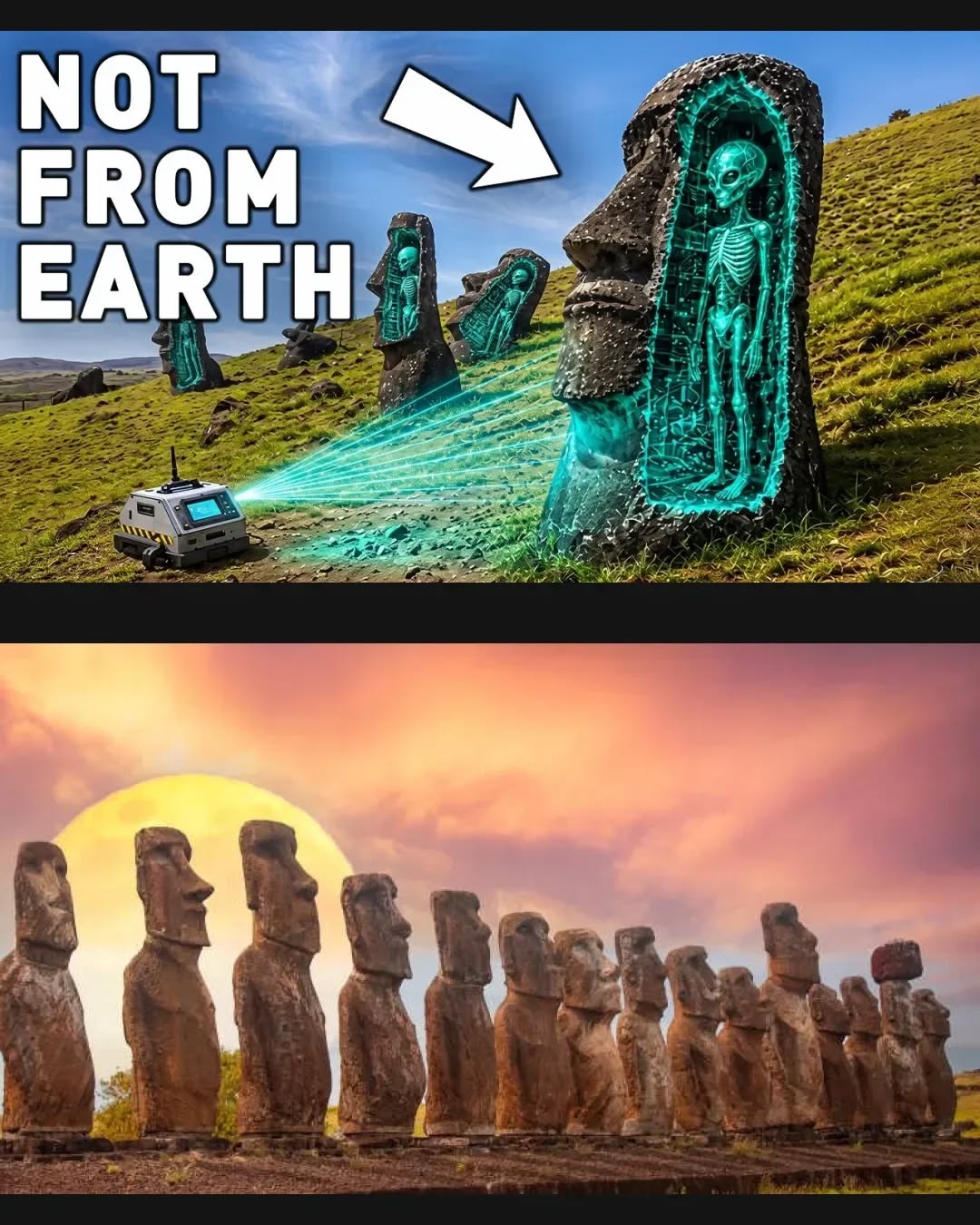
Scientists found a new statue on Easter Island inside the crater of an old volcano. They were sure they already cataloged all the Moai. That’s what they call those famous stone giants. But this discovery changes what we know about them. First of all, the Moai were rarely alone. So we may hear about more of them in the same area. Second, it’s the first Moai found at the bottom of a lake. Scientists were working on a project to restore the marshland in the volcano’s crater when they stumbled upon the statue. The lake that was here began to dry up in 2018. For at least two or 300 years, it was almost 10 ft deep. So it would be impossible for humans to build or put a statue on the bottom. Scientists think the Moai are over 500 years old.
It’s possible that the Rapa Nui people who built them probably brought the statue here when the lake was dry in the past. The new find turned out to be slightly over 5 ft tall, which is smaller than the other statues on the island. It’s a full-bodied one with recognizable features. Researchers also plan to do radiocarbon dating to find out the exact age of the statue. They don’t plan to remove it from where it was found because the oldest members of the Rapa Nui community want it to stay where it is. Moai statues kept scientists puzzled for centuries. They knew that they were built as a dedication to the island’s chiefs, but no one could figure out why they chose these various locations for the statues. Most of them were found along the coast of the island.
Researchers from Binghamton University in New York decided to study the locations more closely and learned that it had to do with water. Easter Island has porous volcanic soil that absorbs rain easily, so there aren’t enough streams or rivers and too little fresh water. Hundreds of years ago, the island’s people relied on groundwater discharge to get drinking water. The water stored deep underground in rock or soil layers called aquifers reach a point where it flows up to the surface. When this underground water emerges near the coast, it mixes with the salty seawater. But, the salt level remains low enough that the water is safe to drink. The islanders used to collect this water directly from the spots where it flowed out. And it looks like that’s why they built the moai along the coast, right near their most important water source.

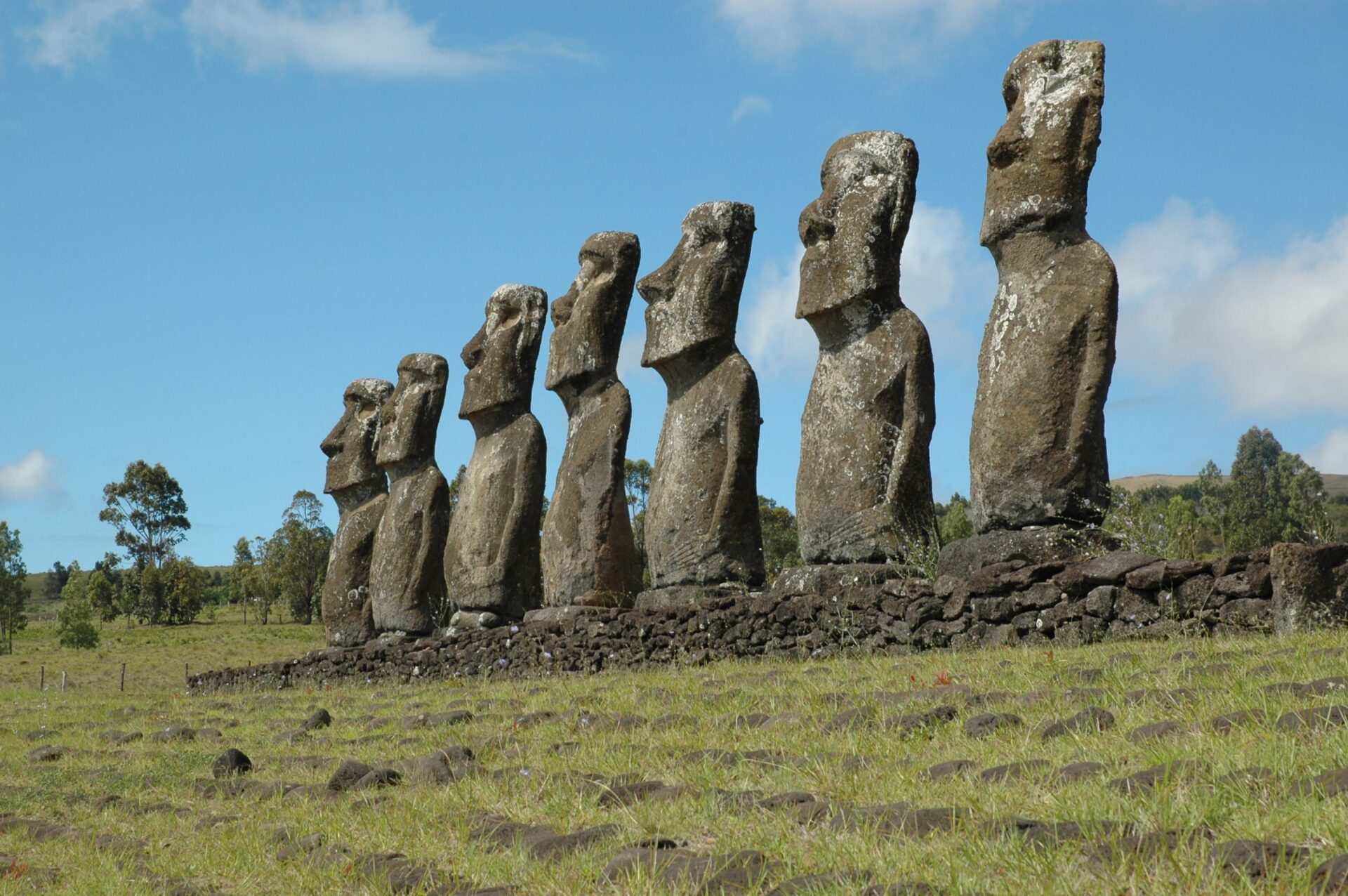
The main bodies of most of the statues were made of volcanic tuff from a local quarry in what used to be a volcano. This material is easy to carve, but not so easy to transport. That’s probably why researchers found over 300 unfinished moai back in the quarry. The rest of them stand in various locations facing the villages. It looks like the statues were carved lying on their backs. Then, their sculptors detached them from the rock, moved them down slope, and set them in a vertical position to finish the work. When it was done, it was time to move the statue to its platform. And we’re talking about moving statues that weighed around half as much as a single-story unfurnished house without a car or any modern equipment for 3 miles. The locals must have invented some original transportation method.
Scientists tried to recreate it and pulled moai replicas on wooden sleds. They thought someone would have used palm trees for that purpose, but this theory has been debunked. The most successful experiment so far was wielding ropes to rock the statue down the road in a standing position. This sounds legit because the local Rapa Nui legends mention that the moai walked from the quarry. And of course, they needed a good road to get there. In the early 20th century, researchers Katherine Routledge found an 800-year-old road network on the island. It was a bunch of pathways around 15 ft wide going from the quarry. She thought that those roads were ceremonial and not built just for the statues. She wasn’t a famous scientist back then, so others mostly ignored the theory. Several decades later, famous Norwegian adventurer and archaeologist Thor Heyerdahl published his theory.
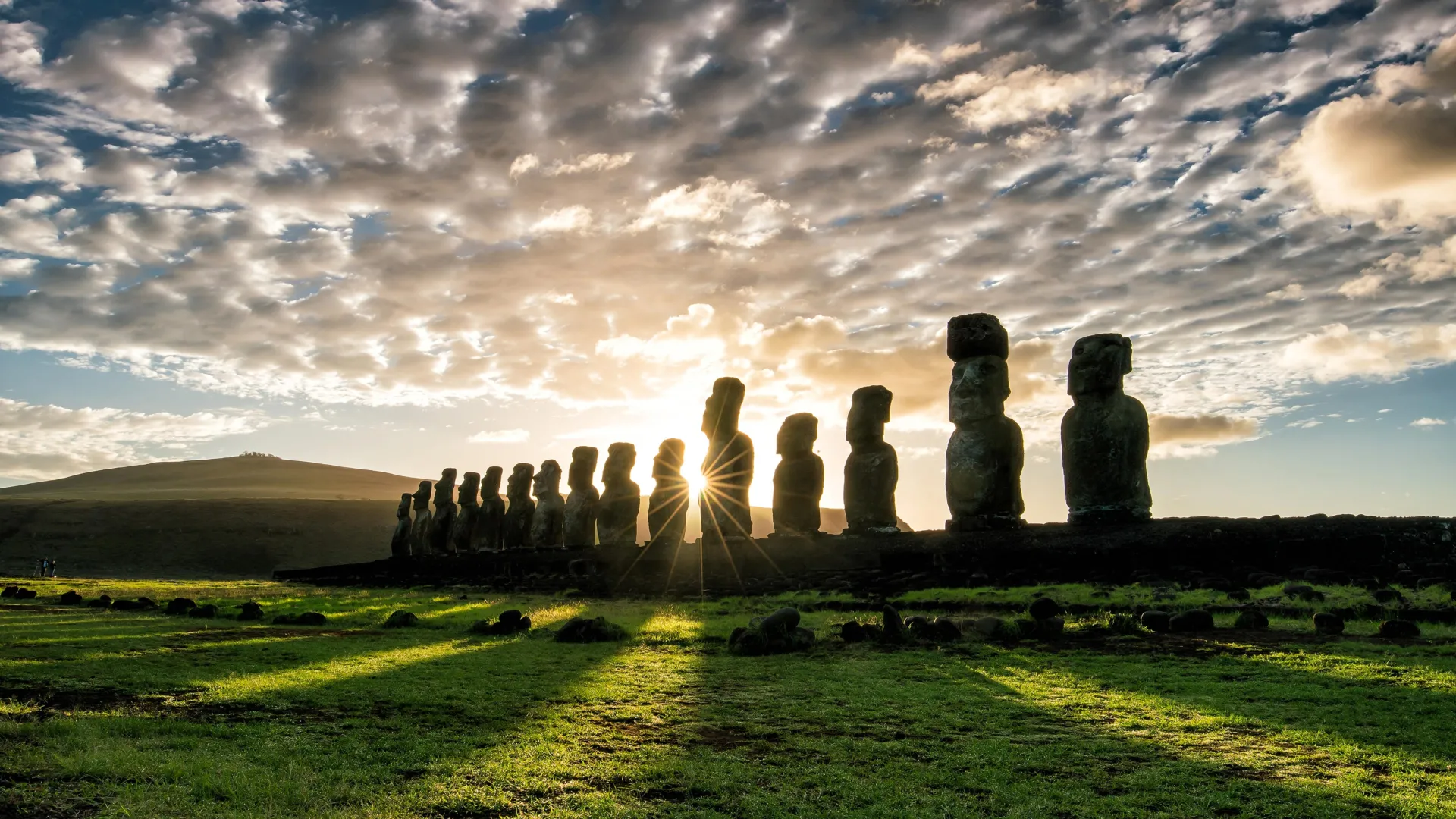
He mentioned that the roads were there exclusively to transport the moai, and some of the statues were dropped along the way for some reason. But in 2010, researchers found that the statues reached their final destinations because they were all set on hidden platforms. The road floor was U-shaped, so pulling massive statues along them wouldn’t be easy. You can still find roughly 15 mi of these roads on the island and see them from satellite images. Scientists used to believe that the Rapa Nui people made Easter Island unlivable and ruined their own civilization. But a new study that used remote sensing data and machine learning says that the island’s population didn’t grow too big and collapse. Instead, the islanders figured out how to live in this challenging place and kept their population small and steady for hundreds of years.
Researchers found amazing rock gardens as proof for this new theory. Easter Island, or Rapa Nui, is one of the most remote places on Earth where people live. It’s surrounded by the Pacific Ocean. Central Chile is 2,200 mi to the east of it, and French Polynesia is 2,600 mi to the west. The island, which is 63 sq mi in size, is made entirely of volcanic rock. But the volcano stopped erupting a long time ago. So, Rapa Nui’s soil has lost most of the useful nutrients that lava once brought here. It’s also drier than tropical islands, and its deep waters made fishing much harder for the settlers, as there’s no shallow lagoons or reefs to fish in. So, the islanders came up with a smart farming method called rock gardening to survive here.
They spread rocks of different sizes over the soil and planted crops like sweet potatoes and taro between the rocks. The rocks protected the plants from harsh winds and salty air and helped regulate the soil’s temperature. They also slowly released minerals into the soil, so it became healthier for growing food. Some islanders still use these gardens, although they don’t produce a lot of food. People in places like New Zealand, the Canary Islands, and the US Southwest have used similar techniques to grow crops in uneasy environments. While scientists are solving Easter Island mysteries, the island itself is teaching them something new about how the Earth’s mantle works. For years, they thought it moved like a slow conveyor belt, carrying tectonic plates along with it. But, a new study by geologists from Cuba, Colombia, and the Netherlands is challenging this idea.
They used a special method called zircon dating to figure out the island’s age. Zircons are tiny crystals that form when magma cools, and they have traces of uranium inside that turns into lead over time. So, the scientists measured this change to tell the age of zircons, and they were shocked when they saw that some zircons were way older than expected, around 165 million years old. The island itself is only 2 and 1/2 million years old. The scientists found that these ancient zircons came from deep inside the mantle under the tectonic plate by magma from earlier volcanic activity. Easter Island’s volcanoes are part of a group called hotspot volcanoes, formed by hot plumes of rock rising from deep within the Earth. Normally, these plumes stay in one spot while the Earth’s crust moves above them and creates a chain of islands like Hawaii.

But the discovery of ancient zircons on a younger island shows there’s more going on deep underground than we thought. Research showed that 165 million years ago, a giant volcanic plateau existed where Easter Island is now. But 110 million years ago, it sank under Antarctica because of tectonic subduction. Ancient zircon minerals stayed put and didn’t travel away with the mantle conveyor belt. So, it looks like the mantle near hotspot plumes doesn’t flow as much as scientists used to think. It stays still. This new idea could lead to big changes in how we understand plate tectonics and how the Earth’s inside moves over time. Welcome to Rapa Nui, better known as Easter Island. It’s a tiny speck in the vast Pacific Ocean, 2,200 miles away from the coast of Chile. This island is most famous for its eerie Moai statues.
This place is also home to one of the most mysterious writing systems in the world called Rongo Rongo. We found it on 27 small wooden tablets. For years, historians have been arguing about the true history of these tablets, and now we might have found the truth. Humans first set foot on this island in the 12th century. For many years, it was home to the Rapa Nui people. They were pretty isolated out there in the Pacific Ocean until Europeans arrived in the 1720s. Europeans brought with them lots of troubles, leaving only a small fraction of the native population alive. Later in the 19th century, a missionary, Eugene Eyraud, went to the island and discovered the wooden tablets with intricate symbols carved on them. He wrote, “How marvelous they are, but there are hundreds of them on the island, and that they can be found in every household.
” But unfortunately, not all of them survived to this day. We’ve only got 27 of them. Some of them were heavily weathered, burned, or otherwise damaged, and now they’re scattered all over the world in museums and private collections. Some of the language’s artifacts were carted off to Tahiti and then to Europe by Europeans, leaving none behind on Easter Island itself. The four sacred tablets found their home in a congregation in Rome. They were the ones used in the recent discovery. For years, historians have been arguing whether this writing system was made up by the islanders themselves or they borrowed it from Europeans. To find the truth, they decided to use a technique called radiocarbon dating. All organic materials, like wood, charcoal, and so on, contain a tiny amount of a radioactive form of carbon called carbon-14.
When life comes to an end, things stop taking in carbon-14, and the amount they had starts to decay over time. By measuring how much carbon-14 is left in a sample, we can assume how old this sample is. This is how we learn the age of many fossils and artifacts. So, they looked at the age of some rongorongo tablets. Three of them were crafted from trees grown in the 18th or 19th century, which aligns with the arrival of Europeans. However, one of them is older than the Europeans’ first visit to the island. There are two reasons to believe that Rapa Nui people created this writing system themselves. First, rongorongo works differently from European languages. Decoding it is a pretty hard task. Unlike English, this language boasts over 400 unique glyphs, none of which resemble any known writing system.
There were many attempts to decipher this language, and none of them were successful so far. And second, one of the tablets is shown to be from around the 15th century, before the Europeans arrived. The problem is that radiocarbon dating can only tell us when the wood the tablet was made from was cut down, not when the writing was put on it. And since we’ve only got one tablet to go by, this isn’t enough to be completely sure. On the other hand, why and where would they preserve cut wood for over 200 years just to grab it and write something on it one day? But anthropologists and historians say that it’s possible. Scarce wood resources might have led the islanders to reuse old driftwood, which could be centuries older than the writing itself. This is known as the old wood problem in archaeology.
Plus, the tablet looks very preserved. It was maintained and protected from wood-damaging insects, humidity, and so on. That’s why it survived over the centuries. Whatever is written on it, it was probably important for the Rapa Nui people. Now, all of these are guesses and clues, but scientists are cautiously optimistic. They believe that Rongo-rongo could be one of the rare instances of independent writing invention, like those of the Sumerians or the Egyptians. But, we need more evidence. In the Rapa Nui language, Rongo-rongo means to reside or to declaim. Not everyone could write, only a select few. Probably only the elite of Easter Island, mostly men, knew and could read this written language. After colonization, none of them survived. So now we have to rack our brains trying to figure out what’s written here. First, scholars can’t agree on what type of script it is.
We aren’t even sure that this was their language. But, even if it was, we don’t know whether it’s a primitive form of writing or a fully developed system. In the 1990s, a linguist, Steven Roger Fischer, believed he might have cracked the code of rongo rongo structure. His idea was that these tablets conveyed cosmogonies. Cosmogonies are stories or narratives that explain how the universe was created and how natural phenomena came to be. They often come from ancient traditions and cultures, like those found in East Polynesia. The tablets could have talked about things like how the world began, where everything came from, and how different aspects of nature, like the stars or the mountains, were formed. This would also explain why only the wise elite could write.
Fischer thought that rongo rongo is a mix of logographic and semasiographic systems, which means that some symbols represent spoken words, while others represent ideas or concepts. But, deciphering them would be very hard because it requires extensive memory and knowing context because the symbols are more like hints than complete expressions. However, other language experts disagreed with his ideas, saying there were problems with how he put together his theory. Unfortunately, Fischer couldn’t prove this hypothesis. Maybe these are just drawings. If we look at the tablets, there are some things that look recognizable: people, animals, plants, and geometric shapes. There are some birds. One of them looks like a frigate bird, which Rapa Nui people associate with the deity Makemake. There were also fish, centipedes, and so on. Or at least these glyphs look like them. Could it be just art or a form of decoration?
Maybe, but there are some problems. The glyphs show a high degree of complexity and structure. They also keep the same style. For example, there are several symbols that show something human-like with a raised hand. The only difference is different heads. As if it wasn’t complicated enough, this unique writing style also uses a system known as reverse boustrophedon. This means that each alternate line is flipped upside down, resembling nothing seen elsewhere. We don’t know why they would turn the tablet upside down after each line. But, all this shows that they had some sort of system and organization behind these symbols. Plus, it seems like they used these tablets every day for some practical purpose. But, there’s some hope for the future. New technology, like AI and other computer programs, might help us understand lost languages.
We already started creating algorithms that could help us solve other mysteries, like the Voynich manuscript. Academics even organized the Vesuvius Challenge, a machine learning competition that, in 2023, cracked the riddle of the ancient Herculaneum scrolls. The scrolls were buried under volcanic mud after the catastrophic eruption of Mount Vesuvius in 79 AD. In real life, the scrolls are very fragile, so deciphering them would be a very hard task. But, with digital scanning and machine learning, it’s much easier. They have a rich history. They most likely belonged to the personal library of an Epicurean philosopher named Philodemus. These scrolls contain very important insights into Greek philosophy and Latin literature. If we decipher more of them, we’ll learn more about the rich history of the Roman Empire. For centuries, the whole world was wondering how the giants of Easter Island moved around.
Maybe powerful chiefs ordered big groups of workers to haul them. Or the elite controlled special statue making quarries. But now we finally know the people of Rapa Nui didn’t drag their Moai statues into place like lifeless logs. They made them walk. Scientists looked at nearly a thousand Moai, checked their shapes, proportions, wear patterns, and the gentle forward lean and curved base that many statues have. And then it struck them. Those details weren’t accidents, but engineered. The forward lean shifts the center of gravity and the curved base lets the statue pivot like a pendulum. Once the motion starts, inertia helps carry each step. Think of it like walking an enormous stone toddler using ropes and balance. To prove this right, the research team built a 4. 35 ton replica. The real statues were around 13 tons. And some weighed up to 80 tons.