For centuries, Jupiter — the colossal gas giant that dominates our solar system — has guarded its secrets behind swirling clouds of hydrogen and helium. But in July 2016, NASA’s Juno spacecraft slipped into orbit around the king of planets, armed with a suite of sophisticated instruments and a mission to peel back layers of mystery that had persisted for decades. What it found has fundamentally rewritten our understanding of the planet, revealing a world far more complex, dynamic, and enigmatic than anyone anticipated.

Jupiter is no ordinary world. With a mass two and a half times that of all other planets combined and a diameter of approximately 273,000 miles (439,000 km), it exerts a gravitational pull 2.4 times stronger than Earth’s. It spins so rapidly — completing one rotation every 9 hours and 55 minutes — that its equatorial bulge is visible from space. Yet for all its majesty, the gas giant has always been difficult to study. Its thick atmosphere obscures the interior, and its immense distance — roughly 483 million miles (778 million km) from the Sun on average — makes close-up observations challenging.

Juno changed everything. The spacecraft, roughly the size of a tennis court, has captured stunning high-resolution images and gathered unprecedented data on Jupiter’s atmosphere, magnetic field, gravity, and interior structure. One of its most startling revelations came from peering deep into the planet’s turbulent weather systems. Previous missions, including Pioneer, Voyager, Galileo, Cassini, and New Horizons, had provided glimpses. But Juno’s polar orbits allowed scientists to view the poles for the first time — regions previously hidden from direct observation.
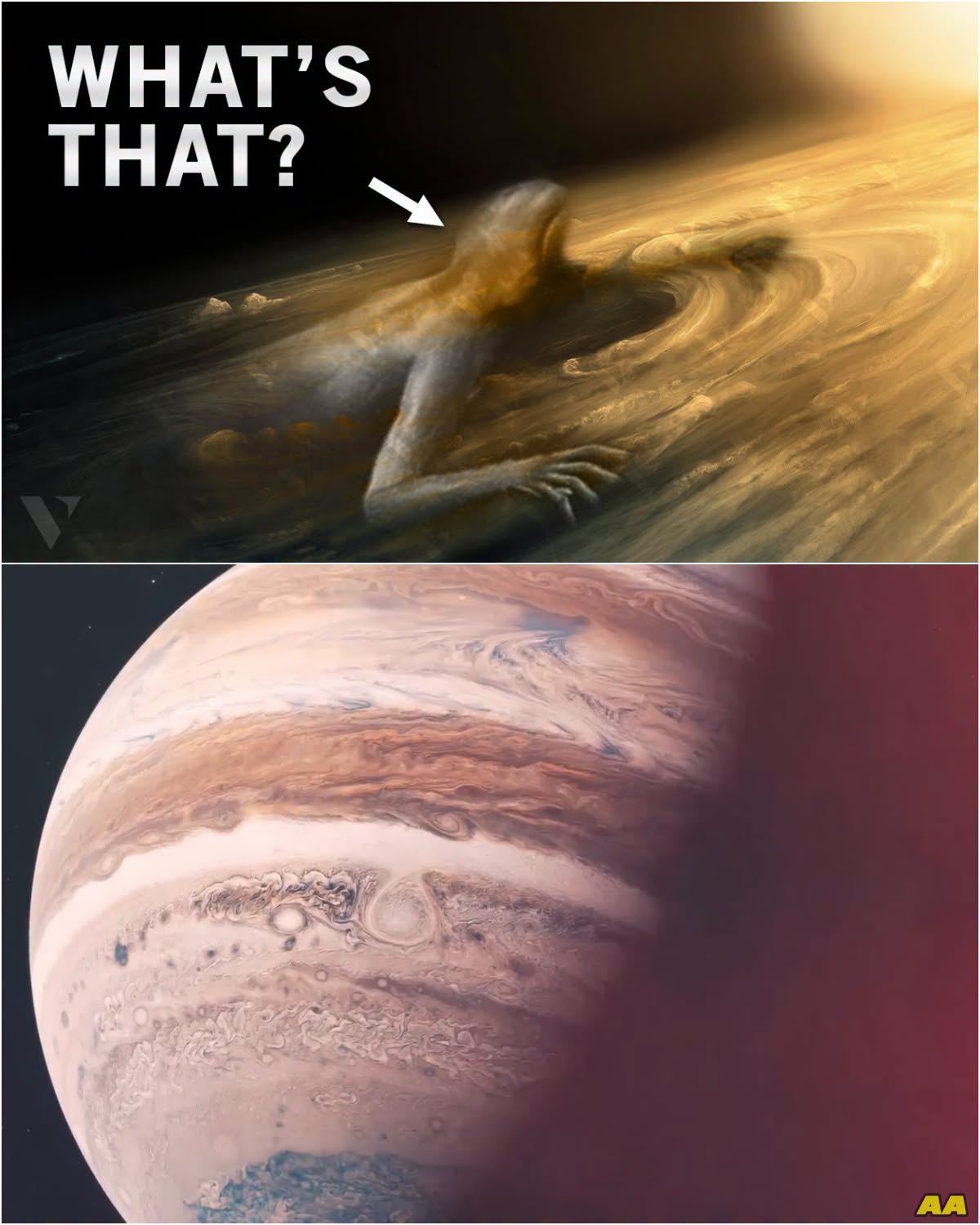
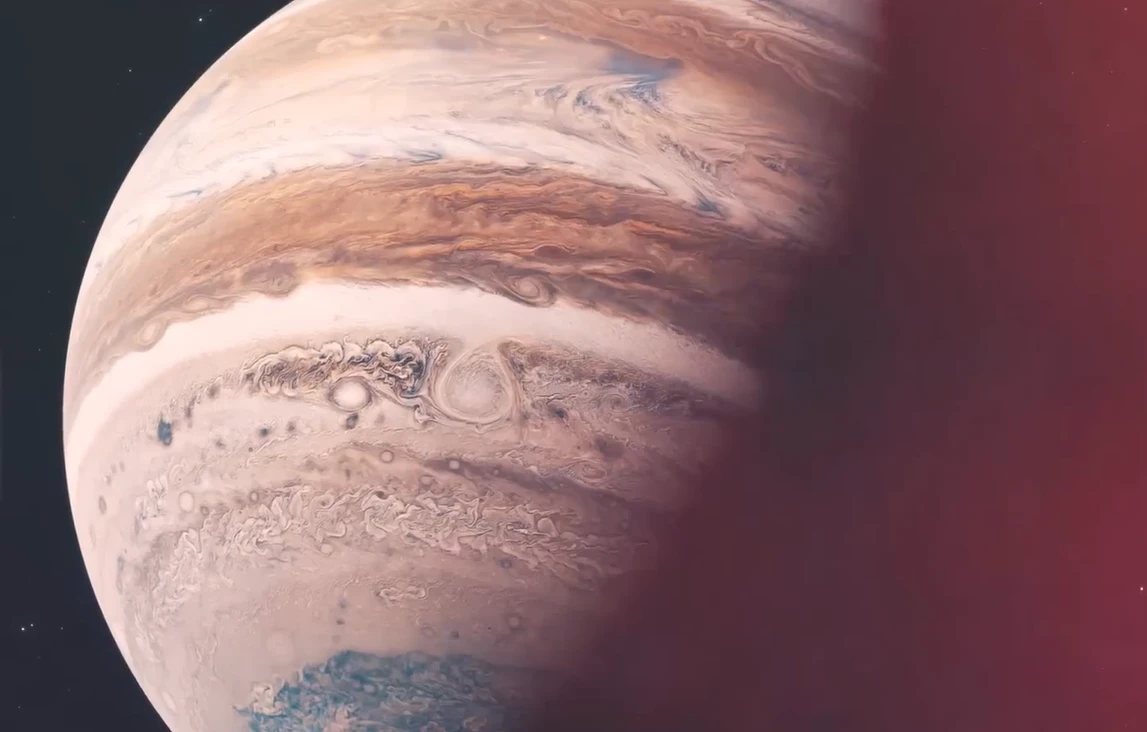
What they saw defied expectations. Instead of the familiar alternating cloud belts and zones that define Jupiter’s equatorial regions, the poles are dominated by chaotic clusters of massive storms. Infrared imaging revealed symmetrical arrangements of cyclones, some hundreds of miles across, arranged in geometric patterns never before observed on any planet. The atmosphere appears far more complex and vertically deep than models predicted, with banded structures extending thousands of miles below the visible cloud tops.

Perhaps most surprising is the discovery regarding Jupiter’s Great Red Spot — the persistent anticyclonic storm larger than Earth that has raged for at least 350 years. Juno data, combined with ground-based observations, suggest the planet may be far richer in water and oxygen than previously thought. This has profound implications for theories about the solar system’s formation and the potential for subsurface oceans on Jupiter’s moons, such as Europa.
What they saw defied expectations. Instead of the familiar alternating cloud belts and zones that define Jupiter’s equatorial regions, the poles are dominated by chaotic clusters of massive storms. Infrared imaging revealed symmetrical arrangements of cyclones, some hundreds of miles across, arranged in geometric patterns never before observed on any planet. The atmosphere appears far more complex and vertically deep than models predicted, with banded structures extending thousands of miles below the visible cloud tops.
Perhaps most surprising is the discovery regarding Jupiter’s Great Red Spot — the persistent anticyclonic storm larger than Earth that has raged for at least 350 years. Juno data, combined with ground-based observations, suggest the planet may be far richer in water and oxygen than previously thought. This has profound implications for theories about the solar system’s formation and the potential for subsurface oceans on Jupiter’s moons, such as Europa.