Mercury Is NOT What We Thought — NASA Found Something Terrifying……….Details in the comments

The planet closest to the Sun has water ice on it, not a little, between 100 billion and 1 trillion tons of frozen water sitting in permanent shadow, completely undisturbed, on a planet where the surface reaches 430° C during the day.
A planet with no oceans, no rain, barely any atmosphere, and somehow, right now, in craters near its poles, there is more frozen water than the entire volume of Lake Erie.
That is not the strangest thing about Mercury.

That is not even close.
Because this planet also has a comet-like tail stretching 15 million miles behind it through space.
It is actively shrinking right now, in 2026.
Its magnetic field should not exist, but does, and that magnetic field generates invisible tornadoes as wide as the entire planet.
A spacecraft is arriving there in just a few months, and scientists genuinely do not know what it is going to find.
And there is a serious theory that says Mercury used to orbit the Sun where Mars is right now, that it somehow violently crashed into the early Earth, and that the debris from that collision became our moon.
Mercury is not the boring little rock everyone skips past in the solar system textbook.

It is the strangest, most contradictory, most poorly understood world in our entire neighborhood, and everything we thought we knew about it is about to be shredded.
Let us start with the thing that should be impossible.
Mercury is the closest planet to the Sun.
It is bombarded by solar radiation at 10 times the intensity that Earth receives.
Its daytime surface temperature exceeds 430° C in the vacuum of space with no clouds, no wind, and barely any atmosphere to spread heat around.
Those temperatures are not estimates.
They are real measurements taken by spacecraft.
The side of Mercury facing the Sun is not just hot.
It is hot enough to melt lead.
It is hot enough that zinc would boil off the surface.
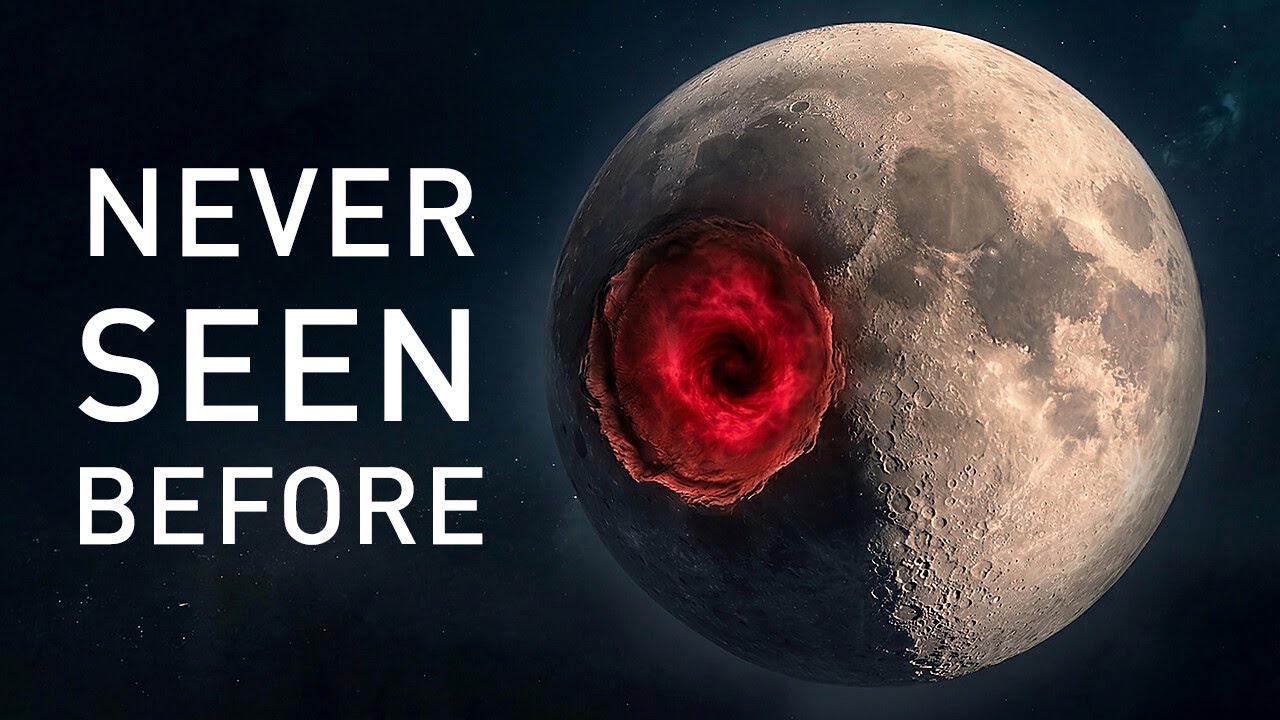
And yet, in the permanently shadowed floors of certain craters near Mercury’s poles, there is frozen water that has been sitting there for billions of years.
Scientists estimate the total deposit at somewhere between 100 billion and 1 trillion tons of ice.
That range is enormous because we have not measured it directly yet.
The Messenger probe orbiting Mercury between 2011 and 2015 gave us the clearest evidence detecting radar reflections from the polar craters consistent with water ice and the photographed four of those craters directly during its sixth flyby of the planet on January 8th, 2025 just 295 km above Mercury’s North Pole.
The craters are named Prokofiev, Kandinsky, Tolkien and Gordimer.
Their rims cast permanent shadows on their floors.
Those floors have never seen sunlight.
And despite being on the planet closest to the Sun, those crater floors are some of the coldest places in the entire solar system.
How does the ice stay there? The same logic that keeps the inside of your freezer cold even when your kitchen is warm.
The sunlit surface of Mercury gets brutally hot, but there is no atmosphere to carry that heat sideways into the shadowed craters.
With no air to conduct heat, the shadows stay frozen.
The question that has puzzled scientists for years is not how the ice stays, it is how it got there in the first place.
And the answer that scientists are currently most excited about is genuinely bizarre.
The Sun may be making it.
On Mercury’s surface, there are chemical groups called hydroxyls, small combinations of one oxygen atom and one hydrogen atom sitting in the soil.
When the solar wind, which is a constant stream of charged particles blasting out from the Sun, reaches Mercury’s surface, it delivers protons.
Those protons interact with the hydroxyl groups in the soil.
The interaction releases energy.
Those hydroxyls collide with each other and the collision produces water molecules.
The Sun is essentially manufacturing water on the surface of Mercury through chemistry.
Most of those water molecules get broken apart immediately by solar radiation or float off into space.
But some of them, a small fraction, drift toward the poles, fall into the permanently shadowed craters, freeze and stay there.
Scientists calculated in a study published before BepiColombo’s arrival that over the next 3 million years, this process alone could generate approximately 11 trillion tons of water ice on Mercury.