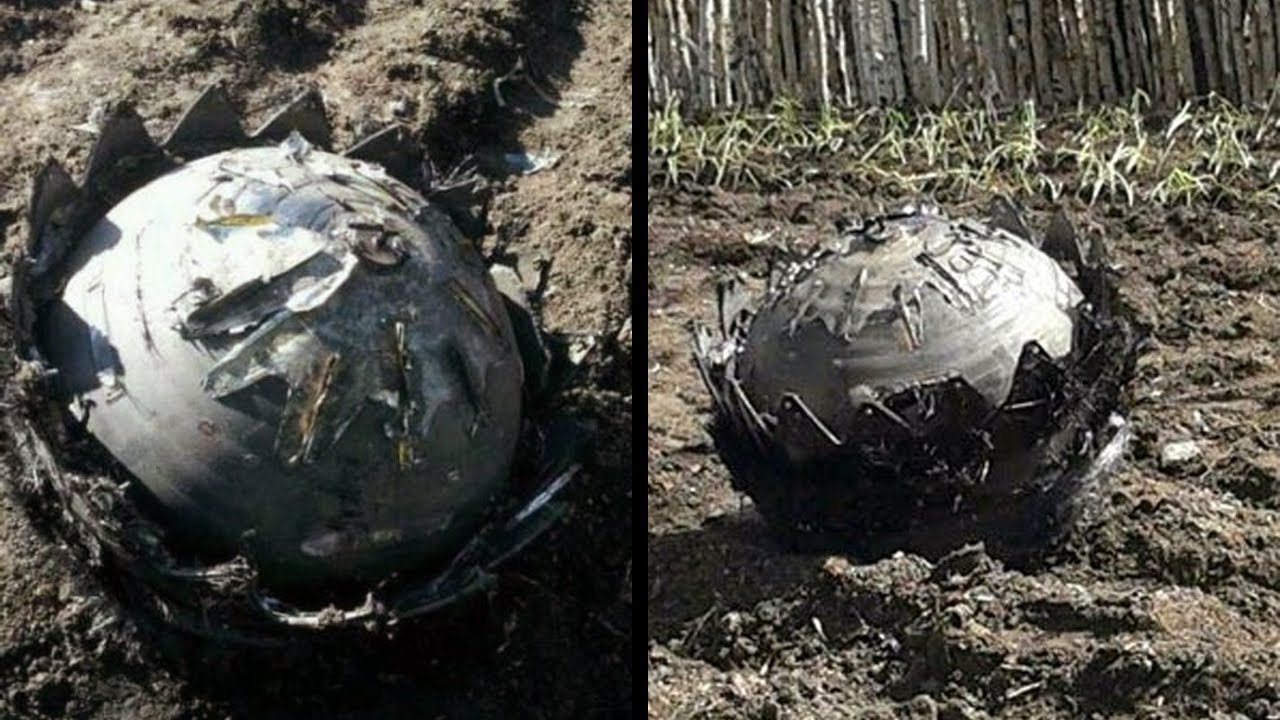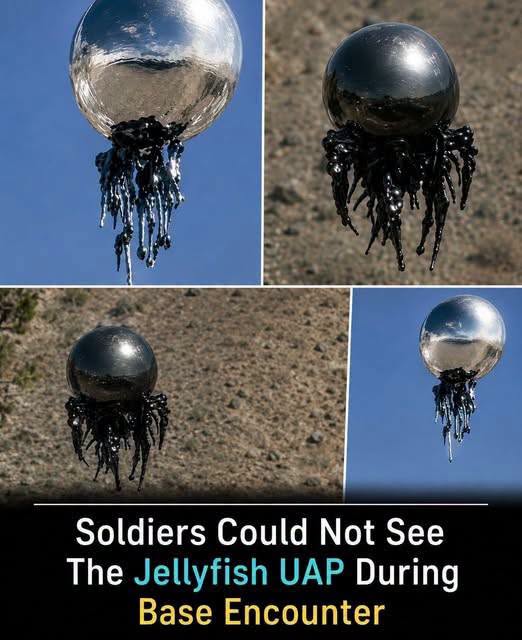

A newly circulating set of images featuring the so-called “Jellyfish UAP” has once again ignited worldwide discussion about unidentified aerial phenomena after renewed claims suggested that military personnel stationed at a secure base were unable to see the strange object with the naked eye, despite sophisticated surveillance systems reportedly tracking its movements. The unusual images, which show a metallic sphere-like object with dark, tentacle-like appendages hanging beneath it, have rapidly spread across social media platforms, fueling fresh speculation about one of the most debated UAP cases in recent years.

The latest images portray what appears to be a reflective silver orb hovering silently above the ground. Beneath the spherical object hangs a cluster of black, irregular strands resembling jellyfish tentacles, giving rise to the now widely used nickname “Jellyfish UAP.” According to online claims accompanying the photographs, the object was allegedly recorded by military infrared surveillance equipment while operating near a secure military installation.
Supporters of the incident argue that one of the most unusual aspects of the case is the claim that soldiers on the ground reportedly never noticed the object directly. Instead, they suggest the phenomenon was visible only through specialized imaging systems, raising questions about whether advanced sensors are capable of detecting aerial objects that remain invisible—or nearly invisible—to human observers.

Although these claims have attracted enormous public interest, no publicly released evidence has confirmed that military personnel were actually unable to observe such an object during the reported encounter. The photographs currently circulating online should therefore be viewed as unverified material rather than confirmed documentation of an extraordinary event.
Interest in the Jellyfish UAP grew significantly after discussions surrounding several military-recorded unidentified aerial phenomena entered public conversation in recent years. Enthusiasts believe the object’s unusual appearance distinguishes it from traditional reports involving disc-shaped craft, triangular vehicles, or glowing orbs. Instead, the Jellyfish UAP appears to possess an irregular, almost organic silhouette unlike conventional aircraft or drones.

Witnesses described in online accounts claim the object reportedly moved silently across restricted airspace without displaying visible propulsion systems, exhaust plumes, wings, or rotors. Some reports allege that it maintained a steady altitude for several minutes before changing direction with little indication of conventional aerodynamic flight.
The object’s reflective upper section has also become a major topic of analysis among independent researchers. Some observers suggest the metallic surface appears almost mirror-like, reflecting sunlight and the surrounding environment. Others argue the appearance could simply result from image enhancement, camera artifacts, or compression effects introduced during digital processing.
Perhaps the most controversial element of the story involves claims that the object somehow avoided direct visual detection while remaining visible to surveillance equipment. Aviation specialists note that military imaging systems frequently operate across multiple wavelengths, including infrared and thermal imaging, enabling them to detect temperature differences that may not be visible to the human eye. This capability alone does not imply extraordinary technology but does explain why certain objects may appear differently on specialized sensors.
Skeptics have proposed several conventional explanations for the Jellyfish UAP. Some believe the object could represent debris attached to a balloon drifting through the air. Others suggest it may have been a cluster of lightweight materials carried by wind currents, creating an unusual silhouette when viewed through infrared imaging systems. Camera artifacts, lens contamination, or image-processing errors have also been considered possible explanations.
At the same time, supporters argue that the reported movement of the object appears inconsistent with ordinary balloons or airborne debris. According to various online analyses, the object allegedly maintained stable flight characteristics despite changing environmental conditions, although these interpretations remain heavily debated due to the limited publicly available footage.

The growing interest surrounding the Jellyfish UAP reflects a broader shift in public attention toward unidentified aerial phenomena. In recent years, governments and defense agencies have acknowledged investigating reports involving objects that remain unexplained after initial analysis. However, officials have consistently emphasized that an unexplained observation does not automatically indicate extraterrestrial technology.
Experts in image forensics stress that extraordinary claims require careful examination using original source material rather than screenshots or edited images circulating online. Important information such as metadata, recording equipment specifications, sensor calibration, environmental conditions, and complete video sequences are necessary before investigators can accurately assess the authenticity of any alleged UAP recording.
Meanwhile, online communities continue to examine every frame associated with the Jellyfish UAP. Artificial intelligence enhancement tools, digital stabilization techniques, and high-resolution image processing have generated countless interpretations, with some viewers claiming to identify structural details while others argue the enhancements introduce artificial features that were never present in the original footage.

Public fascination with unidentified aerial phenomena has undoubtedly grown over the past decade as military encounters, government investigations, and declassified reports have entered mainstream discussion. Cases such as the Jellyfish UAP demonstrate how rapidly unusual imagery can spread across the internet, attracting millions of viewers eager to determine whether they are witnessing advanced technology, natural phenomena, classified defense projects, or simply misunderstood objects.
Despite widespread speculation, there remains no publicly verified evidence demonstrating that the Jellyfish UAP represents extraterrestrial technology or that military personnel experienced an encounter beyond current scientific understanding. Likewise, the claim that soldiers could not see the object directly has not been independently confirmed through official documentation.
For now, the Jellyfish UAP remains one of the internet’s most intriguing and controversial unidentified aerial phenomenon stories. Until original recordings, complete technical data, and independent investigations become publicly available, the incident will likely remain an open mystery—one that continues to inspire debate among researchers, skeptics, and UFO enthusiasts alike while reminding the public that not every unexplained image necessarily has an extraordinary explanation.