James Webb Detects a Planet Better Than Earth and the Ninety Nine Point Seven Percent Life Signal Has Scientists Stunned

This is a strange moment to be alive. We just watched a telescope sniff the air of a planet one hundred twenty four light years away and pick up a chemical smell that back on Earth almost only living things make. And nearly every headline on your phone turned that one faint sniff into a victory speech.
Tonight the real story is what was actually measured what it might mean and what the careful scientists still want you to wait for before you decide.
You probably expected the James Webb Space Telescope to keep finding more dead rocks. Hotter bigger weirder sure but alive almost nobody was ready for that yet. So when a faint chemical signal showed up on a small world most people had never even heard the name of the whole conversation shifted literally overnight.

The mystery does not begin with a weird planet and it does not begin with a heroic telescope. It begins with us. It begins with a question humans have been quietly asking on long winter nights for close to two thousand years almost as long as we have had writing. Are we alone. Is there anyone else out there. Is the rest of the sky just lights or do some of those lights have little worlds with things happening on them.
For most of human history the honest answer was simply that nobody knew. Even the best scientists alive fifty years ago could not really test that question. They only had guesses. Today for the first time ever a small United States built telescope floating far from our planet with mirrors painted in a thin layer of real gold has started whispering a very odd new answer back.
And that whisper began in a place most people did not think was even worth checking.
It starts with a small red dwarf star in the constellation Leo a star that gives off so little visible light you cannot see it without a backyard telescope on a perfectly dark night. And it begins with a quiet belief many people still carry that just is not true at all.
Many grown ups even some who love space think that only planets around stars that look basically like our sun can ever be homes for life. They figure small cool red stars the dim ones astronomers call red dwarfs are too weak and too grumpy to grow anything alive. They picture red dwarfs as cold little embers that barely glow and they assume any planet around them would be a frozen lump of useless chemistry.

That turns out to be exactly backwards and the correction matters more than almost any other single idea in this story. Red dwarfs are not weak the way we usually mean it. They are smaller yes roughly half the size of our sun on average but they are also the most common kind of star in the entire Milky Way galaxy by a long way. Roughly three out of every four stars in our galaxy is a red dwarf.
Think about that for a second. Three out of every four. So if you only look at sun like stars you are skipping three quarters of the neighborhood. You are skipping most of the lights in the sky. That makes red dwarfs the biggest possible lottery in the search for life anywhere. If even a tiny fraction of them host life friendly worlds the universe is much richer than the old picture suggested.
And one of the most interesting tickets in that lottery is a star called K2-18 sitting about one hundred twenty four light years from Earth. That is about seven hundred thirty trillion miles away far far past the reach of any spacecraft we will build in your lifetime or even your grandchildrens lifetime or even one hundred lifetimes from now.
A light year is the distance that a single beam of light travels in one full year. Light moves so fast that it can circle the Earth seven full times in just one second. Even at that speed it takes that beam about eight minutes to reach us from the Sun. So in one full year light covers about six trillion miles. One light year equals roughly six trillion miles. That makes K2-18 about one hundred twenty four times that distance away. Multiply it out and you get seven hundred thirty trillion miles give or take. That is the real size of the gap James Webb has been staring across.
Scientists first learned about the star K2-18 back in two thousand fifteen. The Kepler space telescope a small NASA built planet hunter the size of a school bus was watching a patch of sky for years and quietly counting tiny dips in starlight. Each dip could mean a planet crossing in front of its star blocking a sliver of light we could measure here on Earth. Kepler spotted a faint dimming pattern coming from K2-18. A planet was passing in front of that small red star every thirty three days blocking about one ten thousandth of the light during each pass. That is roughly like one mosquito flying past a single kitchen window light at night dimming it for a few minutes.
The team gave the planet a working name. They called it K2-18b. At first nobody got very excited about K2-18b. The signal was tiny. The planet was thought to be a frozen ball of ice and rock or a tiny Neptune like gas ball kind of a mini version of the ice giants in our own solar system. Nothing special. Nothing to write home about.
Then in two thousand seventeen another team took another careful look and this changed everything. They used the Hubble space telescope still orbiting Earth at that time and they found that K2-18b has an atmosphere. Not a thin poisonous sliver of an atmosphere. A real one with measurable amounts of water vapor floating inside it. Suddenly an awkward frozen rock just became a candidate for something far more interesting than anyone had dared hope.
The observation was published in a peer reviewed paper with researchers from University College London leading the work. The idea that this could really matter caught fire two years later in two thousand nineteen when a group of researchers published a paper suggesting that K2-18b might be a Hycean world. That is a brand new word in astronomy. Hycean means a planet covered by a deep global ocean with a thick hydrogen rich sky above it. Picture a warm mist covered sea wrapped in a glowing gas dome lit by a small dim red sun rising and setting every thirty three days.
Nobody had ever confirmed a Hycean world before in human history. So K2-18b went from a quiet footnote at the bottom of a chart to the most interesting little world any telescope had ever studied closely.
And the moment that turned everything on its head came in late August of two thousand twenty three. A team at the University of Cambridge working out of the Institute of Astronomy led by Professor Nikku Madhusudhan used the James Webb Space Telescope to study the starlight filtering through K2-18bs thin atmosphere during a transit.

The team expected to find the ordinary chemical fingerprint of a hydrogen rich sky. Methane yes probably some. Carbon dioxide also probably some. Maybe a touch of water vapor still hanging around. Anything dramatically stranger than that very unlikely. That was the safe bet the boring answer the answer most astronomers were quietly prepared to accept.
What they actually saw sent a small ripple through the entire field of astronomy in a single afternoon. They detected methane in large amounts. They detected carbon dioxide in large amounts. And they detected a faint but unmistakable signal of a molecule called dimethyl sulfide or DMS for short.
Now here is why that one tiny molecule matters so much. Why the entire field of astrobiology has been quietly obsessed with it for more than a decade. On Earth dimethyl sulfide is almost entirely produced by living things. Most of the DMS in the air around our planet comes from phytoplankton tiny floating ocean plants you have never seen with your naked eye. Bloom by bloom trillion by trillion they pump DMS out of the ocean and into the sky. When a phytoplankton bloom lights up the summer seas up north the gas rises and gets carried on the wind. That gas is what gives the ocean its faint briny cold water smell the smell of sea spray on a windy day at the coast.
So when a telescope a million miles from Earth picks up the exact same molecular fingerprint bending around a planet one hundred twenty four light years away scientists have to sit down and take a long slow breath. They have to ask themselves if the simplest explanation is the right one or the most exciting one.
Right away honesty matters because the loudest headlines will not be honest. The DMS signal Madhusudhans team picked up was faint. So faint that the team itself in their own published paper described it as a tentative marginal detection. The statistical confidence in plain English sat somewhere around ninety nine percent give or take. Still that means there was about a one percent chance it was just noise. One percent sounds tiny but in astronomy one percent is the difference between a hint and a discovery.
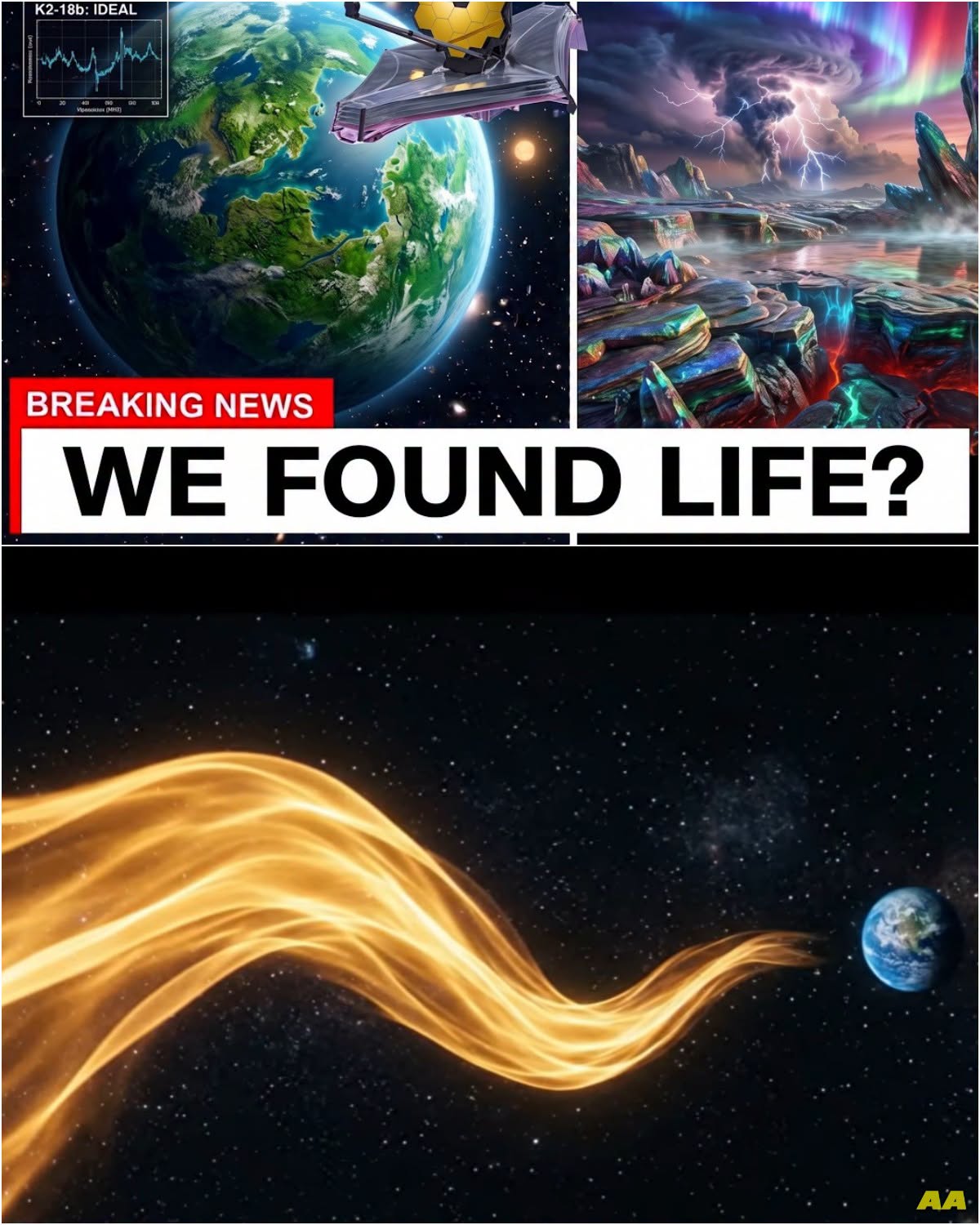
And that is exactly where the loud headline your feed circled came from. You have probably seen posts that say with great confidence that the James Webb telescope has detected life on K2-18b or that this planet is in some specific way better than Earth for life. Some of those posts even quote a ninety nine point seven percent life signal number as if it were carved in stone.
That jump is not what the researchers actually said. The researchers said they had hints very interesting hints. They said they need more data more transits more careful cross checking. They said the DMS hint could still turn out to be statistical noise that happened to fall near a real molecular line. Those headlines were running ahead of the science by a year or more.
So let this land carefully. The Cambridge team led by Professor Nikku Madhusudhan used the most powerful space telescope ever built and aimed it at the small red star K2-18. They detected for the first time ever on a planet outside our solar system the highest amounts of methane and carbon dioxide anyone had measured on a watery world sitting inside the habitable zone of its star. On top of that they reported a faint hint of dimethyl sulfide a gas that on Earth is mostly made by life.
Those careful numbers and that careful language were published in a peer reviewed paper in the journal Nature Astronomy dated September eleventh two thousand twenty three. That paper is real. That signal is real. That interpretation is still being debated in public as science should always be.
The title floating around some video thumbnails online claiming a ninety nine point seven percent life signal that makes K2-18b better than Earth is not a quote from the research team. That number was assembled by people online drawn from one thread of the statistical analysis treated as a click title that captured attention not as a measured finding from a telescope. The actual paper language was cautious careful and modest.
What makes K2-18b so special that it can hold a thick hydrogen atmosphere and a deep ocean at the same time. Two answers both surprising in their own way and both worth taking in slowly.
First the size and the temperature. K2-18b sits right in what astronomers call the habitable zone of its small red star the sweet spot where liquid water can exist on the surface of a planet without boiling off or freezing solid. The planet is about two point six times the size of Earth and roughly eight point six times as massive. So picture Earth then picture something a little bigger than Neptune. That gives K2-18b enough gravity to hold a thick sky while still being small enough that it might have a rocky surface or even a watery surface underneath not a wall of gas like Jupiter or Saturn in our own solar system. That is a strange middle shape our own solar system does not really have what astronomers call a sub Neptune and our galaxy is full of them.
Second something even wilder once you stop and stare at it. K2-18b gets only about five percent more energy from its small red star than Earth gets from the sun. So if there is an ocean down there the surface could be roughly as warm as a comfortable kitchen stove on medium heat not too cold not too hot just right for chemistry to do interesting things hour after hour year after year. For years nobody thought a planet that small around a small dim star could be that gentle and stable. The math however actually says it can. And K2-18b is now serving as the test case for that whole idea.
Then came the moment that changed the discussion all over again. In April of two thousand twenty five a separate independent group of researchers including scientists at the University of California Riverside published a follow up analysis in the Astrophysical Journal Letters. They took the same James Webb transit data ran it through different and harsher statistical models including some simulations of what could create false positive biosignature signals in starlight and came back with a cooler verdict. They confirmed the methane and the carbon dioxide detections as solid but they said the dimethyl sulfide hint was weaker than it first looked and we cannot yet tell what is making it.
That is the honest state of the field right now. Two respected papers. One says this is the strongest hint of life outside the solar system we have ever seen. The other says maybe but the DMS signal is so weak we cannot yet tell what is making it and we cannot rule out an exotic non biological source. That is not failure. That is exactly how real science works layer by careful layer until the picture is clear enough to trust and act on.
The underdog story here matters a lot. For most of the two thousands and tens K2-18b was treated like a quiet footnote that nobody needed to read. Small far away easy to ignore. When the Kepler mission first spotted that mosquito sized dip in starlight back in two thousand fifteen the official NASA mention of K2-18b almost buried the planet in a long list of small candidates. A planet slightly smaller than Neptune in the constellation Leo very far from Earth. That was the entire mention. Nobody on the Kepler team thought they were finding the next best candidate for life anywhere. They were just collecting dots on a chart hoping the dots would tell a story later.
And yet ten years later K2-18b is the world on which James Webb has made one of the most interesting atmospheric measurements it has ever produced beating out famous planets that get all the press. A tiny dim signal became one of the biggest stories of the decade without anyone planning for it. That is the underdog story of the entire search for life sitting right there on one quiet planet.
Now let us talk about what made James Webb able to do all of this in the first place because the telescope itself is its own underdog story and a wild one at that. When the James Webb project was first officially approved back in nineteen ninety six the plan was to launch in two thousand seven and cost roughly half a billion dollars. The reality that actually happened was very different. The project was twenty years late and the final price tag sat at around ten billion dollars. The telescope finally lifted off on Christmas day of two thousand twenty one riding an Ariane five rocket launched from the coast of French Guiana on the edge of South America.
Plenty of people in the United States Congress tried to kill the funding more than once over those long decades. Some called it the telescope that would never fly. Some called it a giant money pit that should be canceled. Today that gold colored telescope sits about a million miles from Earth. Picture the distance between New York and Los Angeles then multiply it by about four hundred. That is the gap. James Webb is parked at a quiet gravitational spot called the second Lagrange point which working astronomers just call L two.
Lagrange points are special pockets in space where the gravity of Earth and the Sun balance out just enough to let a telescope hover in place with very little fuel. James Webb was folded up like a giant piece of origami when it launched and over weeks of patient unfolding in early two thousand twenty two it turned into a fully working observatory. Picture a tennis court sized sunshield eighteen gold plated mirror segments acting as one giant honeycombed eye six and a half meters wide and instruments so cold they sit at a temperature of about minus three hundred eighty eight degrees Fahrenheit. That is colder than the surface of Pluto far colder than anything your home freezer could ever touch. So cold the metal almost stops vibrating at the atomic level.
And here is the beautiful part. From that quiet parking spot James Webb can read the chemical fingerprint of a single molecule on a planet one hundred twenty four light years from here. Stop and think about that scale for a moment. A single photon of starlight smaller than anything your eye could ever see has been bouncing off a warm planet roughly seven hundred thirty trillion miles away slipping through a thin gas layer getting filtered through methane and carbon dioxide and maybe dimethyl sulfide and arriving at a camera chilled colder than winter in Antarctica. That is not just engineering. That is patience made out of metal and light.
While Madhusudhan and his team at the University of Cambridge were studying K2-18b another team spread across MIT and the NASA Goddard Space Flight Center in Maryland was using the same telescope to study a completely different world. Their target was TRAPPIST-1e a rocky Earth sized planet sitting about forty light years away around an even smaller and cooler red dwarf. Scientists had been hoping TRAPPIST-1e might have a thick carbon dioxide atmosphere looking something like Venus or early Mars. So they pointed James Webb at the system and waited patiently for transits.
The James Webb observations published in September of two thousand twenty five by a team that included researchers from MIT and NASA Goddard all but ruled out that Venus or Mars style atmosphere. What they found instead was subtler and a lot more interesting. They picked up a faint statistical hint of a nitrogen rich secondary atmosphere carrying small traces of methane sitting on top of either bare rock or a thin gas envelope. Nothing confirmed yet but the results suggest the planet might be smaller in atmosphere than Venus and richer in chemistry than a bare rock.
So the surprise here was the shape of the discovery not the chemistry itself. What does that mean in plain words. It means TRAPPIST-1e might not be a tiny Venus it might not be a bare naked rock it might be something gentler in the middle of those two extremes. A quiet little world with a thin methane tinted sky hugging a small red star. An Earth size planet with a calm little atmosphere is a much friendlier place for chemistry to do interesting things than a baked greenhouse or a sterile rock. So instead of shrinking the mystery James Webb made the mystery bigger in the best possible way.
That is one of the deepest lessons. The James Webb Space Telescope is not in the business of handing out clean answers. It is in the business of turning vague guesses into careful new questions. Every finding tends to raise two more. That is the feeling of standing at the front door of something we barely understand yet and trying not to bang too loudly on the door.
K2-18b and TRAPPIST-1e sit on opposite sides of a fascinating divide in planet types. K2-18b is bigger about two point six times the size of Earth with a thick hydrogen sky and a possible Hycean ocean. TRAPPIST-1e is Earth sized rocky with a thin sky. Yet both worlds orbit small cool red dwarfs. Both sit roughly in the habitable zone at that sweet distance where water could be liquid. And both have given James Webb some of the most carefully argued hints we have ever pulled from another solar system. Two quiet little planets two very different puzzles one brand new telescope all rubbing shoulders in the same grand question. Are we alone.
Professor Nikku Madhusudhan grew up in India studied at the Indian Institute of Technology then got his PhD in astronomy at Yale and has spent most of his career working on the question of what atmospheres on small planets might look like. He had been building toward the James Webb K2-18b observation for years before the telescope even launched. His team at the University of Cambridge Institute of Astronomy brought together researchers from several countries. The paper they published in Nature Astronomy included co authors from other institutions and was the result of literally years of preparation. Real people real training real patience all coming together on one quiet star.
It is also worth saying this is not a contest between Earth and K2-18b or Earth and TRAPPIST-1e. No other Earth two point zero is getting crowned in a lab somewhere tonight. There is only a real careful slow scientific process unfolding across continents and time zones. And every good scientist will tell you the best part of their work arrives when the careful data stops fitting the old models. That is when new science actually begins.
A study published in the journal Nature Astronomy in late April of two thousand twenty five led again by Professor Madhusudhan and a wider team of collaborators plainly stated that scientists will tell you they do not yet fully understand how dimethyl sulfide could even survive in the atmosphere of K2-18b in the first place. On Earth DMS only lasts about twenty days in the sky before sunlight breaks it apart. Nobody knows for sure how it could last long enough at K2-18b to be detected one hundred twenty four light years from here. The models have predicted something different something quieter. The data did not follow those models. So either something is making DMS very fast down on the surface possibly an ocean full of living things or something is protecting it in the atmosphere that nobody has written down yet.
That is the kind of moment where real science starts to feel like the opening scene of a movie not the middle not the climax. The first scene where the camera pans around an empty room and the music tells you something is about to walk in. We do not know yet what walks in.
One more thing worth keeping in your head as this story keeps unfolding. K2-18b orbits its small red star every thirty three Earth days. Earth orbits the Sun every three hundred sixty five days. The star is so dim and so cool that even at this close distance the planet does not roast. That gentle little dance every thirty three days is what lets James Webb keep probing the same thin slice of atmosphere again and again. If you miss one transit the next chance comes in just a little over a month. Nowhere near the long year long wait for Earths orbit. So patience and opportunity are finally meeting in the same place on a planet a long way from your kitchen table.
Somewhere right now in a quiet patch of space one hundred twenty four light years away a small red star called K2-18 is sending its soft light across a vast empty ocean of nothing. That light is passing through the air of a planet bigger than Earth with a chemical fingerprint that may one day make perfect sense or may turn out to be one more beautiful lesson in how little we still know about the universe we live in.
This is a very different story from the one that began with a small telescope sniffing the ocean from impossibly far away. We are finishing with something quieter something more honest. We are finishing with the knowledge that the universe is patient. It is letting us look. It is letting us measure the whisper of a faint gas on a small planet seven hundred thirty trillion miles from your kitchen table and it is not yet ready to tell us what it means.
The headline that screamed life confirmed or even better than Earth was not the careful version of this story. The careful version is this. We are still listening. We are still measuring. We are still chasing the chemical smell of something biology might be making on a strange little planet in a quiet corner of a small red dwarf sky light years from anything you have ever personally touched.
And here is what to carry forward. The next time you look up at the night sky please remember that every single point of light up there may be a star just like K2-18. Most of them probably are. And around every one of those small cool stars there is a chance a real statistical chance that something is happening on a world we have not even looked at yet.
We may be the very first generation in human history to be able to ask that question with real instruments in our hands. We may also be the first generation patient enough to be completely honest about the answer.
Few people know that in a single drop of starlight our little species has already learned to smell the chemistry of a distant ocean light years away. We all need to remember that. We all need to listen. And we all need to stay curious enough to keep watching the sky.