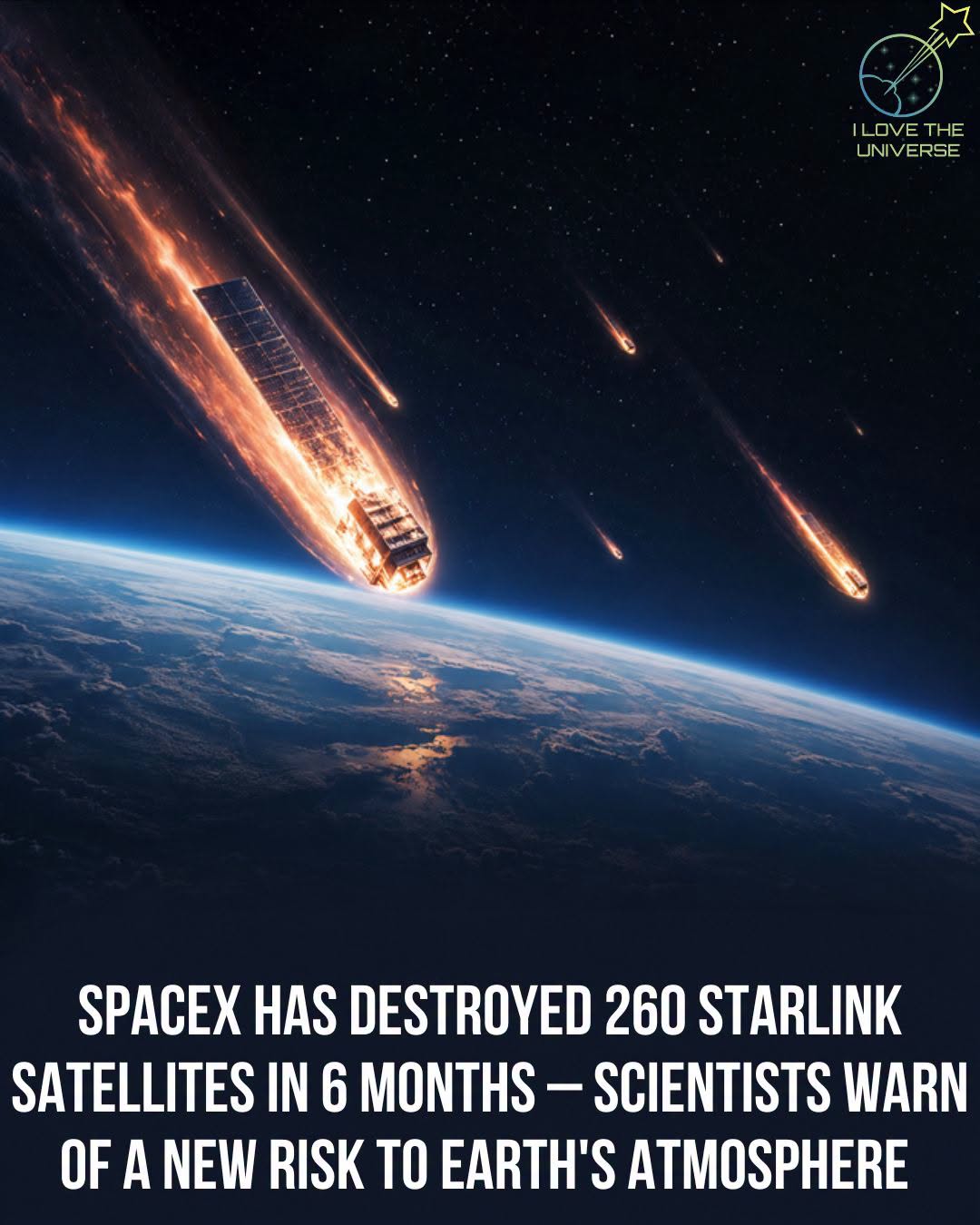
Every night, thousands of Starlink satellites silently cross the sky above us.
But there’s something most people never think about…

In just the last 6 months, SpaceX has deliberately deorbited 260 Starlink satellites, sending them back into Earth’s atmosphere where they completely burn up. Another 349 satellites are already waiting to follow the same fate.
At first glance, this sounds like good news. Controlled re-entry is far safer than leaving dead satellites in orbit, where they could create dangerous space debris and increase the risk of collisions.

However, scientists are now asking a new question:
What happens when thousands—or eventually tens of thousands—of satellites burn up in our atmosphere every year?
Today, Starlink operates more than 10,000 active satellites, and SpaceX has long-term plans for a constellation of up to 42,000. Since each satellite lasts only about five years, future generations could see several satellites burning up every single day.
Researchers are becoming increasingly concerned about what all that vaporized aluminum and other materials might do to the upper atmosphere. Could it affect atmospheric chemistry? Ozone? Climate? The honest answer is… we don’t know yet.
That’s what makes this story so fascinating.
Humanity is building the largest technological network ever placed in orbit, but we’re entering territory where science is still trying to catch up. The benefits are undeniable—bringing internet access to some of the world’s most remote places—but understanding the environmental consequences is just as important.

Space exploration has always been about pushing boundaries. The next challenge may not be reaching farther into space… but learning how to do it responsibly. What do you think? Should companies be required to carry out environmental impact studies before deploying and retiring massive satellite constellations, or is this simply the price of technological progress?