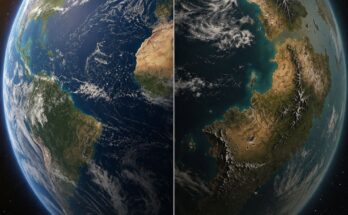
Now if Earth were the size of a nickel Neptune would be about as big as a baseball. That is impressive but it is nothing compared to the giant ninth planet that might be hiding out there. Now our planet nine discovery saga might have finally come to an end. Turns out the problem was not where we were looking but how. And researchers might have just made the biggest solar system discovery in decades.
You see the idea of finding a planet beyond Neptune has been around for years now. I know back in school you probably learned that the ninth planet was Pluto. But forget about Pluto. It has been demoted to a less fancy category since 2006. What I am talking about is the planet nine a hypothetical giant planet that could be our cosmic neighbor. We have never actually seen it but scientists are pretty sure it is out there somewhere hiding in the outer solar system.
To explain why they think that we need a sheet of paper. We place a coin on it and suddenly it starts to move. Unless we are talking about some kind of superpower there is no way this coin is moving on its own right. So you figure someone must be on the other side holding a magnet and moving it around. You cannot see the magnet but it explains why the coin is moving. That is kind of what is happening with planet nine. We cannot see it we cannot prove it yet but its existence could explain the strange movements we see out there in space.
For example the planets in our solar system orbit on a flat plane that is tilted about six degrees relative to the sun. But why six degrees. Well no one really knows for sure. Some scientists think those orbits might be slightly tilted because of the pull of a ninth planet. Its existence could also explain the unusual paths of smaller objects in the distant Kuiper Belt a region full of icy debris that stretches far beyond Neptunes orbit.
Back in 2016 researchers from Caltech published a study about Planet Nine. They suggested it could have a mass about ten times that of Earth and follow a highly elongated path. That is a scientific way of saying it takes forever to make one trip around the Sun. Because of that it would be located in the outer solar system. I mean far far away. It would orbit the Sun about twenty to thirty times farther out than our most distant planet Neptune. According to scientists Planet Nine would take up to twenty thousand Earth years to complete just one full orbit around the Sun. Since it is crazy far out there it is almost impossible to see it.

So as cool as this hypothesis sounds we have never found solid evidence that Planet Nine actually exists. But we might be pretty close.
In May 2025 a team at National Tsing Hua University might have made one of the most exciting solar system discoveries ever. There is a hypothesis that Planet Nine has not been discovered yet because we have not been using the right method. This new study raises an interesting question. What if Planet Nine actually looks brighter in infrared light than it does in visible light.
Scientists have been trying to spot Planet Nine by its reflected light. But here is the problem. To spot it in visible wavelengths sunlight would have to travel all the way out to Planet Nine bounce off its surface and then travel all the way back to Earth. If a Neptune sized planet were about ten times farther away than Neptune it would look about ten thousand times fainter. But a planets own thermal radiation I mean its heat only has to make a one way trip. So in infrared light Planet Nine would only be about one hundred times fainter. That is why it makes more sense to look for it using space based infrared telescopes. And that is the idea behind this new study.
The team started digging through archives searching for old infrared sky survey data and they pulled it from two main sources. First IRAS a satellite launched in the eighties that scanned the sky for almost a year. Then the Japanese satellite Akari another infrared observatory that operated between 2006 and 2011. So basically they compared objects that showed up in IRAS database and noticed which ones had moved by the time Akari took its observations. And by doing that the researchers found something incredible an object that might just be our long lost ninth planet.
Because if something moves it could be a planet orbiting the sun right. And yes they did find some celestial objects showing tiny movements. But before jumping to conclusions they had to rule out the parallax effect. And that is something really important when we are talking about solar system discoveries.
To explain it I need you to do something. Hold one finger in front of your face. Close one eye and now switch. Your finger seems to move a tiny bit right. That is because you are looking at it from a slightly different angle from one eyeball to the other. The same thing happens when we look out into space from Earth. Since our planet orbits the sun our view of very distant objects shifts just a little. That effect is called parallax.
My point is because of this effect Planet Nine would appear to move across the sky as Earth goes around the sun. On any given day it might seem to be in one spot but six months later when Earth is on the opposite side of the sun it would look like it shifted. Six months after that it would seem to move back again. Scientists had to account for parallax. Actually they had to remove its effects. So the team looked at images of the sky taken on the same date every year. Because on that same date Earth is always in the same spot in its orbit. That means if Planet Nine is real it would show up in the same place in those images every year. No fake wiggle from parallax just its real position.
This careful search led them to a single object a tiny dot in the infrared data. The strange little spot had moved slightly along its orbit around the Sun over the twenty three years between IRAS and Akari. Wait could that be it. Did astronomers just confirm a hidden planet. Well maybe but do not get too excited. The data we have on its motion over that time is not enough to figure out its full orbit. So for now we still cannot say for sure if this mysterious object is really Planet Nine. It is definitely a strong candidate though.
Based on how bright the object appears the team estimates it could be pretty massive and that came as a big surprise. You see previous NASA research ruled out any Jupiter sized or Saturn sized planets hiding out there but a smaller world would have gone undetected. So the scientists were looking for something just a bit bigger than Earth. But it turns out this mysterious planet might be more massive than Neptune.
Now that they discovered Planet Nine supposedly at least the plan is to keep tracking it and collecting new data. But do not think the road ahead will be easy. Because since the Akari satellite spotted it for the first time that object did not just sit still. It has been moving slowly through space ever since. So now scientists need to use regular telescopes on Earth to look for it again. And here is the tricky part. They are not exactly sure where it moved to. So they have to search a pretty big patch of the sky. And so far no matching object has been found.
Whether this really turns out to be the Planet Nine discovery or not only time will tell. For now its existence is still up for debate. But with powerful new technology on the way like NASAs Nancy Grace Roman Space Telescope astronomers are more determined than ever to uncover the truth. And if Planet Nine really is out there hiding in the cold dark edges of our solar system it is running out of places to hide.

Look at this giant donut shaped region far away from Earth beyond the orbit of Neptune. We are talking about a distance of more than two point five billion miles. It is the Kuiper Belt and something eerie and bizarre is happening there. Dwarf planets and other small objects dwelling there refuse to cluster together. Instead they follow particular orbits which is weird. The reason might be a large mysterious planet hiding beyond Pluto. Its gravity might be messing up the orbits of those Kuiper space bodies.
Our solar system is made up of the sun and everything that goes around it because of the stars strong gravity. This includes the eight main planets Mercury Venus Earth Mars Jupiter Saturn Uranus and Neptune. There are also smaller things like moons asteroids and Pluto. For a long time people thought Pluto was the ninth planet. But when it was reclassified as a dwarf planet scientists started looking for a new Planet X.
Some really think there might be a big icy planet hiding far far away beyond Neptune. This mystery planet is often called Planet Nine. Now Planet Nine has not been seen yet but scientists think it might be out there because of some tiny faraway space rocks called ETNOs that move following bizarre confusing paths. These paths seem to be grouped together and tilted in a way that does not happen by chance. This could mean there is a hidden planet pulling them into place with its gravity.
If Planet Nine is real it might be five to ten times heavier than Earth. It would also be super far away hundreds of times farther from the Sun than Earth is. Over the years scientists have guessed different distances for its orbit. And the newest guess in 2025 says it could be about two hundred ninety times farther from the Sun than Earth.
There are some cool ideas about where Planet Nine came from. It might have started as a big planet that Jupiter once kicked out of the inner solar system or it might have come from another star or even wandered around space on its own before getting caught by the Suns gravity.
Even though scientists have looked really hard using powerful telescopes no one has actually seen Planet Nine yet. And so far its existence is still just a theory. But recently a group of researchers tried something clever. They used data from two special space surveys called IRAS and Akari. These two looked at the sky in invisible light far infrared about twenty three years apart. Which is helpful because Planet Nine is supposed to move very slowly.
The team focused on a special list from Akari which is better at finding faint moving things in space. They guessed how bright Planet Nine might be and how fast it might move based on how big faraway and cold it could be. Then they looked for matching blips in the sky that were seen by both IRAS and Akari but not in the exact same spot. That is because a real planet would have moved a little over twenty three years and they indeed found thirteen possible matches that could be Planet Nine.
Their estimations were based on how far away the object seemed to be five hundred to seven hundred times farther from the Sun than Earth and how heavy it might be which is seven to seventeen times Earths mass. After looking very carefully at all the images they narrowed it down to one really good candidate. The two detections were not in the same spot in both surveys and the way they appeared in the Akari map matched what you would expect from a slow moving object. It showed up on one date and was not there six months earlier but of course there was a catch. Apparently the old data is not good enough to figure out the exact path of the potential planet. So the team wants to do new follow up observations using a special camera called DECam which is really good at spotting faint moving objects. That way they can find out if this candidate is really Planet Nine.

Additionally it can help us learn more about how our solar system works and how it formed. If Planet Nine is ever discovered it would totally change the way we understand our solar system. It could explain why some far out space rocks in the Kuiper Belt tilt weirdly. The thing is most planets go around the Sun in a flat ish circle but those far away objects are tilted about twenty degrees. Planet Nine might be the reason why.
Next we would probably find out why those tilted objects seem to point the same way. Their orbits are grouped together in one direction. A big hidden planets gravity could be herding them like sheep. There are also some strange tilted objects super far away. They do not make sense unless something big like Planet Nine is tugging on them.
A few space rocks orbit the sun backward between the big planets which is kind of the wrong way. That is super weird unless something big is messing with them. Some far out Kuiper Belt objects keep crossing Neptunes path and have not been flung away. That is because Planet Nine might be helping keep their orbits stable over a long time.
Another cool thing is that if Planet Nine existed it would be a super Earth a kind of planet we see a lot around other stars but we do not have in our solar system yet. So finding one here would make our solar system more like the others out there.
Throughout history people have been wondering if there could be hidden planets far beyond Neptune even before Pluto was found. Back in 1880 a guy named George Forbes guessed there might be two unknown planets way out there. One about one hundred times farther from the sun than Earth and the other about three hundred times farther. He thought these mystery planets might be pulling on some comets and changing their orbits kind of like how Jupiter does with the comets near it.
In 2004 scientists found a weird little world called Sedna. It had a strange path around the sun that did not seem to be affected by any of the known planets. Its closest point to the sun called perihelion is way too far for Neptune to be the reason. This made some scientists wonder if Sedna got pushed into its path by a hidden planet maybe even something as big as Earth or bigger.
Then in 2014 another odd object was discovered. It had a very similar orbit to Sedna which made people even more suspicious that there could be something big out there messing with their paths. This kicked off a new round of the Planet X or Planet Nine hunt.
At a meeting in 2012 a scientist named Rodney Gomes said that maybe there was a big hidden planet around one thousand five hundred times farther from the Sun than Earth. He thought it could explain the orbits of other odd objects like some far out comets and centaurs small bodies that wander among the giant planets.
At that time those who supported the Planet Nine theory believed that if it existed it would move around the Sun in a huge stretched out circle called an elliptical orbit. It would be about four hundred to eight hundred times farther from the Sun than Earth is about thirteen to twenty six times farther than Neptune. If it really had that kind of orbit it would take around ten thousand to twenty thousand years to go around the Sun just once. Plus if it indeed orbited the Sun it would not follow the same flat path as the other planets. Its path would be tilted by about fifteen degrees to twenty five degrees.
As for the composition of Planet Nine it would probably be a lot like Uranus or Neptune. It would have a thick atmosphere made of hydrogen and helium and it would be super cold minus three hundred seventy five degrees Fahrenheit. Its core would be made of iron and its middle layer would be full of rock and water ice. At the same time if the planet was smaller and denser then it might be more like Earth with a rocky surface instead of a gassy one.
According to a scientist named Mike Brown if Planet Nine was real a space probe would reach it in about twenty years if we used a powerful slingshot path around the Sun.
The candidate sits in the infrared archives waiting. The gravity of the outer solar system still bends in ways that demand an explanation. One slow moving infrared source may finally be the missing world. Or it may vanish under closer scrutiny. Either way the search has never been closer. And the ninth planet if it exists is running out of darkness in which to hide.