
A surge of online speculation is once again surrounding ʻOumuamua, with viral posts claiming the object has “returned” and is now emitting non-random signals toward Earth. The narrative describes mysterious energy bursts and coded patterns, leading some to question whether the interstellar visitor was ever a natural object at all.

However, astronomers are clear: there is no evidence that ʻOumuamua has returned. After its discovery in 2017, the object passed through the inner Solar System and is now traveling away from the Sun at high speed, far beyond the reach of current observation. No telescope, including the James Webb Space Telescope or ground-based arrays, has detected any reappearance or renewed activity.
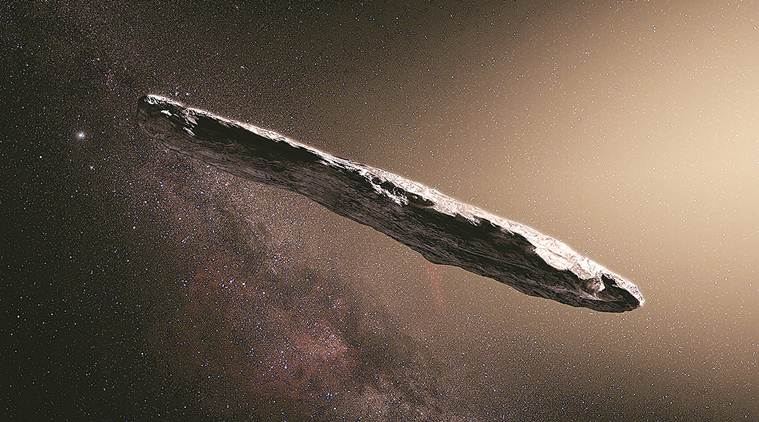
The claims of “signals” are also unverified. Scientists note that interstellar objects can exhibit unusual behavior—ʻOumuamua itself showed non-gravitational acceleration, likely caused by outgassing of hydrogen—but this does not imply artificial origin. Structured signals or energy bursts would require consistent, repeatable detection across multiple independent instruments, which has not occurred.
Researchers emphasize that while ʻOumuamua remains scientifically fascinating due to its origin outside our Solar System, current data supports natural explanations. Studies suggest it may have been a fragment of a larger icy body, shaped and altered by extreme cosmic conditions over millions of years.

The idea that it is transmitting messages or intentionally directing signals toward Earth belongs to speculation, not confirmed science. Still, the renewed attention highlights how little humanity has explored beyond its cosmic neighborhood—and how quickly mystery can evolve into myth when facts are incomplete.
For now, ʻOumuamua continues its silent journey through interstellar space, leaving behind questions—but no evidence of return, communication, or intent.