
For more than a century, King Tutankhamun’s tomb has been one of the most famous archaeological discoveries on Earth.
When Howard Carter entered the tomb in 1922, he found something extraordinary.
Gold.
Jewelry.
Chariots.
Weapons.
Statues.
Funerary objects.
And, at the center of it all, the remains of a teenage pharaoh whose short life had become one of ancient Egypt’s greatest mysteries.
But there was something strange about Tutankhamun’s tomb.
It was unusually small for a king.
And that simple observation eventually led archaeologists to ask a much bigger question.
What if Tut’s tomb was never originally intended for Tutankhamun?
What if the young pharaoh had been buried inside a tomb prepared for someone else?
And what if the missing royal figure was one of the most famous women in ancient history?
Queen Nefertiti.
That possibility transformed Tutankhamun’s tomb into something far more mysterious.
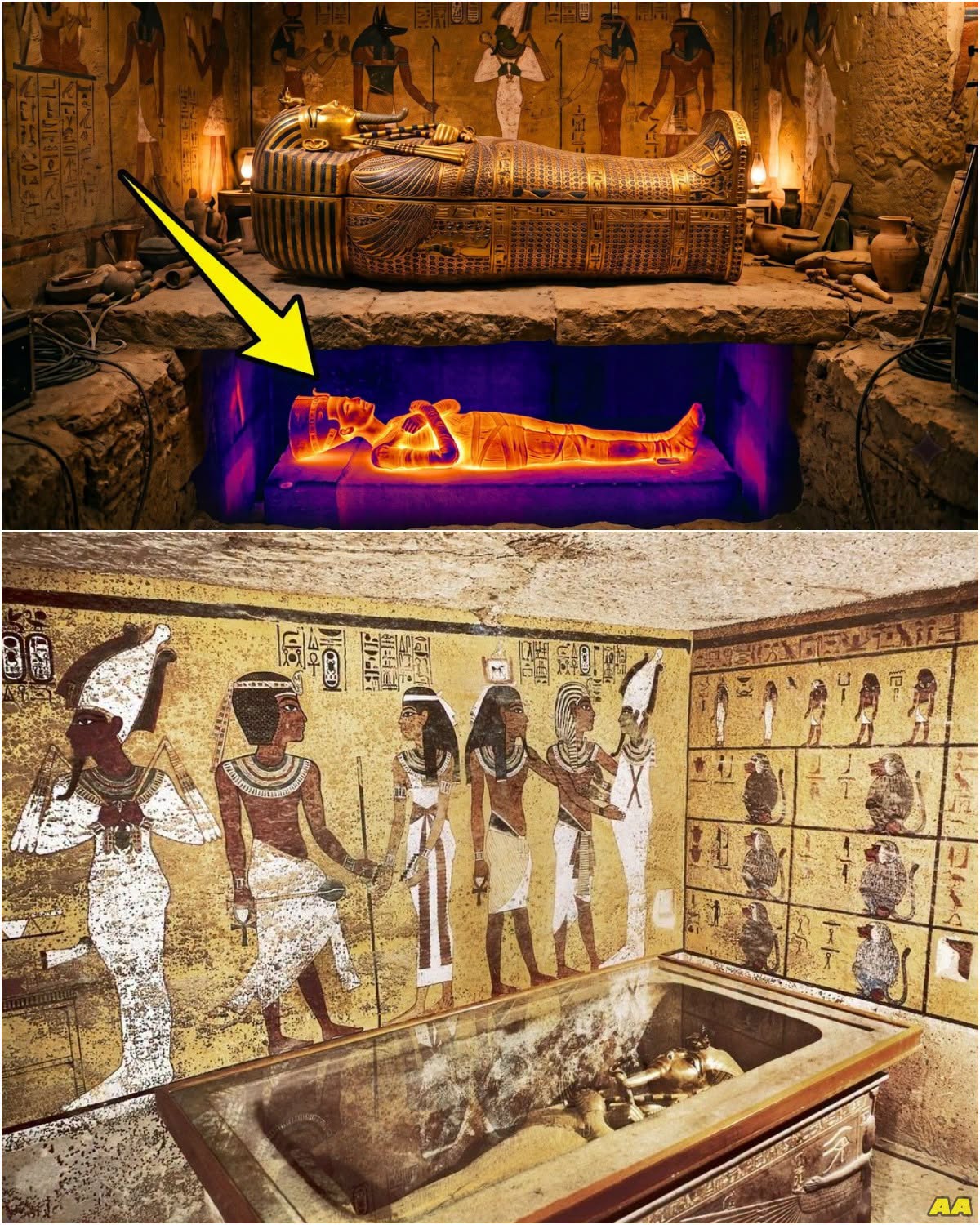
For years, archaeologists searched for evidence that another chamber might be hidden behind the beautifully painted walls of the young king’s burial chamber.
Then radar entered the story.
And suddenly, the walls appeared to be hiding something.
The first major theory came from Egyptologist Nicholas Reeves.
After studying extremely detailed scans of Tutankhamun’s tomb, Reeves argued that certain features on the walls might represent sealed doorways and corridors.
The idea was extraordinary.
Perhaps Tutankhamun’s burial chamber had been constructed inside a much larger tomb.
Perhaps the original tomb belonged to Nefertiti.
And perhaps her burial chamber remained hidden behind the walls.
The theory was controversial from the beginning.
But then technology seemed to offer a way to test it without destroying anything.
Ground-penetrating radar could send electromagnetic waves through the walls and potentially detect changes in the material beyond them.
If there were empty spaces, doorways or hidden chambers, the radar might reveal them.
In 2015, a Japanese radar specialist named Hirokatsu Watanabe conducted scans of the tomb.
The initial results were astonishing.
The scans appeared to indicate changes behind the walls.
Egypt’s antiquities minister at the time, Mamdouh Eldamaty, said he was highly confident that another chamber existed behind the north wall.
The possibility of finding another royal burial chamber captured global attention.
And the name Nefertiti immediately became part of the story.
Imagine the discovery.
A queen whose final resting place had remained unknown for more than 3,000 years.
A burial chamber potentially hidden directly beside the tomb of her stepson.
A royal mystery surviving beneath layers of plaster and paint.
It sounded almost too perfect.
But archaeology does not end when an exciting theory appears.
It begins there.
The next radar investigation produced a very different result.
A National Geographic team conducted another survey in 2016.
The researchers could not reproduce the same evidence for hidden rooms.
Outside experts examined the data.
The expected reflections from a large empty chamber were not there.
Suddenly, the Nefertiti theory was back in doubt.
One radar scan appeared to say yes.
Another appeared to say no.
The mystery had become a technological argument.
Scientists needed a more comprehensive test.
So in 2018, a third and much larger radar investigation was conducted.
This time, researchers from the Polytechnic University of Turin and associated institutions used multiple radar frequencies.
They scanned the tomb repeatedly.
They collected an enormous amount of data.
And they compared the results independently before reaching a conclusion.
The result was devastating for the hidden-chamber theory.
The researchers reported that the data did not support the existence of hidden chambers or passages immediately adjacent to Tutankhamun’s burial chamber.
They concluded with a very high level of confidence that the proposed hidden spaces were not supported by the GPR evidence.
So did scientists find Nefertiti?
No.
In fact, the most comprehensive radar investigation pointed in the opposite direction.
But that does not mean the mystery of Nefertiti disappeared.
It became even more complicated.
Because Nefertiti remains one of ancient Egypt’s most fascinating missing figures.
She lived during the turbulent Amarna period.
She was the great royal wife of Pharaoh Akhenaten.
She appears prominently in ancient Egyptian art.
Her famous painted and sculpted images have survived for thousands of years.
Yet the location of her final burial remains uncertain.
That contradiction is extraordinary.
We know what she looked like.
We know her name.
We know the identity of her husband.
We know she was enormously important.
And yet we still do not know where she was buried.
That missing tomb has generated theories for generations.
One possibility placed her somewhere in the Valley of the Kings.
Another connected her to the royal tomb at Amarna.
And Reeves’s controversial theory suggested that Tutankhamun’s tomb itself might conceal the answer.
But the 2018 radar results weakened that particular possibility.
The story is therefore not one of archaeologists discovering Nefertiti behind Tut’s walls.
It is a story about how modern technology challenged one of the most exciting archaeological theories ever proposed.
And that may actually be more fascinating.
Because archaeology is not about proving a spectacular theory at all costs.
It is about following the evidence wherever it leads.
The radar controversy demonstrated exactly why that matters.
The original scans appeared to reveal hidden spaces.
The follow-up scans did not.
The final investigation produced a much more comprehensive dataset.
And the researchers concluded that the supposed chambers were not supported by the evidence.
They even proposed an explanation for some of the earlier radar anomalies.
The painted plaster and geological characteristics of the tomb may have produced unusual radar reflections.
The researchers described them as possible “ghost signals.”
In other words, the equipment may have detected something real — but not a hidden room.
That distinction is critical.
Radar can detect changes in materials.
It cannot automatically tell an archaeologist:
“There is a queen buried here.”
It can indicate an anomaly.
Researchers then have to determine what caused it.
A void?
A wall?
Different rock?
Plaster?
A large stone object?
Or an artifact?
This is where the Nefertiti mystery became a lesson in scientific caution.
A strange signal can be exciting.
But excitement is not proof.
And in archaeology, one incorrect interpretation can send researchers searching in the wrong place for years.
Still, the original theory was not completely irrational.
There were genuine reasons to wonder about Tutankhamun’s tomb.
Its size is unusual.
Some of the objects found inside appear to have been made originally for other members of the royal family.
Certain artistic features have generated questions about whether parts of the burial equipment were repurposed.
And the political history surrounding Tutankhamun’s reign was extraordinarily complicated.
His father, Akhenaten, had radically transformed Egyptian religion.
He promoted the worship of the Aten.
Traditional religious institutions were disrupted.
After his death, Egypt eventually returned to older religious traditions.
Tutankhamun became the young ruler associated with that restoration.
The period was chaotic.
Royal succession was complicated.
And several important figures disappeared from the historical record.
Nefertiti was one of them.
That is why her missing tomb remains so compelling.
There is a gap in the story.
And archaeologists naturally want to fill it.
But the absence of evidence creates another possibility.
Perhaps her tomb was never built where researchers expect.
Perhaps it was destroyed.
Perhaps her remains were moved.
Perhaps she was buried somewhere that has not yet been identified.
Or perhaps the evidence is still sitting underground, waiting for a technology capable of detecting it.
That last possibility is what keeps the search alive.
Technology is changing archaeology rapidly.
Ground-penetrating radar.
Infrared imaging.
Laser scanning.
Digital reconstruction.
DNA analysis.
Satellite imagery.
These tools allow researchers to investigate ancient sites without immediately disturbing them.
That is especially important at Tutankhamun’s tomb.
The walls contain precious paintings.
The burial chamber is fragile.
Any invasive investigation could cause irreversible damage.
Non-invasive technology therefore offers an extraordinary advantage.
Researchers can search without immediately opening anything.
And that means the mystery can continue to be investigated while the tomb itself remains protected.
But there is another fascinating possibility.
What if Nefertiti’s tomb is not in Tutankhamun’s tomb at all?
What if the search has simply been looking in the wrong place?
Nefertiti’s final resting place has never been conclusively identified.
That means the archaeological hunt remains open.
The queen could still be waiting somewhere beneath the sands of Egypt.
And if her tomb is eventually found, the discovery could be one of the greatest archaeological events of the modern era.
Think about what might survive.
Funerary objects.
Inscriptions.
Royal names.
Images.
Perhaps evidence that could finally clarify the final years of her life.
Perhaps even information that could transform what historians believe about the succession following Akhenaten.
The discovery would not merely provide another tomb.
It could fill one of the biggest gaps in the history of ancient Egypt.
But until that happens, every claim must be treated carefully.
That is particularly important because Nefertiti’s name has become almost synonymous with mystery.
Every unusual wall.
Every radar anomaly.
Every forgotten passage.
Every unidentified mummy can suddenly become connected to her.
But archaeology demands more.
A hypothesis must survive testing.
A radar signal must be reproduced.
A supposed chamber must actually exist.
A burial must contain evidence connecting it to the person being sought.
And that is why the 2018 results matter so much.
They did not solve the Nefertiti mystery.
They eliminated one of its most exciting possibilities.
There is no confirmed evidence that Nefertiti was hidden behind Tutankhamun’s burial chamber.
The queen’s tomb remains missing.
Yet there is something almost poetic about that conclusion.
The technology designed to reveal the hidden chambers of Tutankhamun’s tomb ended up revealing something else.
It revealed the limits of what we think we know.
It showed that even modern instruments can produce confusing signals.
It demonstrated that ancient monuments can behave in unexpected ways.
And it reminded archaeologists that mystery is not the same thing as evidence.
Tutankhamun himself remains one of the best-known pharaohs in history.
His tomb transformed our understanding of ancient Egypt because so much of its contents survived.
But even after Carter’s extraordinary discovery, the tomb was not necessarily the end of the story.
It became the beginning of another mystery.
Why was the tomb so small?
Why were some objects apparently prepared for other royal figures?
Why did Nefertiti disappear from the historical record?
Where was she buried?
And what happened during the complicated succession between Akhenaten and Tutankhamun?
These questions remain.
Perhaps future technology will eventually answer them.
Perhaps another radar survey will reveal something genuinely unexpected somewhere else.
Perhaps satellite imaging will identify a structure hidden beneath the desert.
Perhaps DNA analysis will connect an unidentified mummy to a famous royal family.
Or perhaps Nefertiti’s tomb is already known to archaeologists but remains unidentified.
The possibilities are enormous.
And that is why the story refuses to disappear.
The phrase “they scanned King Tut’s tomb — then found Nefertiti” makes for an incredible headline.
But the real story is more nuanced.
They scanned Tutankhamun’s tomb.
They found anomalies.
One investigation suggested hidden chambers.
Another could not reproduce the result.
A comprehensive 2018 investigation ultimately found no radar evidence supporting chambers behind the burial chamber walls.
And Nefertiti?
She remains missing.
But perhaps that is exactly why the mystery is still alive.
For more than 3,000 years, the sands of Egypt have kept secrets from us.
Technology has allowed humanity to uncover astonishing amounts of information.
But every answer seems to create another question.
Tutankhamun’s tomb was supposed to be a final resting place.
Instead, it became a doorway into a much larger historical mystery.
And somewhere beneath Egypt, there may still be another doorway waiting.
A doorway that could finally reveal where Nefertiti went.
The question is not whether archaeologists will keep searching.
They will.
The real question is what happens when they finally find the place where the famous queen was laid to rest.
Because if Nefertiti’s tomb is ever discovered, the contents may tell us something far more valuable than where she was buried.
They may finally tell us who she really was.