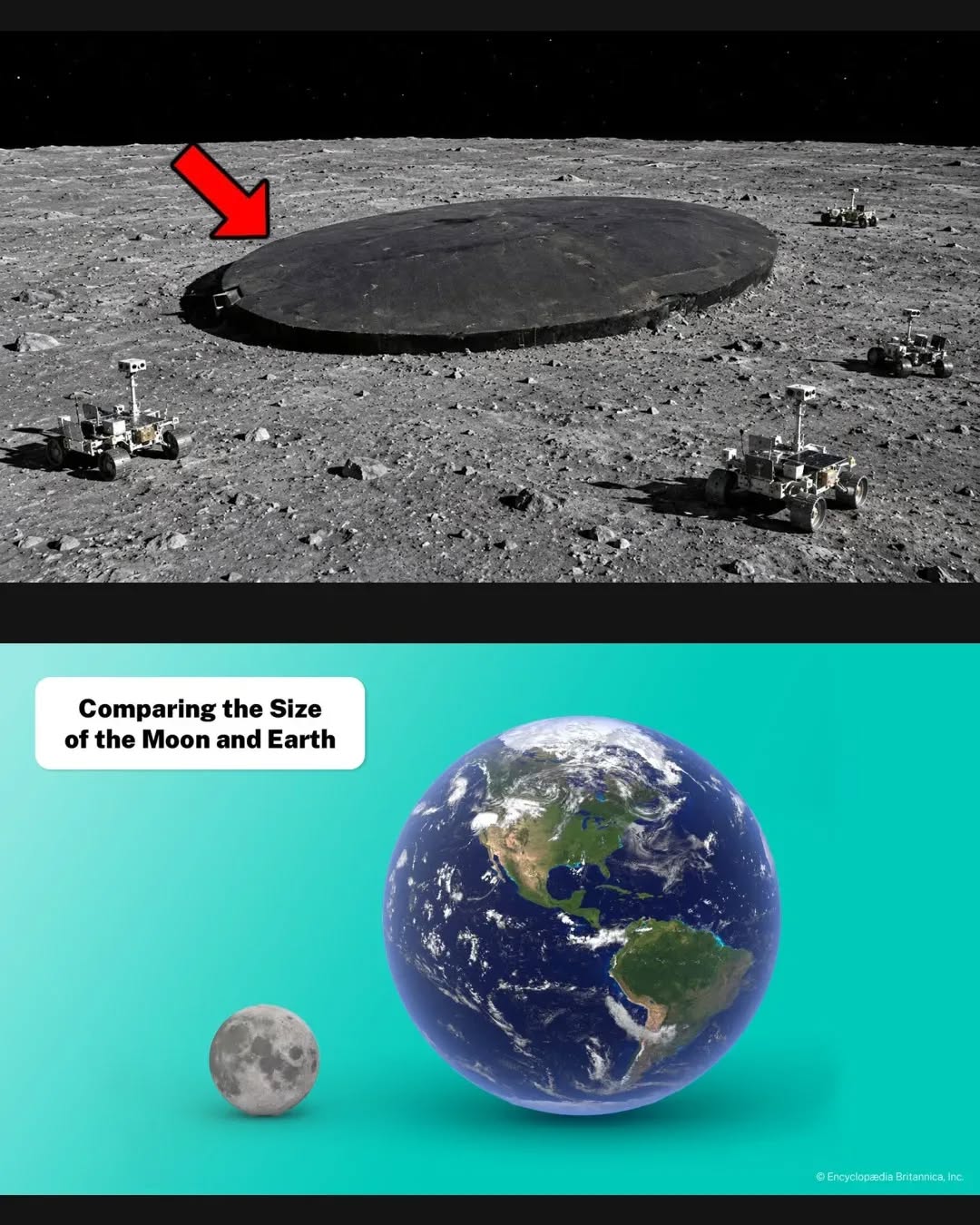


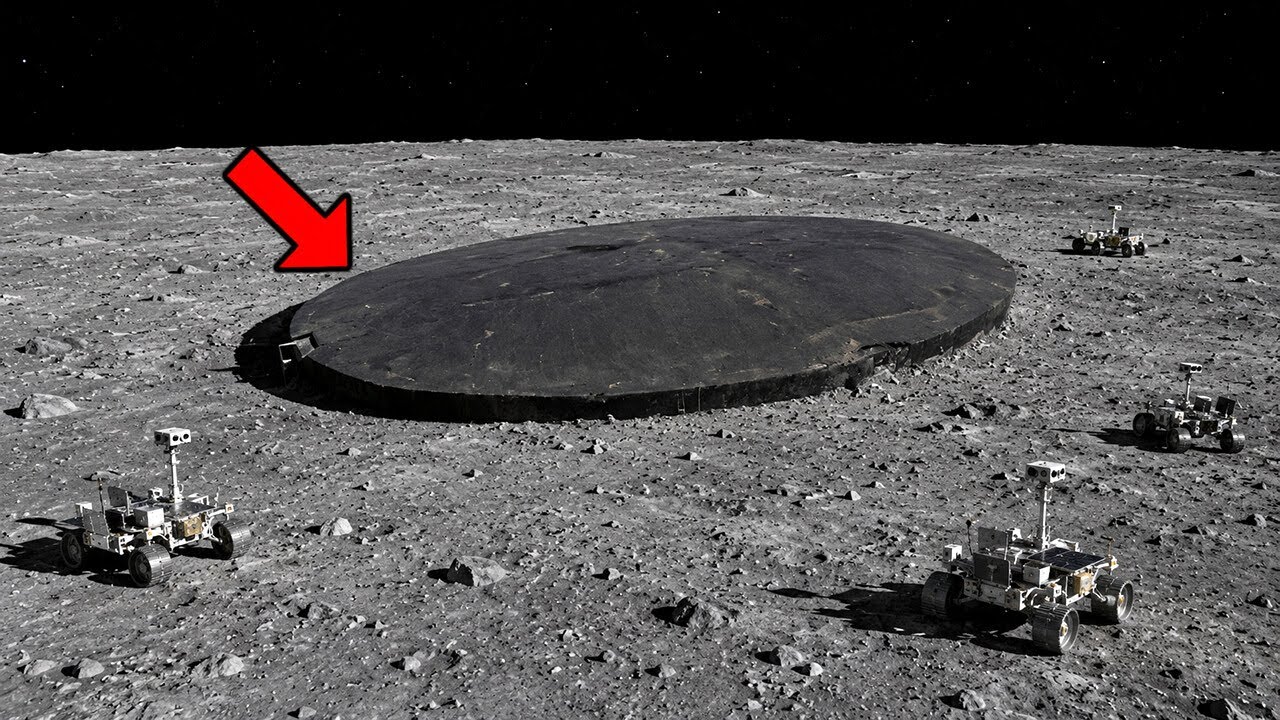
Something unusual has been spotted on the moon, and it’s getting attention for a reason. New high-resolution observations linked to NASA’s Artemis program revealed areas where the lunar surface appears to have shifted, cracked, or partially collapsed. In some images, it even looks like a section of the moon has broken away. At first glance, this sounds extreme. The moon is usually described as geologically inactive, a stable and unchanging world. But the data tells a different story.

Certain regions now show surface features that were not clearly visible in older imagery, suggesting relatively recent changes. The key to understanding this lies in how the moon actually evolves. Even without plate tectonics like Earth, the moon is still slowly changing. One of the main reasons is temperature. The lunar surface experiences extreme swings from about 120° C during the day to 130° C at night.
These rapid changes cause the surface material to expand and contract over and over again, gradually weakening rock structures. Over time, this leads to cracking. Another major factor is the moon’s internal cooling. As the moon slowly loses heat, its interior contracts. This process creates stress in the crust, forming features known as lobate scarps, which are essentially small cliffs or fault lines. Data from NASA’s Lunar Reconnaissance Orbiter has identified thousands of these structures, some stretching for several kilometers. What makes them important is their age. Many of these scarps appear relatively young, which suggests the The is still tectonically active on a small scale. There is also direct evidence of seismic activity. Instruments left on the surface during the Apollo missions recorded moonquakes with magnitudes up to about 5. 0. These are strong enough to shift surface material, especially in areas where the ground is already unstable.

Recent analysis shows that some of these lunar faults may have been active within the last 50 million years, which is extremely recent in geological terms. In some regions, boulders up to several meters in size have been observed at the base of cliffs, likely dislodged by seismic activity. Computer models suggest that even a moderate moonquake could trigger cascading rockfalls across unstable slopes, especially near the lunar poles where future missions are planned. This means that what looks like a small surface crack in satellite images could actually be part of a much larger and ongoing structural shift. In several locations, high-resolution images show slopes that appear to have partially collapsed. Loose material has moved downhill, leaving behind fresh-looking surfaces that stand out from older terrain. In some cases, this creates the visual impression that a chunk of the moon has broken off.

In reality, these are most likely landslides or regolith movements triggered by moonquakes, temperature stress, or both. Micrometeorites add another layer to the process. The moon has no atmosphere, so even tiny particles strike the surface at high speeds. Over time, these constant impacts disturb the upper layer of dust and rock, making it easier for material to shift when other forces act on it. All of these factors combined make the lunar surface more dynamic than it appears from Earth. For scientists, this is not just an interesting detail. It has practical implications. Missions like Artemis are focused on long-term exploration, including future landings and potential infrastructure on the moon. Understanding which areas are stable and which are prone to change is critical. Regions with active fault lines or loose surface material could present risks for landing spacecraft or building equipment.

That is why updated mapping and continuous observation are so important. At the same time, these changes provide valuable scientific insight. They show that the moon is not completely inactive. It is still evolving, slowly reshaping its surface through small but continuous processes. The idea that a massive piece of the moon suddenly broke off is not supported by current evidence. But smaller-scale changes are happening, and they are measurable. And in some cases, they can look dramatic enough to raise new questions. Because when they look at the moon with higher precision than ever before, we are starting to see something unexpected. A world that seemed frozen in time is still changing. Recently, Chinese scientists discovered something interesting on the moon, an unusual crystal. Moreover, they found out that this crystal contains an element that can literally replace nuclear fuel. Let’s find out more.
The composition of the moon has long remained a mystery to us. Half a century has already passed since the Apollo mission. Unfortunately, we haven’t traveled to the moon much since then. So, it’s not surprising that it’s not so easy for us to study it. But recently, we’ve made a breakthrough in this area. In December 2020, Chinese scientists sent the Chang’e 5 probe to the moon. The mission was named after the ancient Chinese deity of the moon, Chang’e. Quite poetic, isn’t it? Anyway, after the probe went to the nearest side of the moon, it spent several days digging through the surface and rocks, and then returned to Earth. In total, it collected about 4 lb of various lunar rocks, like basalt, solidified lava, and so on. And yeah, maybe it doesn’t sound too impressive, but it’s actually a mini breakthrough.
After all, we hadn’t received any lunar samples since 1976. And these samples are very important for learning the history of our world. We’ve been struggling for many years to find out, for example, how the moon was born at all. Yes, there were a lot of theories, but we still couldn’t find any proper evidence for any of them. But thanks to the latest missions and some computer simulations, scientists finally found out the truth. The moon was born when some random dwarf planet crashed into our Earth many millions of years ago. This dwarf planet was slightly smaller than Mars. The fragments of the Earth went into space, but some of them stayed in our orbit. Then they stuck together and formed the moon. It sounds horrifying, but in reality, the birth of the moon was the best thing to ever happen to our planet.
If it weren’t for this beautiful satellite, all our oceans would be small puddles. Life wouldn’t have appeared on Earth at all. So this is already an amazing discovery, but that’s still not all. Studying the collected rocks, scientists from the Beijing Research Institute discovered something unusual, a rare lunar crystal. Looks pretty boring, doesn’t it? Just some tiny transparent monocrystal about the thickness of a human hair. We’ve already found such things on the moon before. These crystals were formed as a result of volcanic activity, just like some garnets on the Earth. And yep, the place where they discovered these crystals also suffered from volcanoes 1. 2 billion years ago. That means that this tiny baby is over a billion years old. But that’s not the most important thing. It’s the fact that this crystal is made of a unique material, the one that we’ve never seen before.
Researchers from the International Mineralogical Association have confirmed that such a composition can’t be found anywhere on Earth. The crystal was named chang’e site, again after the same moon deity. And this is another achievement. This is the sixth previously unknown mineral that we found on the moon and the first one found by China. Now, it has become the third country in the world to make such a lunar discovery. However, this tiny crystal still wasn’t the only remarkable thing they found. After studying this gem and about 140,000 other lunar particles, scientists have discovered something else. They found helium-3. Why is it so important? Because this is one of the elements that feed the sun and other stars in our universe. We tend to say stuff like put out the sun, the sun is burning, and so on.
And this is one of the reasons why many people actually think that the sun is a huge fireball. But it’s not. It’s burning is actually a completely different process, which is called nuclear fusion. The process itself is quite simple. During this reaction, hydrogen in the star turns into helium. But this simple process is actually one of the most violent and and reactions in the universe. There’s a real boiling broth of particles inside the sun. The hydrogen nuclei that jump and rush there are constantly repelling each other since all of them are positively charged. And so they could continue to boil and chill around without bothering anyone if it weren’t for the stars. The stars turned out to be cheaters. They have such strong gravity that they basically grab billions of these little atoms and squeeze them together.
Combining with each other, these atoms create new heavy elements like the mentioned helium. And when this happens, they throw a lot of energy into space. And that’s how the sun burns. At the same time, it spreads so much energy that we can’t even imagine. Okay, so what is helium-3? Well, this is an element to which even the sun can say, “Whoa, dude, you should calm down. ” The fusion of helium-3 atoms releases even more energy than in typical nuclear fusion. And most importantly, it doesn’t pollute the atmosphere with harmful things like radiation. We have very, very little helium-3 on Earth. Its prevalence in our atmosphere is about one in a million. And besides, it’s constantly trying to escape from us back into space. Probably feels some bad vibes from us.
However, scientists have recently found out that there’s a place that contains a lot of this element. Yep, you guessed it. It’s the moon. We think that there’s more helium-3 on the moon than on Earth because of the solar winds. The sun has been hammering on the moon with its helium-3 for billions of years, so now it’s all over the place. It’s still not too much if you compare it, for example, with Jupiter or Saturn. But don’t forget how much energy it can release. For your information, with only 25 tons of helium 3, it’s possible to provide America with energy for an entire year. Now, there are 35,000 tons of it here on Earth, and more than a million tons on the moon. Only these sources could feed the entire US for thousands of years.
So basically, in the future, helium 3 may become a new source of fuel. And it’s better than nuclear fuel in basically everything. Helium 3 won’t leave any harmful waste and radiation. It’s more powerful and not that dangerous. In other words, this environmentally friendly and efficient energy could be a revolution for our planet. Sounds cool, huh? So, what are we waiting for? Grab the shovels, you might say. But there’s a little problem here. Unfortunately, we haven’t yet come up with anything as wildly strong and hot as the stars. To use helium 3, we need crazy temperatures and pressure. We need a thermonuclear reactor, and we have no idea how to build it yet. And even if we could heat it up to such temperatures and get the needed pressure, we still don’t really know how to handle helium 3 correctly.
Therefore, even if we have an infinite amount of helium 3, we still won’t be able to use it. But still, there’s a great power behind helium 3. So it’s not surprising that different countries have already started a race for nuclear resources. Now that Chang’e 5 has discovered a new helium 3 deposit on the nearest side of the moon, this race can become downright global. For example, China already plans a new lunar mission in 2024, Chang’e 6. During this mission, they want to collect the first samples from the far side of the moon. As you can see, finding this lunar crystal was very important for us. These crystals can help us find new ways to create helium-3. And if we manage to do that, humankind will enter a new era. But to do this, we still have to solve a number of problems.
How to deliver a bunch of these lunar crystals to Earth? How to make them produce energy? And so on. Let’s hope that in the future these issues will be resolved and we’ll find a way to produce clean, safe, unlimited energy. Sometimes, when you look at the moon, you see a face smiling down at you from the moon surface. Of course, this is an illusion, but many people see it, and that’s because its surface is shaped by some sort of lunar seas and highlands. From our point of view, we see these as light and dark patches. These seas are dark parts and large hardened lava plains formed because of volcanic eruptions that happened a long, long time ago. The light regions are actually the mountains and the highlands. And people all around the globe see these lunar patches as a smiling face or even some other shapes.
Our brain tends to play with things of this nature, and that’s a phenomenon called pareidolia. It’s when you see familiar faces and shapes even though they’re not actually there. Similar to how you can see a face in a slice of toast or shapes while watching the clouds. And in the northern hemisphere, people see a face in those different lunar seas. The eyes are the Sea of Serenity and Rain. The Sea of Clouds represents his mouth, while the Seas of Islands and Vapors form his nose. But that’s just one way to interpret this picture, and that mostly works in the northern hemisphere. If you live in the southern hemisphere, you see in the moon the other way up. When they look at the moon, some see a person that looks like they’re carrying a bundle of sticks. Or there’s the shape of a woman.
She wears her hair up and it has two jewels in it, and they see the left side of her face in profile. One of the craters is reminiscent of a shiny diamond, which it seems she’s wearing around her neck. In some places, people may see the shape of a rabbit, whereas people from the Pacific Northwest in America even have a story about the toad they see when looking at the moon. The story says there was a wolf that fell in love with a toad, and the toad didn’t quite trust the wolf since it wanted to escape and didn’t know where. It simply made one huge leap and landed on the moon. Now, do other planets have beautiful rainbows like we do? The ingredients for that are raindrops and sunlight.
At the moment, we don’t know of a planet with liquid water on its surface, and none have enough water in their atmosphere to make it rain. But, droplets of some other liquid could refract light coming from the sun and spread it out into various colors. Titan is one of Saturn’s moons, and the atmosphere there is rich in droplets of liquid methane, which probably form rain. The atmosphere on Titan is very hazy. That means that direct sunlight is not that common, but there’s still a slight chance we could catch methane rainbows someday. If they really exist, they’d be similar to rainbows on Earth, but they’d be a bit broader because methane refracts light differently than water. There’s a similar thing on Venus called glory. Scientists caught pictures of this optical phenomenon of sunlight falling on sulfuric acid droplets, similar to a rainbow.