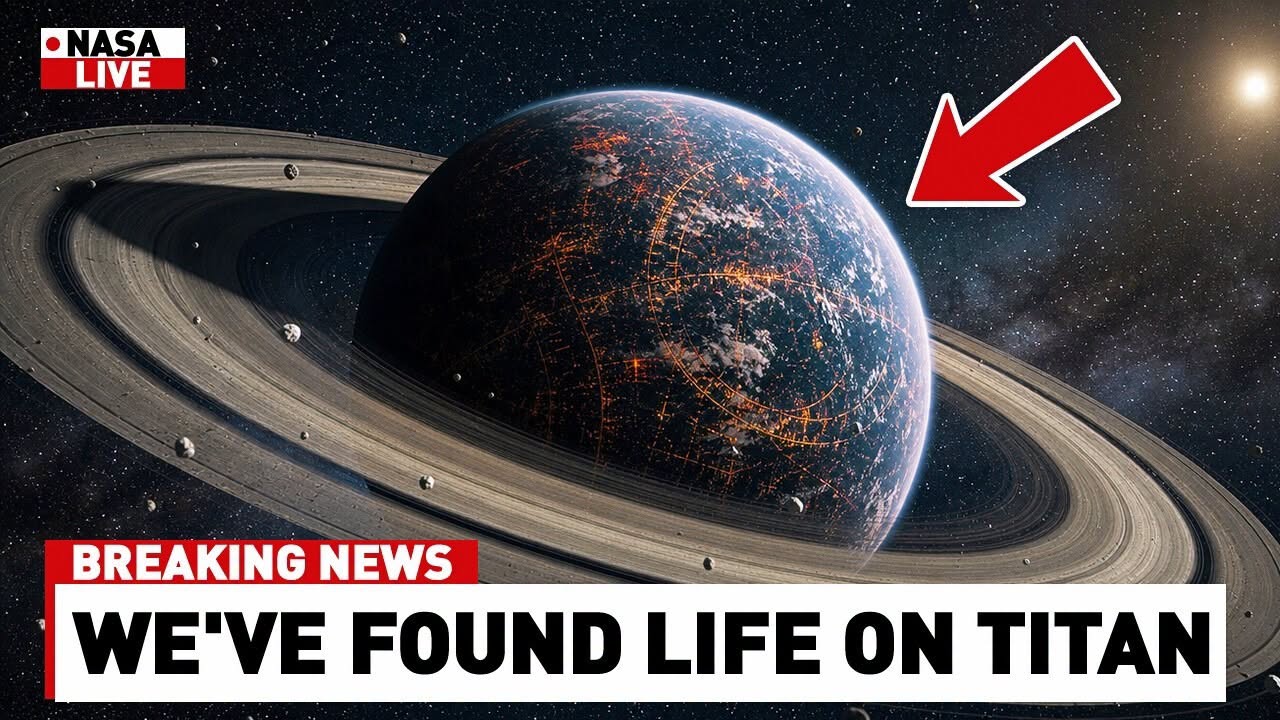
What if the most promising place to find alien life in our solar system isn’t Mars? What if it’s a frozen moon hidden nearly 1. 4 billion km from the sun? NASA scientists have been studying Saturn’s largest moon, Titan, for years. But recently, new research and data analyses have renewed interest in one shocking possibility. Titan may contain some of the key ingredients needed for life and in much larger quantities than scientists once thought. And the deeper researchers investigate this strange world, the stranger it becomes. At first glance, Titan doesn’t look like a place where life should exist. Surface temperatures average around 1709°, making it colder than almost anywhere on Earth. Water ice on Titan is so frozen that it behaves almost like rock. Yet, Titan is unique in the entire solar system.
It is the only moon known to have a thick atmosphere and the only world besides Earth with stable rivers, lakes, seas, rain, and weather systems on its surface. There is just one catch. Those rivers and seas are not made of water. They’re made of liquid methane and ethane. When NASA’s Cassini spacecraft arrived at Saturn in 2004, scientists expected Titan to be interesting. They did not expect to find entire coastlines, massive hydrocarbon seas, river channels stretching hundreds of kilome, and weather cycles that in some ways resemble Earth’s. Then things became even more surprising. Cassini’s instruments detected a rich mix of organic molecules in Titan’s atmosphere. These molecules are built from carbon, the same fundamental element used by all known life on Earth. Over time, sunlight and energetic particles from Saturn break apart atmospheric gases, triggering complex chemical reactions.

The result is a continuous production of organic compounds that slowly fall to the surface. In other words, Titan is running one of the largest organic chemistry experiments in the solar system. And scientists believe this chemistry may be far more complex than previously imagined. Recent studies suggest that beneath Titan’s frozen crust lies a gigantic underground ocean of liquid water. Some estimates indicate this ocean could contain more water than all of Earth’s oceans combined. That discovery immediately changed the conversation. Because wherever scientists find liquid water, they start asking the same question. Could life survive there? Researchers now believe Titan may contain three ingredients generally considered essential for life. Liquid water, organic molecules, and a source of chemical energy. That’s a combination very few places in the solar system can offer.
And recently, scientists identified evidence that complex organic compounds may be moving between Titan’s surface and its hidden subsurface ocean through cracks and geological processes. This is important because it potentially creates opportunities for chemistry that could become increasingly complex over time. Some researchers have even proposed that if life exists on Titan, it may look nothing like life on Earth. Instead of relying on liquid water at the surface, hypothetical organisms could potentially use liquid methane as part of an entirely different biological system. These ideas remain speculative, but Titan is one of the few places where scientists can seriously discuss them. Another reason researchers are excited is the sheer amount of organic material present. Some estimates suggest Titan’s atmosphere and surface contain hundreds of times more accessible organic compounds than existed on early Earth before life emerged.
That doesn’t prove life exists, but it means Titan possesses an enormous supply of the raw ingredients from which life could potentially develop. NASA is so interested in the moon that it is already preparing a mission called Dragonfly. Scheduled for launch later this decade, Dragonfly will send a nuclearpowered flying drone to Titan. Unlike traditional rovers, it will hop between locations across the moon’s surface, analyzing chemistry, searching for complex organic compounds, and investigating whether Titan’s environment could support biological processes. The mission is expected to travel tens of kilometers across the surface and study areas that may preserve clues about prebiotic chemistry. In other words, NASA is not just looking for water anymore. It is looking for signs that the chemistry of life may already be happening. Now, to be clear, scientists have not found aliens on Titan.
They have not discovered microbes, plants, animals, or direct evidence of living organisms. But they have found something that may be almost as important. A world where many of the building blocks of life appear to exist together in one place. And every new discovery seems to make Titan less like a frozen dead moon and more like a giant natural laboratory that has been running for billions of years. Which is why many astrobiologists now consider Titan one of the most promising locations in the solar system to search for life beyond Earth. Because if life can emerge in environments this strange, the universe may be filled with more living worlds than we ever imagined. The only life that we are certain about so far in the entire universe is on planet Earth. Whether that life is intelligent is, let’s say, arguable.
But anyway, it’s not surprising that we’re tirelessly searching for life on other planets. So far, they’ve discovered more than 4,000 of them. But what’s even cooler, NASA has compiled a new list of 24 planets that aren’t just Earthlike, they’re better. The conditions on them are so good that they’re more comfortable than on our planet. So, let’s examine some of them. Let’s be koi. K oi, shall we? This wonderful planet is in the constellation Signnos. And why is it so wonderful? Well, our sun is a yellow dwarf. And sorry, son. Even though you’re not bad at supporting life, there are some stars that can do it better. Nothing personal. The planet KOI5715. 01 orbits near an orange dwarf. Orange dwarfs are stars slightly smaller than our sun and have a little lower luminosity. Did you like the alliteration there? Anyway, don’t worry.
It doesn’t mean we’re going to live in complete darkness. In fact, if the planet is found closer to the sun and it has a thicker atmosphere, it may even be lighter and more colorful than on Earth. Our sun has a very short lifespan. Right now, it has 7 to 8 billion years left to live, a little longer than the Earth’s age. But orange dwarfs can live from 45 to 70 billion years. This is great, not only because we’ll be able to hang out on this planet longer, but also because the planets around these stars have more time to form life. Ideally, we need to find a planet next to an orange dwarf that is about 7 billion years old. It’s very likely that there will be at least some organisms there. KOI 57115. 01 is about 5. 5 billion years old.
Yeah, it may not seem mature enough, but that’s okay. Neither do I. Our Earth is a billion years younger, and that didn’t stop us. The planet is quite close to its star and is in a habitable zone. One year there lasts 190 days. Imagine going to elementary school and already getting a driver’s license. It’s almost two times larger than the Earth. The average temperature there is 52 degrees quas, which is slightly less than ours, 57° quas. But it most likely feels warmer there because strong gravity helps it hold on to heat in the atmosphere longer. It’s a little too far away, though, like 3,000 lighty years from Earth, which is about 18 quadrillion miles. Yep. Better bring a really big lunch with you. KOI 310. 01. This planet is found next to the star KOI2010. This planet sounds like a very pleasant world.
The average temperature on this planet is 67°. So, a little warmer than ours, but that’s a good thing. Scientists believe that on a perfect planet, the temperature should be just about 10° hotter than on the Earth. The more heat there is on the planet, the more comfortable it’s to live there. Also, the higher chances of developing life. The radius of this planet is nearly 1 in12 times larger than Earth. There’s some atmosphere, although we’re not yet sure about its composition, but it’s probably like the Earth’s. Scientists think that we’ll find an ocean there, and it can cover up to 60% of the surface, which is also cool. In a perfect world, water and land should be distributed more evenly than on our planet. A little more land means a little more territory and resources, right? But listen, this planet is actually very similar to the Earth.
The resemblance is so striking that scientists believe that we have an 84% chance to find life there. Of course, not necessarily an intelligent life, but at least some animals. Wouldn’t that be cool? What do you think they could look like? Hm. Very Earthlike planet, but with stronger gravity. If someone lives there, they’re probably big, but have a small height and strong little legs. Sounds adorable and scary. But we won’t be able to find out the truth anytime soon. So far for us, these planets are microscopic dots in space. We only have some dry, boring data about them and don’t even know what they look like. We’ll have to wait until we can find a way to get closer to these planets. Kepler 186f. This is also one of the best candidates for having life.
This rather cute planet was nicknamed the Earth’s cousin because it does have a strong resemblance. Anyway, these two planets are like sisters, not twins. Kepler 186f rotates near the red dwarf. Red dwarfs are stars even dimmer and smaller than orange dwarfs. Yeah, they’ll also live for a very, very long time, but their luminosity is also quite low. However, Kepler 186F is closer to its star than we’re to our sun, so it shouldn’t be too dark there. Well, at least not nightlike dark. The sky on this planet is sure to be an unusual shade of red, like sunsets on Earth. What do you think? Would you like to live on a planet with an eternal sunset? The size of this planet is about the same as Earth. Not bad, not perfect. Why so?
Because the coolest planets are those that are bigger than Earth and have stronger gravity. You’ll probably say, “But won’t it be harder to walk there and even harder to get out of bed on Monday? ” Of course. But on the other hand, this planet will pull the atmosphere better. The atmosphere will be thicker and denser. This means more protection from the scary space stuff, more oxygen, and more heat. Not to mention the fact that the bigger planets have more space to settle. Awesome, right? But of course, the Earth’s size is also an excellent choice. Another cool fact is that the tilt of Kepler 186F is about the same as ours. It means that there should be stable seasons and a normal dayight cycle. Do you know how important the tilt of the planet is? Let’s look at Mars.
Mars is also in fact found in the habitable zone of our sun. But its tilt is very unstable and as a result the entire ocean that could have been on it once now completely dried up. Today it’s just a red desert and there is no life there. At least not as far as we know. But you see how important these tiny details are. This planet is also quite far away from us. 490 lightyear. It’s about 3 quadrillion miles. So yeah, we’re just going to keep waiting for intergalactic travel. Kepler 62 Zens and Kepler 62F. These planets were called the most Earthlike before we discovered Kepler 186f. They’re very comparable to our home. Kepler 62M is about 1. 5 times larger than Earth. And Kepler 62F is just slightly smaller than that. They’re located in the constellation Lyra about 1,200 lighty years away from us.
They both also orbit a red dwarf. One year on Kepler 62E lasts about 122 days, even less than on that first planet we’ve talked about. Scientists believe that both 62E and 62F are sort of water worlds. Warm places mostly or even completely covered with water. If there is land there, it’s probably just some islands. A world consisting entirely of islands, a fantasy dream for some. Think Hawaii and a nightmare for others. Think Megaladon. But if you’re a fan of ancient marine animals, just imagine how gigantic they could be there. Still, there are many things we don’t know about this planet. Does it have a surface? What is its composition? Density. One day maybe we’ll be able to answer these questions. And so that’s it for the super Earths. Of course, the original list is much longer and you can go check it out on the internet.
The best thing about all this is that these are the planets that are better than the Earth. But we also know thousands of other exoplanets that are just close enough to ours. And the odds are a few of them have at least some form of life, but they’re very, very far away. So, we have no way to check it right now. Perhaps down the road, we’ll find some cool creatures on many of them. Perhaps we’ve all stopped to think at one point about what it would be like to live on another planet. I know I’ve had days like that. Got to get away. and maybe even interact with other types of creatures that already live somewhere else in space. These days, such ideas sound more like something from a science fiction book.
But in the future, permanently changing your address to another planet might turn out to be mandatory. Think of the stars in our solar system as a battery. Billions of years from now, its energy will be gone. Without its light and warmth, life on Earth can’t exist. When you think about it this way, we have to hope that future humans will have found some other place to live by then. Thankfully, there’s good news. Recently, scientists at NASA have announced that they have found a new planet that might be able to support life. They call it TOI700E. E is roughly the same size as Earth and it’s located in a region of space where scientists think water could exist in its liquid form which is crucial for the development of life. This planet is not the only one though.
Close to it there’s another promising planet which they call TOI 700D. But this one is further away from its star. Because of the distance from the main source of light, planet D lies in a special area called the conservative habitable zone. In simple terms, scientists aren’t sure whether life might exist on this one, but they don’t exclude such a possibility. Planet E is in the optimistic zone, which means that it’s possible that it has water and even an atmosphere. Hey, at least we have some options. The two planets are in the solar system that’s only 100 light years away from Earth, which is considered pretty close in space terms. NASA found these planets by watching the light from the star and measuring how it moves when a planet passes in front of the star.