On February 27th, something happened on a spacecraft 19 and a half billion kilometers from Earth that nobody was supposed to have to explain.
Mission engineers were running a routine roll maneuver, the kind Voyager 1 had performed a hundred times before to calibrate its magnetometer when the numbers on their screens did something they were not supposed to do.
During a scheduled roll maneuver on February 27th, the mission team noticed that Voyager 1’s power levels dropped unexpectedly.
Not gradually, not on schedule, unexpectedly.

And here is where you need to understand what that word actually means when you’re talking about a machine that left Earth in 1977 and has been alone in the dark for 49 years.
It means the people who know this spacecraft better than anyone alive were staring at a screen watching a decad’s old probe do something they had not planned for at a distance where a single command takes almost an entire day just to arrive.
Think about what that means.
If the power kept falling, there was no fixing it in real time.
There was no engineer who could climb into that spacecraft and tighten a wire.
There was only a countdown and a fault protection system built into Voyager’s ancient computer brain that would on its own without asking anyone start shutting things down to save itself.
If Voyager 1’s power levels dropped any lower, such a decrease would trigger an autonomous fail safe called the undervoltage fault protection system.
That system exists for one reason.
Because somewhere in Voyager’s design, engineers in the 1970s already understood that one day, decades after launch, their creation might have to save itself from itself with no one on Earth able to help in time.
And on February 27th, that theoretical scenario stopped being theoretical.
But here’s where it gets worse.
The undervoltage fault protection system is not a controlled shutdown.
It’s a blunt instrument.
If it triggers, it starts cutting components according to its own internal logic, not according to what scientists on Earth actually want to keep alive.
Once triggered, the sequence of automated shutdowns would require recovery by the flight team, a process mission engineers describe as lengthy and carrying its own risks.
In other words, if the fault protection system had taken over, Voyager 1’s own survival instinct might have crippled parts of the mission that 49 years of patients had kept alive.
So, the team at NASA’s Jet Propulsion Laboratory did something almost unthinkable.
They decided to make the sacrifice themselves before the machine could make it for them.
This is not chaos.
This is strategy.
On April 17th, engineers sent a command across 19 12 billion km of empty space.
A command that would take almost a full day just to arrive, instructing Voyager 1 to switch off one of its own senses forever.
Mission engineers at NASA’s Jet Propulsion Laboratory in Southern California turned off the low energy charged particles experiment aboard Voyager 1 on April 17th, 2026.
Read that again.
an instrument that had been running almost without a single interruption since Jimmy Carter was in the White House, since disco was still playing on the radio.
Since the idea of a smartphone would have sounded like science fiction, that instrument was deliberately silenced by choice to keep the rest of the spacecraft breathing.
What most people are not seeing is what that instrument actually did and why losing it matters more than a single dead sensor on an old machine.
The instrument measured low energy charged particles including ions, electrons, and cosmic rays originating from our solar system and galaxy and had provided critical data about the structure of the interstellar medium, detecting pressure fronts in regions of varying particle density in the space beyond our heliosphere.
This was not a redundant gadget.

This was one of the only working eyes humanity has ever had on the true edge of our solar neighborhood, the invisible battlefield, where the sun’s influence finally loses its grip on the galaxy.
The Twin Voyagers are the only spacecraft that are far enough from Earth to provide this information.
There is no backup probe.
There’s no second mission quietly waiting to take over.
When that instrument went dark, humanity lost, possibly forever, its clearest window into a region of space no other machine we have ever built has come close to reaching.
And this is where everything changes because the shutdown of that one instrument was never really about that one instrument.
It was a symptom of something much larger, something that has been unfolding in near silence for almost 30 years.
While the world was busy looking somewhere else, Voyager 1 is dying slowly, predictably by the laws of physics themselves, and there’s nothing anyone on Earth can do to stop it.
Both Voyager probes run on radioisotope thermmoelectric generators, devices that convert the heat provided by decaying plutonium into electricity.
And since the probes began flying nearly half a century ago, they have been losing an estimated 4 watts of power per year.
Four watts.
That number sounds small until you understand what it actually represents.
A slow motion countdown ticking silently across five decades with no way to refuel, no way to repair, no way to send a single technician into the void to patch what time itself is unraveling.
According to informed sources within the mission, the engineers who have quietly been managing this decline for years, the spacecraft’s power supply has fallen dramatically from where it started.
The power supply, three radioisotope thermmoelectric generators fueled by plutonium 238, produced approximately 470 watts at launch and now produces roughly 250 watts.
Almost half of Voyager 1’s original strength is simply gone, bled away year after year by an unstoppable nuclear decay curve that was set in motion the day the plutonium was manufactured, long before the spacecraft ever left the ground.
Every year that passes, the spacecraft gets weaker.
Every year, the choices facing the people who run this mission get harder.
And every year, the list of things Voyager 1 can still do gets shorter.
This is the part almost nobody talks about because it doesn’t fit into a headline.
The real story is not a single dramatic failure.
It’s death by a thousand quiet decisions made one at a time over decades by people who know that every single choice might be the one that finally ends the longest running space mission in human history.
Of the 10 identical sets of instruments that each spacecraft originally carried, seven have already been shut off.
Seven out of 10.
Think about that number sitting there in the dark of interstellar space.
A spacecraft that once carried a full suite of scientific instruments methodically stripped down piece by piece.
Not by damage, not by accident, but by the calculated hand of engineers trying to buy just a little more time before the inevitable silence.
But here’s where the tension sharpens even further.
Because the choices are not just about which instrument dies next.
They are about temperature.
And in the region of space where Voyager 1 now travels, temperature is a silent executioner.
Turning off a heater saves power, but risks a critical component freezing in the roughly 270 degrowish ambient temperature of interstellar space.
270° below zero C.
A temperature so extreme it exists only a few degrees above the theoretical coldest possible point in the entire universe.
Every heater NASA turns off to save power is a bet.
A calculated risk that the machine underneath will survive being plunged into cold that would shatter almost anything built by human hands.
Cold that exists just outside the thin metal skin of a spacecraft designed in an era before the internet, before GPS, before the microprocessors in your phone even existed.
And yet, against every expectation, something remarkable happened.
Something that even the scientists who built these instruments did not think possible.
When engineers shut off the heater, protecting the very instrument they eventually had to sacrifice, the Sensor’s motor kept working even as its temperature plunged far below anything it was ever designed to endure.
The stepper motor had worked flawlessly for nearly 49 years and over 8.
5 million steps.
And it continued to step even after its supplemental heater was turned off to save power and its temperature dropped to -62° centigrade.
The principal investigator behind that instrument, watching data trickle back across 19 billion km of vacuum, could not hide his disbelief.
He called it the stuff that dreams are made of.
A machine engineered in an era of slide rules and punch cards operating in conditions its own creators assumed would kill it.
Simply refuse to stop.
Read that again and let it sink in.
Because this is not a metaphor.
This is a real documented almost unbelievable act of mechanical defiance happening right now.
49 years and 8 and a half million steps into a mission that was only ever supposed to last five.
But defiance has limits and the clock underneath all of this has never stopped running.
The engineers are not simply reacting anymore.
They are gambling on something they have nicknamed almost too casually for what it actually represents, the Big Bang.
Engineers are now working on a bold plan that could extend Voyager 1’s life and possibly revive the instrument later.
This is not a routine software patch.

This is a highstakes experimental procedure being tested on a machine that cannot be repaired if it fails, cannot be rebooted if it crashes, and cannot be replaced under any circumstances because there is no factory on Earth building a second Voyager.
There never will be.
And because the stakes are so absolute, the mission team is not even testing this fix on Voyager 1.
They are testing it quietly, cautiously on its twin.
The team will implement the fix on Voyager 2 first, which has a little more power to spare and is closer to Earth, making it the safer test subject with tests planned for May and June 2026.
Think about the psychology embedded in that decision.
Two spacecraft launched within weeks of each other in 1977 have spent nearly half a century flying in almost total isolation.
And now in 2026, their fates have become linked in an entirely new way.
one machine serving as the test subject so that its sibling farther out, weaker, more vulnerable, might survive whatever comes next.
If the tests go well, the team will attempt the same fix on Voyager 1 no sooner than July.
And if it works, if this improvised experimental gamble actually succeeds against every reasonable expectation, there is a chance, however small, that the instrument silenced in April could be switched back on.
There is even a chance that Voyager 1’s LECP could be switched back on if the fix works.
This is where you have to sit with the sheer improbability of what’s actually happening here.
A team of engineers on Earth, most of whom were not even born when Voyager 1 launched, are attempting to resurrect a piece of 49-year-old hardware, from a distance, where their commands take almost 24 hours just to arrive, using techniques that did not exist when the spacecraft was built on a machine that is currently sailing through conditions colder than anything found naturally anywhere near our planet.
If this were fiction, it would sound implausible.
It is not fiction.
It is happening right now in 2026 largely outside the awareness of most of the world.
And while all of this unfolds in the background, Voyager 1 is racing quite literally toward a milestone that will redefine what distance even means for a human-made object.
NASA announced on June 17th, 2026 that Voyager 1 will reach one light day from Earth, the distance it takes light to travel in 24 hours at 12:167 a.
m.
Central time on November 18th, 2026.
stop and actually process that number.
Not one light hour, not 10 light hours, a full light day.
This historic milestone equals about 16.
1 billion miles or 25.
9 billion km or 173.
14 astronomical units.
To put that into human terms, if you could travel at the speed of light itself, the fastest anything in the universe is capable of moving, it would still take you a full 24 hours to catch up to where this 49-year-old spacecraft currently sits in the darkness.
And the consequences of that distance are not abstract.
They are operational, immediate, and almost impossible to fully comprehend.
The Voyager project manager at JPL described it in terms that strip away all the scientific jargon and leave only the raw strange truth.
Susie dod explained that if she sends a command and says, “Good morning, Voyager 1,” at 8:00 a.
m.
on a Monday morning, she will get Voyager 1’s response back at approximately 8:00 a.
m.
on Wednesday morning.
A two-day round trip for a single sentence.
Every single interaction between Earth and this spacecraft now unfolds at a pace that makes even the slowest human bureaucracy look instantaneous by comparison.
There is no real-time control here.
There’s no margin for a quick correction if something goes wrong mid-command.
Every decision made about Voyager 1 has to be made in advance, blind, trusting that the spacecraft will still be functioning, still be cold but alive, still be listening a full day after the command was sent.
This is where the story stops being about a single machine and starts becoming something closer to a meditation on the limits of human reach.
Voyager 1’s three computers have just 68 kilobytes of memory between them and their processors run at only 250 kHz.
Commands sent to the probe are transmitted at a mere 16 bits per second, while the scientific data it sends back to Earth typically arrives at only 160 bits per second, roughly half a million times slower than an ordinary home internet connection.
A spacecraft with less onboard computing power than a modern calculator is right now transmitting humanity’s only real-time data from beyond the edge of the solar system across a communication link so thin it would have felt primitive even in the earliest days of dialup internet.
And it is still working, still listening, still speaking back one impossibly slow signal at a time.
But even this triumph carries an expiration date and everyone involved in the mission knows it.
NASA engineers project that the spacecraft will lose the power required to operate its final remaining instruments sometime in the 2030s.
And once the power falls below that critical threshold, the probe will go permanently silent, continuing its journey through the cosmic dark without transmitting a signal back to Earth ever again.
Somewhere in the next decade without warning, without a dramatic final transmission, without any goodbye at all, Voyager 1 will simply stop talking.
The last watt of power will drain away.
The last heater will fail.
The last circuit will go cold and humanity’s longest conversation with the universe will end.
Not with an explosion, not with a crash, but with silence.
A silence that no one on Earth will even witness happening in real time.
Because by the time we realize the signal has stopped, the spacecraft will already have been quiet for almost a full day.
And here is the part that should genuinely unsettle you.
Silence does not mean the story ends.
The prob’s mechanical journey will continue to span geological time scales even after it goes dark.
In roughly 300 years, Voyager 1 will arrive at the inner boundary of the Orort cloud, the colossal spherical shell of frozen cometary bodies that encapsulates our solar system.
And in roughly 30,000 years, it will finally clear the outer edge of that cloud, escaping the sun’s gravitational domain entirely.
Let that timeline settle in your mind.
Every person alive today, every civilization currently existing on this planet, every language spoken right now will very likely be gone, forgotten or transformed beyond recognition, long before Voyager 1 even finishes leaving our solar system.
The spacecraft’s silence in the 2030s will only be the beginning of a journey that stretches so far into the future, it becomes almost meaningless to measure in human years at all.
And bolted to the side of this dying, drifting machine is something that makes the entire story even stranger.
a deliberate message to whatever or whoever might one day find it.
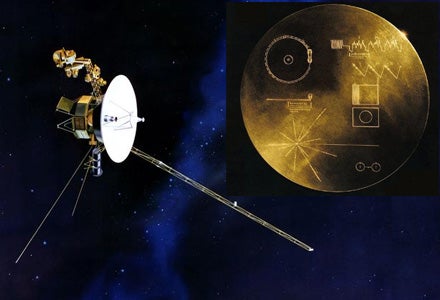
Voyager 1 carries a 12-in goldplated copper photograph record curated by a committee chaired by astronomer Carl Sean containing 115 analog images, spoken greetings in 55 languages, and 90 minutes of diverse global music designed to introduce Earth to any extraterrestrial civilization that might intercept the craft in the distant future, along with etched diagrammatic instructions explaining how to construct a playback device.
Think about what that actually means.
Sometime around 1977, a small group of scientists sat down and made a decision on behalf of the entire human species.
A decision that none of us alive today were consulted on and that none of our descendants will be able to revise.
They chose which sounds, which images, which fragments of human existence would represent all of humanity to the universe, sealed inside a golden disc, riding silently through the dark on a spacecraft that will very likely outlive every trace of civilization that built it.
What most people are not seeing is how close this entire mission has come to ending more than once and how quietly those near misses have been managed.
The power crisis in February was not a headline moment for most of the world.
The instrument shutdown in April barely registered outside of specialist science coverage.
And yet each of these events represented a genuine non-trivial possibility that the longest operating spacecraft in human history could have gone dark years or even decades ahead of schedule.
Every fix, every sacrifice, every calculated shutdown has been part of an ongoing, largely invisible campaign to squeeze a handful of extra years out of technology that was never designed to survive this long in the first place.
And this is where the deeper unease sets in because the fight to keep Voyager 1 alive is not really about one machine anymore.
It has become a race against the fundamental limits of physics itself.
plutonium decay that cannot be paused.
Temperatures that cannot be warmed without spending power that does not exist to spare and a distance so vast that even light itself needs a full day to make the trip.
Nothing NASA does can change any of those constraints.
All they can do is manage the decline with as much precision and ingenuity as possible, buying months, sometimes only weeks at a time against a countdown that started the moment this spacecraft first left the launch pad in 1977.
So, think about where that leaves us.
Right now, in the middle of 2026, a 49-year-old machine stripped down to a fraction of its original capability is racing toward a distance so extreme that a single hello and goodbye between it and Earth takes two full days to complete.
Engineers are testing an experimental high-risk revival procedure on its twin first because they cannot afford to fail on the one that matters most.
An instrument that watched the edge of our solar system for 49 years has already gone dark, possibly forever, possibly only temporarily, depending on whether an untested fix succeeds later this year.
And somewhere in the back of every engineer’s mind on this project, is the quiet, unspoken knowledge that any single command, any single maneuver, any single unexpected power fluctuation could be the one that finally ends it all.
Not in the 2030s as currently projected, but tomorrow without warning, a full day before anyone on Earth even realizes something went wrong.
What happens in the coming months will decide more than most people realize.
If the Big Bang fix succeeds on Voyager 2 this summer and then successfully carries over to Voyager 1 sometime after July, an instrument long thought permanently silenced could reopen its eyes on a region of space that no other human-made object has ever touched.
If it fails, that same instrument may remain dark for the rest of the mission’s life.
A small, quiet loss buried inside a much larger ongoing story of decline.
Either way, in November, Voyager 1 will cross a threshold no human creation has ever crossed before, becoming for the first time in history, genuinely, measurably, a full day away from everyone who has ever known it existed.
And somewhere out past the edge of everything familiar, drifting through cold that would kill almost anything else humans have ever built, an aging, half-blind, painfully slow, impossibly stubborn machine keeps sending its faint signal home.
For now, the real question nobody can answer yet is how many more of these quiet crises are still waiting out there in the dark? And whether the next one will end with another improbable fix, another act of mechanical defiance against all reasonable expectation, or whether it will end finally and permanently in silence.