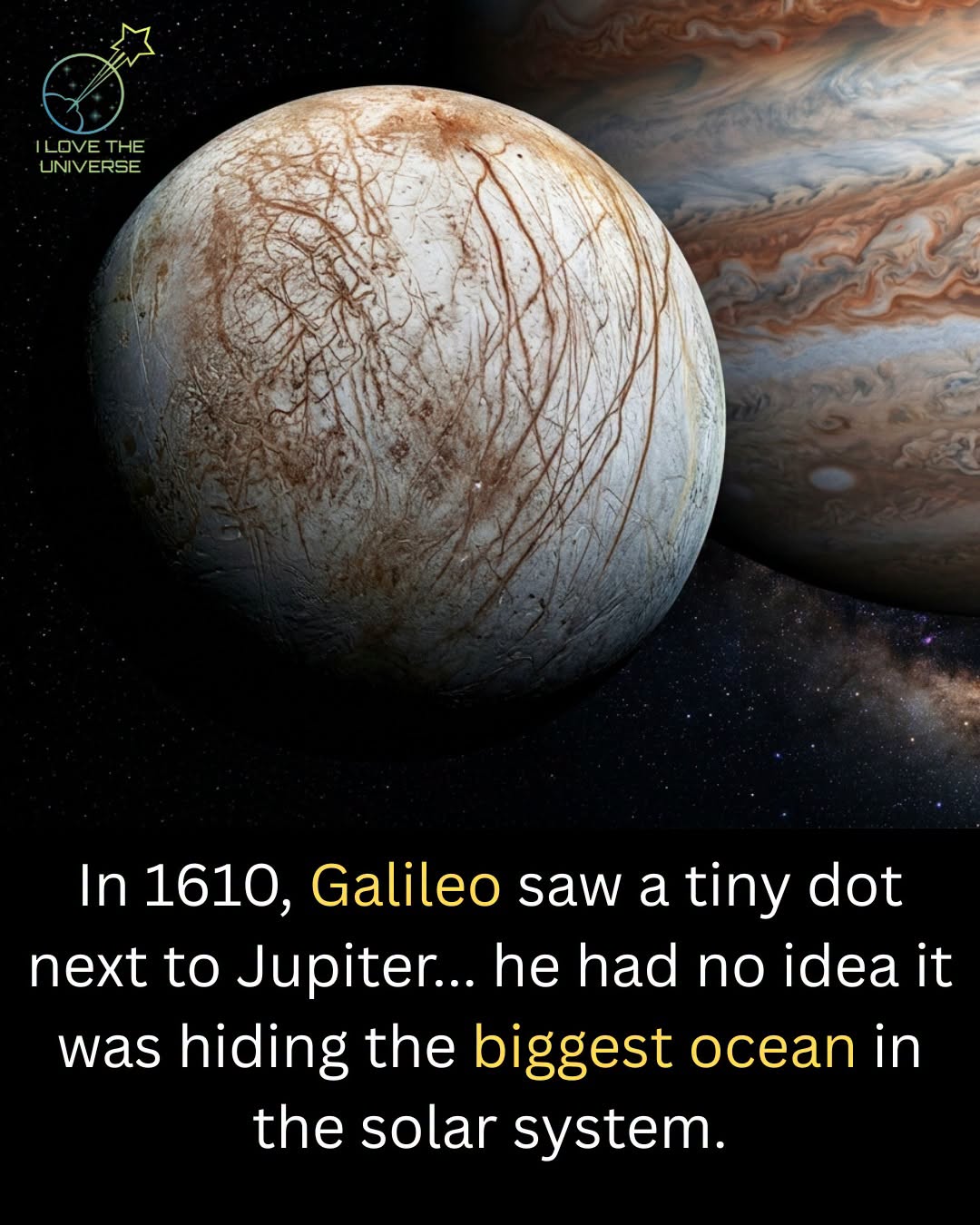
In January 1610, Galileo looked at Jupiter through a small telescope and saw something strange… a few tiny dots of light next to it, moving a little each night.

He had no idea what he had just found.
That tiny dot was Europa… one of Jupiter’s biggest moons.
Almost 400 years later… spacecraft flew past Europa and noticed something odd. Its surface wasn’t old and covered in craters like most moons. It looked smooth and young… like something underneath kept fixing it.

Then, in the 1990s, NASA’s Galileo spacecraft (yes, named after him) found a big clue. Jupiter’s magnetic field acted strangely near Europa. The reason? A giant layer of salty water is hiding under the ice.
This water isn’t warmed by the Sun… Europa is way too far away for that. Instead, Jupiter’s gravity keeps squeezing and stretching the moon, and that creates heat inside it.

The result? An icy shell on top, maybe 15-25 km thick… sitting above an ocean that could be 60-150 km deep. That’s possibly more water than every ocean on Earth combined.

No sunlight has ever reached that water. No spacecraft has ever touched it. NASA’s Europa Clipper mission is now on its way to study the ice and check if this hidden ocean could support life.
A tiny dot Galileo could barely see in 1610… might actually be one of the best places to find life beyond Earth.