A strange sight on Mars
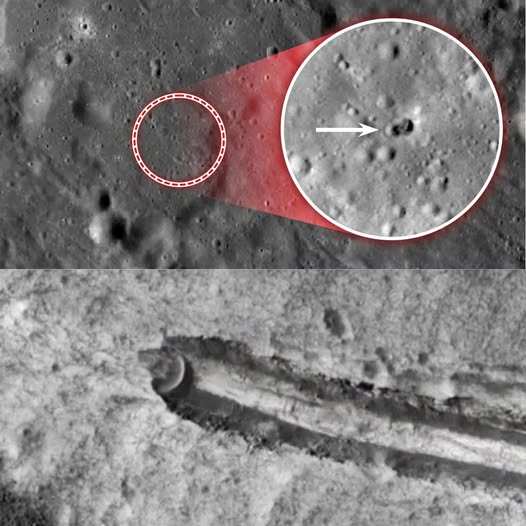
Imagine scrolling through nearly 7 million images of Mars taken by the Mars Reconnaissance Orbiter since 2006, only to stumble upon something utterly baffling in 2021. This was the reality for one keen-eyed observer who spotted a pair of long parallel lines leading to what looked like a partially buried disk with a distinct crescent edge on the Martian surface.
The buzz surrounding the discovery
George Haas, director of the Cydonia Institute, and a South African researcher have proposed a surprising hypothesis: the remains of a crashed UFO. Measuring between 12 and 15 meters in diameter, this object has sparked debate about its origins – was it Martian or did it come from another corner of the galaxy?
Evidence of Ancient Civilizations?
The Cydonians, an ancient civilization believed by some to have thrived on Mars, may offer some context. The planet’s surface is dotted with pyramid-like structures and mountain formations that defy natural explanations, including the famous “Paratopia parrot,” supporting theories of extraterrestrial activity.
Could it be a flying saucer?
The object’s perfectly shaped crescent rim suggests a man-made object rather than a natural formation. But if it’s not a natural geological feature, then what? Could this be evidence of the Grays, a species rumored to have visited Earth and possibly Mars for millennia?
Expert information
Astrophotographer Andrew McCarthy suggests a meteor impact could explain the formation, comparing it to similar craters on the Moon. However, the object’s intact state and smooth crescent shape raise questions about its origin, with some speculating it could be a probe’s heat shield.
NASA geologist Bob Anderson offers a more substantiated explanation. The formation, found in Candor Chasm near Valles Marineris, may be an ancient geological rift, with wind erosion carving its peculiar shape.
Unexplained phenomenon?
Despite the plausible geological explanations, the object’s peculiar characteristics – its symmetry and the way it fits into the landscape – leave room for speculation. For now, the discovery on Mars remains an unexplained phenomenon, keeping the door open to endless possibilities about our enigmatic neighbor.
Conclusion
The debate over the “UFO crash” on Mars underscores our endless fascination with the Red Planet and the universe beyond. While the truth behind this peculiar object remains a mystery, it fuels our imagination and drives our relentless quest for knowledge about the cosmos.
James Webb Telescope Detected Artificial City-Like Lights on Proxima B!..Full story in the comments

James Webb Telescope May Detect Artificial Lights On Proxima b