
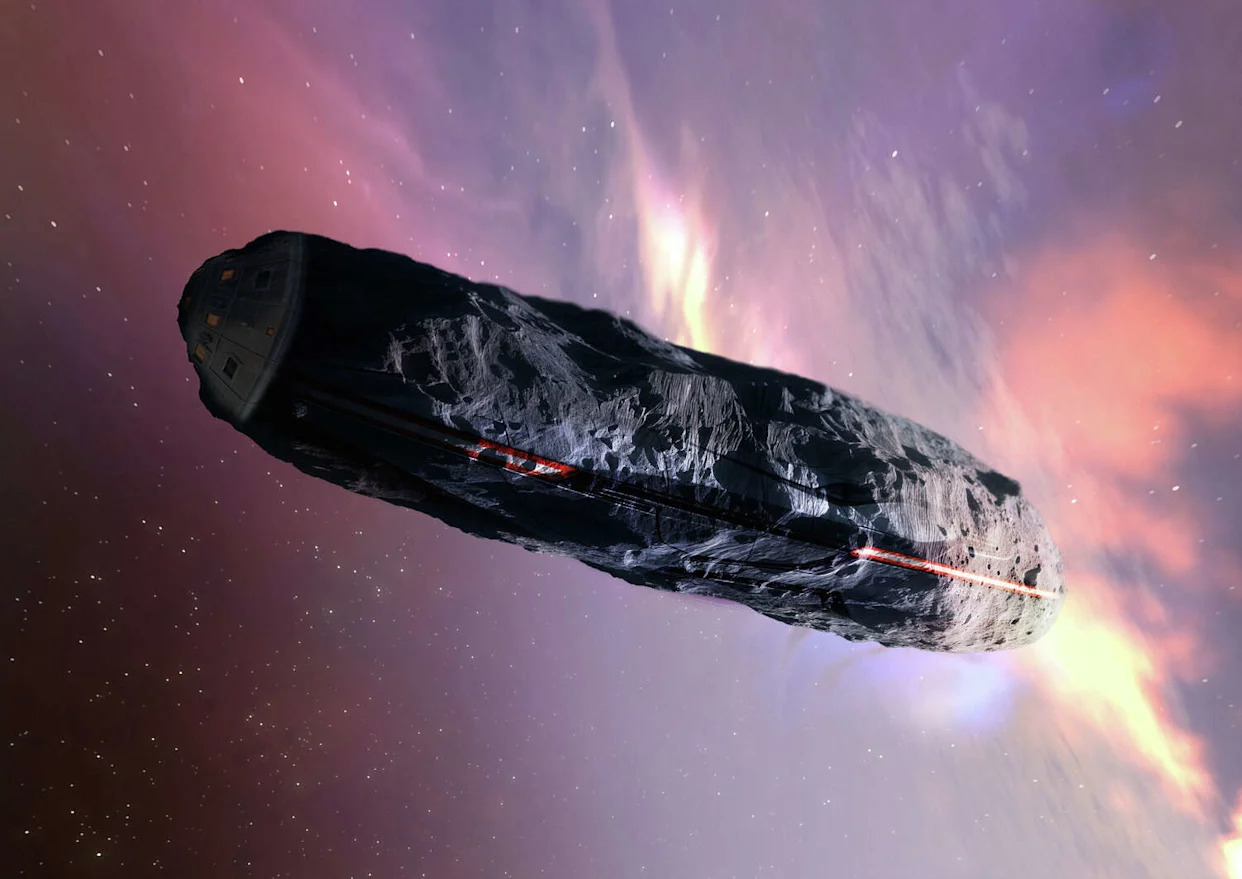
A surge of online speculation is once again surrounding ʻOumuamua, with viral posts claiming the object has “returned” and is now emitting non-random signals toward Earth. The narrative describes mysterious energy bursts and coded patterns, leading some to question whether the interstellar visitor was ever a natural object at all.
However, astronomers are clear: there is no evidence that ʻOumuamua has returned. After its discovery in 2017, the object passed through the inner Solar System and is now traveling away from the Sun at high speed, far beyond the reach of current observation. No telescope, including the James Webb Space Telescope or ground-based arrays, has detected any reappearance or renewed activity.
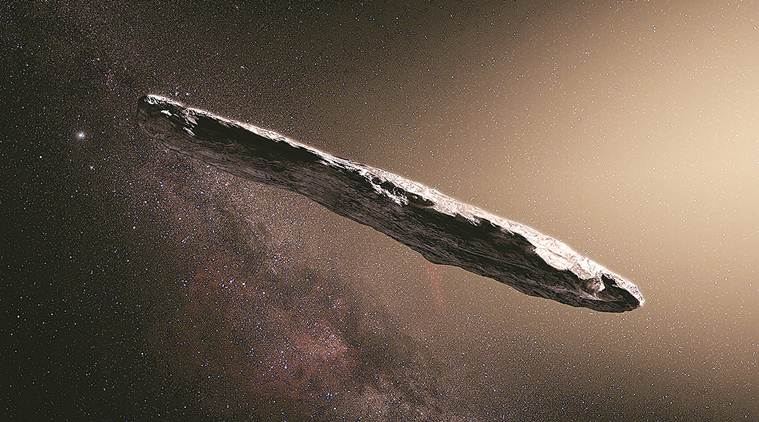
The claims of “signals” are also unverified. Scientists note that interstellar objects can exhibit unusual behavior—ʻOumuamua itself showed non-gravitational acceleration, likely caused by outgassing of hydrogen—but this does not imply artificial origin. Structured signals or energy bursts would require consistent, repeatable detection across multiple independent instruments, which has not occurred.
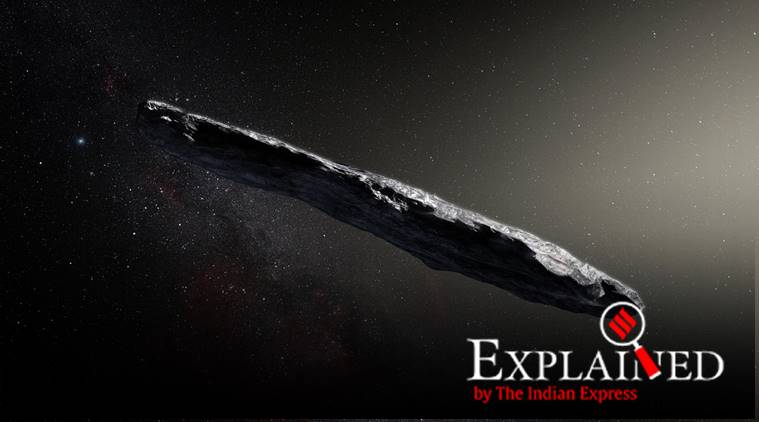
Researchers emphasize that while ʻOumuamua remains scientifically fascinating due to its origin outside our Solar System, current data supports natural explanations. Studies suggest it may have been a fragment of a larger icy body, shaped and altered by extreme cosmic conditions over millions of years.

The idea that it is transmitting messages or intentionally directing signals toward Earth belongs to speculation, not confirmed science. Still, the renewed attention highlights how little humanity has explored beyond its cosmic neighborhood—and how quickly mystery can evolve into myth when facts are incomplete.
For now, ʻOumuamua continues its silent journey through interstellar space, leaving behind questions—but no evidence of return, communication, or intent.
The James Webb Space has once again turned its gaze toward the mysterious interstellar visitor 3I/ATLAS — and what it captured this time has left NASA scientists both stunned and cautious. A newly leaked image, circulating within internal research channels, reportedly shows something that doesn’t match any known cometary behavior
A Sudden Shift in Appearance
For weeks, telescopes worldwide have been tracking 3I/ATLAS as it approached its next observational window. But when Webb captured its latest high-resolution image, researchers noticed something missing — the tail. Instead, a faint halo-like structure was observed, pulsing faintly against the cosmic background.

The lack of a tail on a sunward-moving comet defies all known models of sublimation and solar heating. Scientists are now wondering if the object’s surface chemistry has changed or if something entirely different is happening inside it
Adding to the confusion, Webb’s infrared sensors detected a dense signature of unknown compounds — material that shouldn’t exist under cometary conditions.
NASA’s Confidential Reaction
Multiple sources within NASA reportedly confirmed that the image was “flagged for internal review.” Though no official statement has been released, leaks from inside the Webb data team suggest that the object’s readings have been temporarily classified.
Researchers close to the mission claim the anomaly resembles a magnetic or gravitational distortion, not a tail composed of gas and dust. That possibility alone raises unsettling questions about what kind of object 3I/ATLAS truly is.
Whispers of “non-cometary structure” have surfaced in several private discussions, though officials remain silent for now.
The Halo Phenomenon
Unlike a traditional comet tail, the faint spherical glow surrounding 3I/ATLAS seems to react to solar activity in unpredictable ways. During one flare event, Webb recorded the glow flickering in intensity, almost as if responding to the burst.
This strange interaction could suggest ionized material behaving under an unknown magnetic mechanism — or perhaps a shell-like composition that reacts differently to radiation
Scientists are reluctant to jump to conclusions, but many agree this is something never before documented by any
Strange Readings From Webb’s Instruments
During data review, Webb’s NIRSpec and MIRI instruments captured an energy distribution pattern inconsistent with typical reflection or emission signatures. The readings displayed interference effects, possibly hinting at an organized structure.
While some dismissed it as a calibration glitch, others noted the same signal appeared in three separate observation windows, ruling out random noise
f confirmed, this could mean the comet’s outer layer is reflecting or refracting energy in a controlled pattern — a discovery that would rewrite much of current interstellar science
Following the leak, observatories in Chile, Hawaii, and Japan redirected instruments toward 3I/ATLAS. Preliminary ground-based reports confirm the absence of a conventional tail and the presence of an asymmetric glow pattern.
Independent analysts argue this behaviour might represent the disintegration of the comet’s outer crust, while others insist it could be an artificial-like structure holding shape under extreme conditions.
The debate has split the astronomical community in two — those calling for caution, and those believing humanity may be seeing evidence of something truly unique
Possible Natural Explanations
Some researchers are offering more conservative theories. They suggest the comet may have exhausted volatile materials, or that its tail could have been temporarily obscured by dust alignment or viewing angles.
Others point out that similar “tail-loss” events have been recorded in rare cases, though never with a halo emission of this intensity.
Still, the scale and stability of the anomaly make a simple explanation difficult to sustain.
Leaked Data and Speculation
An anonymous insider hinted that more images exist, but have not yet been cleared for public release. Reportedly, one sequence shows a dim object detaching briefly from 3I/ATLAS before fading from view.
That frame alone has fuelled online speculation about artificial origin theories. While NASA has not confirmed such data, silence from official channels only intensifies public curiosity
A mysterious object linked to 3I/ATLAS has reportedly reached Earth, igniting intense debate across military, and intelligence circles. Detected months ago as fragments detached and maneuverer through space, the event escalated when one object allegedly survived atmospheric entry and impacted the Pacific Ocean, raising urgent questions about whether this was a natural interstellar object
The Discovery of 3I/ATLAS
Astronomers first identified 3I/ATLAS as an interstellar object entering the solar system at extreme velocity. Unlike typical space debris, its trajectory and speed immediately set it apart from known asteroids or comets.

Early observations showed behaviour inconsistent with passive motion. Tracking data suggested adjustments that could not be fully explained by gravity alone, placing the 3I/ATLAS object into a new and controversial category of study
As awareness grew, the mysterious space object began appearing in defence and intelligence briefings, marking a rare overlap between astrophysics and national security analysis.
Fragment Detachment and Unusual Behaviour
Months before impact, sensors recorded an asteroid fragment earth event unlike any previously observed. Pieces separating from the main body did not scatter randomly but followed distinct and measurable paths.
Scientists initially proposed natural explanations such as outgassing or electromagnetic effects. However, these models failed to explain repeated acceleration changes detected across multiple fragments.

As one fragment aligned toward Earth, monitoring agencies elevated alert levels. The possibility of an interstellar object earth interaction moved from theoretical to immediate.
What intensified concern was coordination? Multiple fragments altered velocity within narrow timeframes, suggesting command-like behaviour. This pattern strongly challenged natural explanations and fuelled early alien probe theory discussions.
Pacific Ocean Impact Event
The situation escalated when a fragment reportedly entered Earth’s atmosphere without burning. Unlike conventional debris, it maintained integrity during descent, defying established ablation models.

Mid-entry trajectory changes indicated active control rather than atmospheric drift. Analysts quickly ruled out standard meteor behaviour.
The object ultimately impacted the Pacific Ocean, transforming the incident into a suspected UFO ocean landing and triggering global attention.
Pentagon Mobilizing Response
Within minutes of confirmation, a Pentagon mobilizing response was initiated. Naval and research vessels were redirected under classified protocols toward the impact zone
Defence analysts categorized the incident as an unknown object Pacific Ocean event with potential non-human origin. Information was restricted as cross-agency coordination intensified.
The speed and scale of mobilization suggested the object posed strategic implications beyond scientific curiosity

Underwater sensors detected signatures inconsistent with geological formations or known human technology. Analysts described the readings as structured rather than residual.
- Energy emissions detected at extreme depth
- Signal patterns inconsistent with seismic activity
- No match to known propulsion or reactor systems
- Intermittent activity rather than decay
These findings reinforced the classification of the object as a possible non terrestrial object rather than inert debris.
Scientific Debate and Alien Probe Theory
The scientific community remains divided. Some researchers argue the object represents an extreme but natural mysterious space object governed by unknown physics
Others contend the evidence aligns more closely with the alien probe theory. Survival through atmospheric entry, controlled descent, and subsurface energy output suggest engineered design.
Whether probe, sensor, or autonomous system, the 3I/ATLAS fragment landing in pacific ocean remains one of the most contested events in modern astronomy.
What Comes Next
Recovery efforts face unprecedented technical challenges due to depth and pressure. Specialized unmanned systems are being prepared for cautious investigation.
If retrieved, the object could redefine understanding of interstellar technology and confirm long-standing speculation about non terrestrial object encounters.
Until then, silence from official channels continues to amplify speculation worldwide.
Conclusion
The 3I/ATLAS incident stands at the intersection of security, and existential uncertainty. Whether advanced natural phenomenon or deliberate construct, its arrival forces humanity to confront the possibility that Earth.